
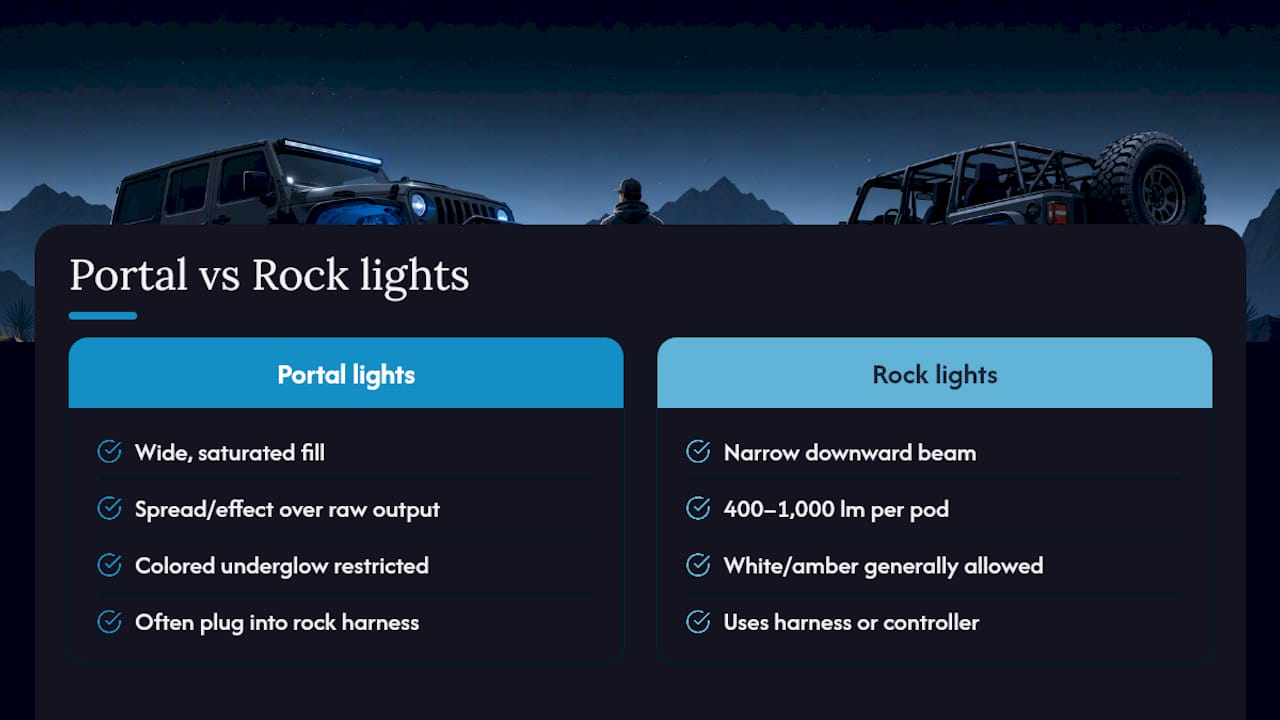
For trail visibility, rock lights win. For a bold underglow effect on a show build, portal-style RGBW kits take it. And if you want both, a combined system built on a shared harness gives you tire-edge lighting on the trail and color-changing impact in the parking lot.
Here’s the short version before we get into wiring, specs, and cost:
- Trail driving and rock crawling: Rock lights, typically rated IP68 and pushing 400 to 1,000 lumens per pod, are what actually help you see your line at night.
- Show trucks and underglow builds: Portal or RGBW portal-style kits deliver wider, saturated color that rock lights aren’t designed to produce.
- Everyday drivers who want both: A properly fused harness from a brand like Wheellightexpress lets you run rock lights now and add portal lighting later without rewiring the truck.
The rest of this guide breaks down the differences in brightness, wiring, durability, and cost, then walks through a buying checklist so you don’t overspend on features you won’t use.
Key Takeaways
Rock lights deliver functional trail visibility while portal-style RGBW kits deliver show-grade underglow, and a proper harness lets you run either or both without rewiring your truck.
| Point | Details |
|---|---|
| Choose by mission | Rock lights for trail visibility, portal-style RGBW kits for show and underglow effects. |
| Check IP rating first | IP68 is the recommended minimum for serious off-road exposure to water and mud. |
| Wiring is non-negotiable | Every kit needs a relay, a fused feed at the battery, and properly gauged wire. |
| Watch pod specs | Look for 400 to 1,000 lumens per pod and die-cast aluminum housing with potted electronics. |
| Stage your build | Wheellightexpress harnesses let you start with rock lights and add portal lighting later without rewiring. |
Table of Contents
- Portal Lights vs. Rock Lights: The Core Differences
- What Are Rock Lights and When Do You Need Them?
- What Are Portal Lights and How Do They Compare?
- How Do You Wire Rock Lights and Portal Lights Safely?
- Which Lights Should You Choose for Your Build?
- What Should You Check for Durability Before Buying?
- What Does a Rock Light or Portal Light Kit Cost?
- Why Wheellightexpress Is Worth a Look for Your Next Kit
- Frequently Asked Questions
- Sources
Portal Lights vs. Rock Lights: The Core Differences
The two products solve different problems. Rock lights point down and light the ground near your tires so you can spot rocks, ruts, and ledges at night. Portal lights point outward and wide, built to flood the underbody with color for visual impact rather than trail function. One is a tool. The other is a statement piece. Some kits do both reasonably well, but nobody builds a single pod that’s the best at everything.
Here’s how they stack up across the criteria that actually matter when you’re deciding what to bolt onto your rig.
| Criteria | Rock Lights | Portal Lights |
|---|---|---|
| Best for | Trail visibility, obstacle spotting, technical crawling | Show builds, underglow, color displays |
| Brightness / effect | Focused downward beam, 400–1,000 lumens per pod | Wider fill pattern, higher saturation, often RGBW |
| Placement | Frame rails, control arms, bumper corners | Wheel wells, underbody edges, portal-style mounts |
| Installation complexity | Moderate; standard 4 to 8 pod harness | Moderate to high; often needs its own controller or taps into an existing harness |
| Wiring & power draw | Low to moderate; relay and fuse required | Moderate; higher draw with RGBW modes running full brightness |
| Durability / IP rating | IP67 to IP68 common; IP68 recommended minimum for real trail use | Similar IP standards, but check exposure at mounting point |
| Typical cost range | Entry to mid-tier for most 6 and 8 pod kits | Mid to premium, especially with RGBW and app control |
| Street-legal considerations | Generally fine if white/amber and not visible as a distraction; check local law | Colored underglow faces more restrictions in some states |
If you’re chasing tire-edge visibility at night, rock lights are the answer. If you want a truck that turns heads at a meet, portal-style RGBW kits do that job. Most enthusiasts who do both end up running rock lights first and adding portal lighting as a second phase once the harness is already in place.
What Are Rock Lights and When Do You Need Them?
Rock lights are small, weatherproof LED pods mounted underneath your vehicle and aimed downward, built to light the ground around your tires so you can pick a line through technical terrain at night. They’re a functional tool first. The glow is a side benefit, not the point.
Most consumer kits ship in a few configurations:
- Single-color white or amber pods for straightforward trail lighting with no frills.
- RGB pods for color-changing effects without a true white channel.
- RGBW pods that add a dedicated white emitter alongside RGB, giving you usable neutral white for trail work plus color for show when you want it.
- Switchback pods that shift color based on a trigger, like reverse lights or a turn signal.
Kit sizes typically run a few pods; smaller trucks or Jeeps need fewer pods, while larger or longer-wheelbase rigs often benefit from more to eliminate dark gaps along the frame.
Pro Tip: If you’re only going to buy one spec sheet number before purchasing, make it the IP rating. A pod rated below IP67 is a liability once you’re crawling through mud and standing water regularly.
Before you buy, check four things: lumen output per pod (commonly 400 to 1,000 lumens for practical trail use), IP rating, housing material (die-cast aluminum outlasts plastic), and whether the kit includes a harness, relay, and fuse or leaves you to source those separately. Beyond the trail, owners run rock lights for camp lighting, engine bay work, and bed or cargo illumination when the tailgate’s down and you need your hands free.
What Are Portal Lights and How Do They Compare?
Portal lights are high-output underbody or wheel-well LED pods built for maximum visual impact rather than pinpoint ground visibility. They’re often sold as RGB+W portal kits designed to flood a wider area with saturated color, the kind of underglow effect you see on show trucks and UTVs at off-road events.
The functional difference comes down to beam shape and intent. Rock lights aim narrow and down, chasing visibility. Portal lights spread wide and bright, chasing effect. You could technically use a portal kit to light your trail line, but you’d be overpaying for color modes you don’t need at 2 a.m. on a rocky climb.
A few patterns show up across most portal-style products on the market:
- They’re commonly sold as four-light or four-wheel portal kits, one pod per corner.
- RGBW versions let you run a clean white mode for practical use and switch to color for shows, following the same logic as RGBW rock lights.
- Some kits ship without a standalone controller and are designed to plug into an existing rock light harness, while others include their own app or remote.
One quick note on terminology: “portal” also refers to a rendering or display technique in gaming and graphics, unrelated to vehicle lighting. If you’re researching online and searching results feel off-topic, that’s why. In the off-road and truck accessory space, portal lights specifically mean underbody or wheel-well pods built for bright, wide-area illumination and show-grade color.
How Do You Wire Rock Lights and Portal Lights Safely?
Rock lights and portal lights draw far less current than high-lumen forward light bars, but that doesn’t mean you can skip the fundamentals. Every kit still needs a relay, a fuse close to the battery, and a harness rated for the total amp draw. Skip any one of those and you’re looking at melted connectors or a dead battery, not a lighting upgrade.
Here’s how to think through the wiring before you touch a single wire:
- Add up your total wattage. An 8-pod RGBW kit running at roughly 3 to 5 watts per pod pulls somewhere around 24 to 40 watts total, which translates to just a few amps at 12 volts. That’s manageable for most factory electrical systems, but stacking multiple lighting circuits changes the math fast.
- Confirm alternator headroom. Higher lumen output generally trades against runtime and load, so if you’re already running a winch, air compressor, and light bar, verify your charging system has room before adding a fourth circuit.
- Use a relay and a fused feed at the battery. This protects your factory wiring and isolates the new circuit if something shorts out.
- Ground properly. A poor ground is the single most common reason rock lights flicker or fail intermittently.
- Match wire gauge to amp draw. Undersized wire heats up under load and is a frequent cause of early harness failure.
Pro Tip: The three installation shortcuts that cause the most warranty claims are skipping the fuse at the battery, grounding to a painted surface instead of bare metal, and running wire gauge too thin for the total draw. None of them save real time, and all three cause comebacks.
One detail worth knowing if you’re planning to expand later: many portal kits are built as a modular add-on, meaning they plug directly into an existing rock light harness or controller instead of requiring a full separate wiring run. That’s a real advantage if you buy a quality wire harness up front. For a deeper look at load calculations when you’re running multiple lighting circuits, see this guide on powering multiple high-lumen lights.
Which Lights Should You Choose for Your Build?
The right choice depends on what your truck actually does most weekends, not what looks best in a single Instagram post.
- Trail driving and technical crawling: Rock lights, full stop. You need downward, focused light on your tires, not wide-area color. Practical guidance backs this up: add rock lights once you’re doing technical night runs, where visibility around obstacles becomes essential rather than optional.
- Show builds and underglow displays: Portal-style RGBW kits. You’re optimizing for color saturation and spread, and that’s exactly what these pods are built to do.
- Camping and worklight use: Rock lights again, since white or RGBW-white output gives you real usable light around camp.
- Mixed-use daily drivers: Start with rock lights on a proper harness, then add portal lighting later. This keeps your initial investment lower and your wiring simpler.
A stock commuter truck rarely needs more than a basic 4-pod white kit. A lifted off-roader benefits from 6 to 8 IP68-rated pods for real trail coverage. A dedicated show truck is where portal-style RGBW kits earn their keep. The trade-off across all three: more lights mean more wiring complexity, so match your kit size to your actual use, not your wish list.
What Should You Check for Durability Before Buying?
Trail use is brutal on electronics. Rocks, mud, standing water, and constant vibration will find every weak point in a cheap housing within a season.
Run through this checklist before you commit to a kit:
- Mounting location: Protected frame rails and control arms beat exposed mounting points that take direct rock strikes.
- Suspension travel slack: Leave enough wire slack that flexing suspension doesn’t yank a connector loose.
Watch for two common failure modes: slow water ingress through a cracked seal over time, and thermal degradation in housings without proper heat dissipation. If you’re mounting near a canopy or chassis rail, a solid chassis mount canopy system gives you a stable, protected anchor point instead of stressing the light housing itself.
What Does a Rock Light or Portal Light Kit Cost?
Entry-level 4-pod white kits sit at the low end of the market and typically include basic pods, a harness, and a simple switch. Mid-tier 6 to 8 pod RGBW kits with a relay, fuse, and Bluetooth or remote control cost more but deliver real versatility. Premium portal-style kits with app control and higher lumen output sit at the top of the range.
Before buying, run through this checklist:
- IP rating (IP68 minimum for trail use)
- Pod count and lumen rating per pod
- Housing material (die-cast aluminum preferred)
- Harness, relay, and fuse included or sold separately
- Controller type (app, Bluetooth remote, or physical switch)
- Warranty terms and return or financing options
Pro Tip: Don’t judge a kit by pod count alone. A 6-pod IP68 kit with a proper harness beats an 8-pod kit with thin wiring and no fuse every time.
Wheellightexpress covers this full range with wheel light rings and strips, replacement strips, and both original and replacement wire harnesses, which matters more than most buyers realize since a weak harness is the most common point of failure in any lighting kit.
Why Wheellightexpress Is Worth a Look for Your Next Kit
Whatever you land on, wiring quality decides whether your lights last one season or five. Wheellightexpress designs and assembles its lighting products in Louisiana rather than sourcing generic overseas kits, and that shows up most in the harness and connector quality, the part most buyers never think to check until it fails.
If you’re building out rock lights first, the Wire Harness Leads and Wires give you a proper relay and fused connection from day one. Already running lights and dealing with a worn connector or a pod that stopped syncing? The Replacement Wire Harness covers that without forcing a full teardown. For show-focused builds, the Wheel Light Ring and Strip delivers the underglow effect portal-style buyers are after, and the Remotes for Remote Harness add simple control without a full app setup. Every product comes backed by a satisfaction guarantee, and financing options mean you don’t need to pay the full cost upfront. Browse the wheel light strips and harnesses to find the kit that matches your build.
Building for your actual mission, not the trail you rarely run
Most enthusiasts overbuy for a scenario they hit twice a year. Build for what your truck actually does most weekends, and add capability later rather than front-loading every feature you might someday want.
My advice: buy a rock light kit with a real harness, relay, and fuse first, even if a portal kit looks more exciting in photos. You can stage in portal lighting later using that same harness, and you’ll never have to rewire the truck to do it.
Frequently Asked Questions
Are portal lights or rock lights brighter? Portal lights typically produce a wider, more saturated fill of color and light, while rock lights focus a narrower beam straight down. Rock lights usually run in the 400 to 1,000 lumen range per pod, which is plenty for ground visibility, while portal-style kits prioritize spread and effect over raw output.
Can you legally drive with rock lights or portal lights on? White or amber rock lights used for ground visibility are generally acceptable in most states when they aren’t a distraction to other drivers, but colored underglow from portal-style kits faces tighter restrictions in some areas. Check your state’s vehicle lighting statute before running colored lights on public roads.
Do portal lights and rock lights use the same wiring harness? Many portal-style kits are built to plug directly into an existing rock light harness or controller, which simplifies expansion if you already have a proper wiring setup installed. Confirm compatibility with your specific harness before assuming plug-and-play.
How many rock lights do I need for my truck? Most kits run 4, 6, or 8 pods. Smaller vehicles do fine with 4, while longer-wheelbase trucks and Jeeps typically need 6 to 8 to avoid dark gaps along the frame rails.
What’s the difference between RGB and RGBW rock or portal lights? RGBW adds a dedicated white emitter alongside the RGB color channels, giving you usable neutral white light for trail work in addition to color modes for show. RGB-only pods can approximate white but rarely match the clarity of a true white channel.
Sources
- Off-Road Lighting Guide 2026: LED Light Bars, Pod Lights, and Rock Lights for Your Jeep - IGNA Online
- What Are Rock Lights? (And Do You Need Them?) | LedLightsGeek
- Powerfull LED Portal Lights, Mega UTV Portal Light Options