

Most people assume wheel lights are purely decorative. That assumption misses a lot. How wheel lights work explained properly reveals a system built on LED technology, motion sensors, smart power management, and precise mounting strategies that together deliver both visual impact and real safety value. Whether you’re planning your first install or just want to understand what’s actually happening inside those glowing wheels, this article covers the mechanics, the system types, the safety benefits, and the practical installation knowledge you need to make a confident decision.
Table of Contents
- Key takeaways
- How wheel lights work explained: the core mechanics
- Types of wheel light systems
- Benefits of wheel lights beyond looks
- Wheel light installation guide: what you need to know
- My honest take on wheel lights after years in automotive lighting
- Upgrade your vehicle with quality wheel lighting
- FAQ
Key takeaways
| Point | Details |
|---|---|
| LED technology powers wheel lights | LED strips or rings convert electrical current into light with minimal heat and long service life. |
| Motion sensors create dynamic effects | Accelerometers and magnetometers sync LED activation with wheel rotation for speed-responsive light arcs. |
| Safety benefits are real | Rotating wheel lights improve vehicle conspicuity and give other drivers depth perception cues in low light. |
| Installation requires electrical planning | Proper grounding, inline fuse placement, and suspension clearance are what separate lasting installs from early failures. |
| System type determines your options | Static, dynamic, and battery-powered systems each suit different vehicles, budgets, and customization goals. |
How wheel lights work explained: the core mechanics
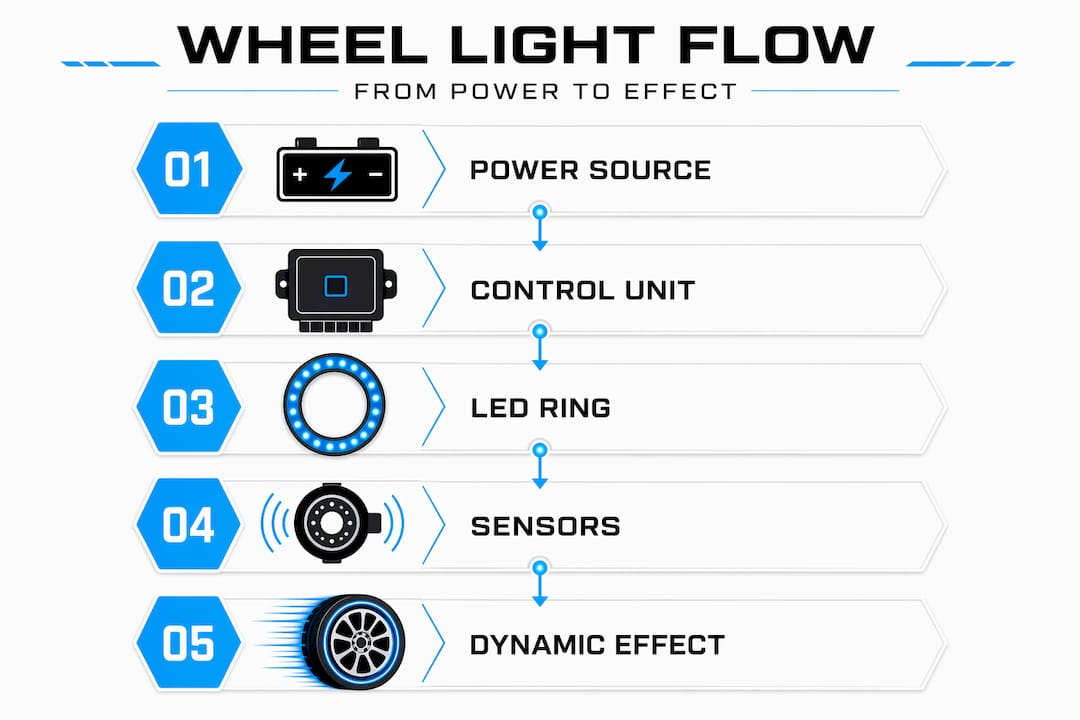
At the most basic level, wheel lights are LED strips or rings mounted either inside the wheel well or directly on the wheel face. When power flows through the circuit, the LEDs emit light. That’s the simple version. The full picture involves several interconnected components working together.
Here’s what makes up a typical wheel light system:
- LED strips or rings: The light source itself. LEDs are used because they draw low current, produce minimal heat compared to incandescent bulbs, and last tens of thousands of hours under normal conditions.
- Power source: Most vehicle wheel light systems tap into the 12-volt electrical system directly from the battery. Bicycle systems and some aftermarket kits use rechargeable lithium-ion batteries instead.
- Control unit or harness: A wire harness routes power from the source to each light pod. The control unit manages switching, color selection, and effect sequences.
- Activation and control methods: Programmable LED sequences allow you to adjust colors and lighting effects through Bluetooth apps, handheld remotes, or onboard keypad controllers depending on the kit.
Dynamic systems add another layer. These use accelerometers and magnetometers embedded in the light unit itself. As the wheel rotates, the sensor detects the orientation and speed of rotation. The controller then fires specific LEDs only at precise points in the rotation cycle, creating arcs of light that expand and contract with vehicle speed. This is not a simple on/off circuit. It’s a real-time sensor feedback loop.
Pro Tip: If you want effects that respond to speed rather than just staying on solid, look specifically for kits that list accelerometer or motion sensor technology in their specs. Static kits will not produce that behavior no matter how you configure the controller.
Electromagnetic induction plays a role in some higher-end systems as well. Rather than running wires through or near a spinning wheel, induction-based designs transfer power wirelessly across a small gap between a stationary transmitter mounted on the vehicle frame and a receiver on the wheel. This eliminates the wiring challenge of a rotating component entirely, though these systems carry a higher price point.
Types of wheel light systems
Not all wheel lights function the same way. Understanding the differences helps you choose the right system for your vehicle and goals.
| System type | Power source | Activation method | Best use case |
|---|---|---|---|
| Static LED strip (wheel well) | 12V vehicle battery | Switch, remote, or app | Cars and trucks, always-on accent lighting |
| Dynamic sensor-based (wheel face) | 12V or onboard battery | Motion sensor, auto-activates | High-visibility effects tied to speed |
| Bicycle wheel lights | Rechargeable lithium-ion | Accelerometer, brake sensor | Cyclists needing smart safety lighting |
| Induction-powered wheel rings | 12V vehicle system | Wireless induction, auto | Premium builds, no rotating wires |
Static LED strips are the most common starting point for automotive enthusiasts. They mount inside the wheel well and illuminate the surrounding area with a consistent glow. Color and brightness are controlled manually or through a remote. These are straightforward to install and widely compatible with most vehicles.
Dynamic systems, popularized in the cycling world by products like the Revolights Skyline, use accelerometers and magnetometers to synchronize LED activation with wheel rotation. The result is a light arc that appears to stay in a fixed position relative to the road as the wheel spins. At higher speeds, the arc tightens. At lower speeds, it widens. This behavior is not cosmetic. It communicates speed and direction to other road users in a way a static light cannot.
Bicycle-specific systems also incorporate brake detection. When the rider decelerates, the rear arc brightens automatically as a brake light signal. This kind of smart acceleration and brake detection represents where automotive wheel lighting technology is heading as well.
Battery-powered systems offer easier installation since there is no wiring to the vehicle’s electrical system. The trade-off is that you must remember to charge them and battery life limits continuous use. Wired systems connected to the vehicle’s 12V supply eliminate that concern but require more careful installation work.
Benefits of wheel lights beyond looks
The safety case for wheel lights is more solid than most people realize. Wheel lights increase vehicle visibility by enhancing conspicuity, which is how easily other drivers notice and correctly interpret your vehicle’s position and movement.
“Wheel lights increase vehicle visibility and safety by enhancing conspicuity and providing depth perception cues, reducing near-collision risks especially under low light or adverse conditions.” — Car Wheel Lights
Standard headlights and taillights communicate front and rear position. Wheel lights add lateral visibility. When a vehicle with illuminated wheels moves through an intersection at night, drivers approaching from the side can perceive the vehicle’s speed and trajectory more accurately because the rotating light creates a motion cue that a static reflector cannot replicate. That depth perception benefit is particularly valuable in rain, fog, or poorly lit urban environments.
For cyclists, the benefits of wheel lights extend to near-collision reduction. Studies on bicycle conspicuity consistently show that motion-based lighting attracts attention from peripheral angles far more effectively than static lights. A driver whose eyes are not directly on the road ahead is still likely to catch a spinning illuminated wheel in their peripheral field.
Vehicles also benefit from the supplementary illumination wheel well lights provide near ground level. This height range is below where most vehicle lighting operates, which means wheel lights fill a genuine gap in the visibility profile of any car or truck on the road at night. For enthusiasts who also use their vehicles on golf cart or low-speed paths, this low-level illumination becomes even more relevant.
Wheel light installation guide: what you need to know
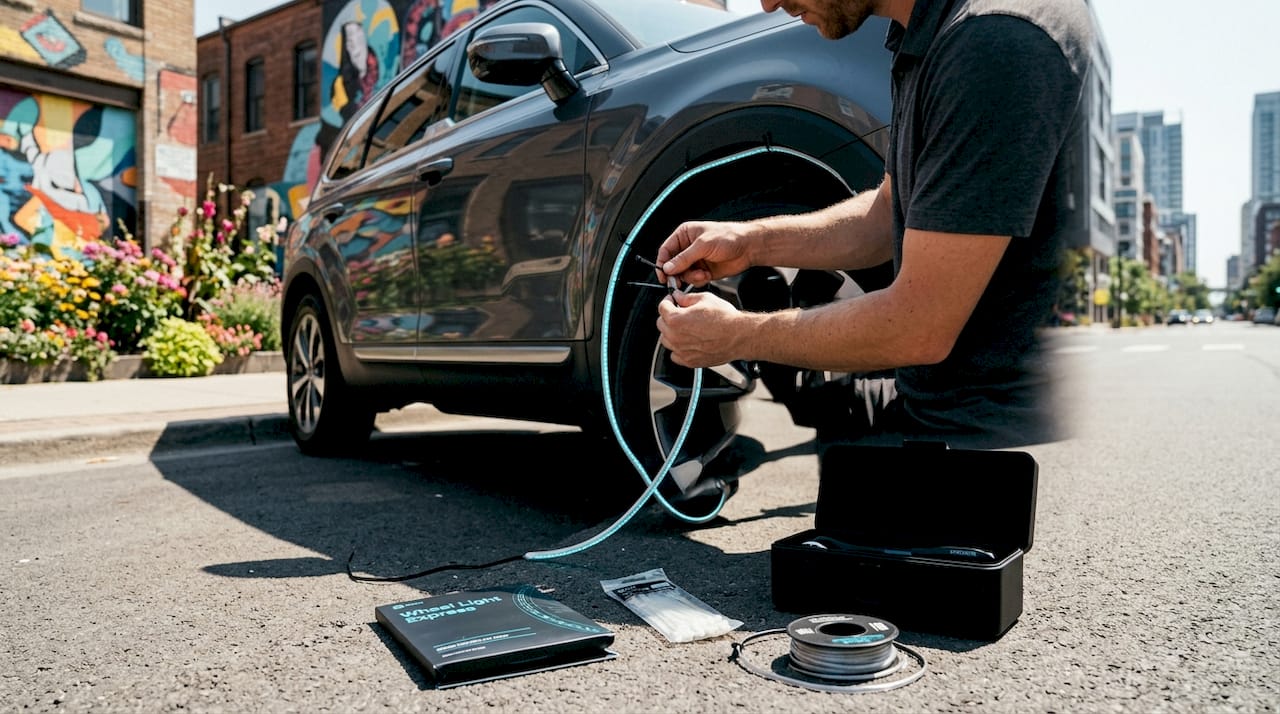
A typical wheel well LED installation takes about one full day when done carefully. That timeline assumes you have the right tools and a clear plan before you start. Here is a step-by-step overview of how the process works:
- Plan your mounting locations. Walk around the vehicle and identify where each light pod will sit. Avoid any area that contacts the suspension during travel. Suspension travel must be accounted for before you commit to a mounting position. A simple test: push down on the corner of the vehicle by hand and watch where the wheel well geometry changes. Nothing should be mounted there.
- Clean and prepare the surface. Wheel wells collect road grime, oil, and moisture. Wipe down the mounting surface thoroughly before applying adhesive or drilling for mechanical brackets.
- Mount the light pods or strips. Use mechanical brackets where possible for the most secure hold. Adhesive-only mounting can fail in high-heat or high-vibration areas. Wheel light ring brackets designed for automotive use provide the most reliable long-term hold.
- Route the wiring carefully. Keep wires away from heat sources, moving parts, and sharp edges. Use grommets wherever wire passes through metal panels.
- Install an inline fuse near the battery. This is not optional. Inline fuses are mandatory to cut power during a short circuit and prevent fire. Place the fuse within 18 inches of the battery connection.
- Ground the system correctly. Poor grounding is the leading cause of premature failure in wheel well lighting. Use dedicated chassis ground points and sealed connectors to prevent corrosion from moisture and vibration.
- Test before finalizing. Power the system and check every light pod before securing all wiring permanently. Fix any issues while access is still easy.
Pro Tip: Never rely on electrical tape alone for connections in a wheel well environment. Soldered connections protected by heat shrink tubing are the only reliable choice in an environment that sees moisture, heat cycles, and constant vibration.
The decision between DIY and professional installation comes down to your comfort level with vehicle electrical systems. If you have never wired directly to a vehicle battery or worked with automotive fuse boxes, a professional install is worth the cost. Mistakes in vehicle electrical work can cause battery drain, blown fuses, or in worst cases, electrical fires. If you are confident with basic automotive wiring, a quality kit with a well-documented harness makes DIY very achievable.
My honest take on wheel lights after years in automotive lighting
I’ve seen a lot of wheel light installs go wrong in the same predictable ways. The most common failure point is not the lights themselves. It’s the electrical planning, or the lack of it.
Most DIYers focus entirely on where the lights will look best and spend almost no time thinking about load management. A poorly planned circuit that draws too much current from an already loaded accessory circuit will cause intermittent faults, blown fuses, or slow battery drain that takes weeks to diagnose. Proper vehicle integration is what separates a system that runs flawlessly for years from one that causes headaches within months.
The other thing I see overlooked constantly is the distinction between wheel lights and steering wheel LED covers. They are completely different product categories with different safety profiles. Steering wheel LED covers that are loose or poorly fitted can impair grip and in some cases affect airbag deployment. Wheel well and wheel face lighting carries none of those risks when installed correctly.
My honest opinion on whether wheel lights are worth it: yes, but only when you choose a system that matches your vehicle’s electrical capacity and install it with the same care you’d give any other safety-related modification. The visual payoff is real. The safety benefits are real. But neither matters if the system fails at 60 miles per hour on a dark highway because someone skipped the inline fuse.
The technology is also improving fast. Sensor-based systems that were exclusive to high-end bicycle lighting two years ago are now appearing in automotive kits. If you are buying today, look for systems that offer programmable sequences and motion-responsive effects. You will get more value and more visibility from them than a basic static strip.
— Christopher
Upgrade your vehicle with quality wheel lighting
Ready to put this knowledge to work? Wheellightexpress designs all of its wheel lighting products right here in Louisiana, which means every LED strip, wire harness, and mounting component is built with U.S. quality standards and real automotive conditions in mind.
Whether you want a clean wheel well glow or a full dynamic ring system, Wheellightexpress has the components to make it happen. Browse the full range of aftermarket automotive lighting to find LED rings, strips, and complete kits built for enthusiasts who care about both quality and customization. Need to protect your wiring? The self-tappers and fuses kit gives you everything required for a safe, code-correct install. Wheellightexpress also offers financing options so you can build the setup you actually want without compromising on components. Every purchase comes with a satisfaction guarantee.
FAQ
How do wheel lights get their power?
Most automotive wheel lights connect directly to the vehicle’s 12-volt battery through a wired harness with an inline fuse. Bicycle and some standalone kits use rechargeable lithium-ion batteries instead.
Are wheel lights legal to use on public roads?
Legality varies by state and country. Most jurisdictions permit wheel well accent lighting in non-red and non-blue colors when the vehicle is parked or moving on private roads. Check your local vehicle lighting regulations before installing.
What makes dynamic wheel lights different from static ones?
Dynamic systems use accelerometers and magnetometers to fire specific LEDs at precise points during wheel rotation, creating speed-responsive light arcs. Static systems stay on at a fixed brightness with no motion-based behavior.
Are wheel lights worth it for safety, not just looks?
Yes. Wheel lights enhance vehicle conspicuity by adding lateral visibility and depth perception cues that standard headlights and taillights do not provide, which is especially valuable in low-light or adverse weather conditions.
How long does a wheel light installation take?
A careful wheel well LED installation typically takes about one full day, including mounting, wiring with an inline fuse, grounding, and testing all light pods before finalizing connections.