

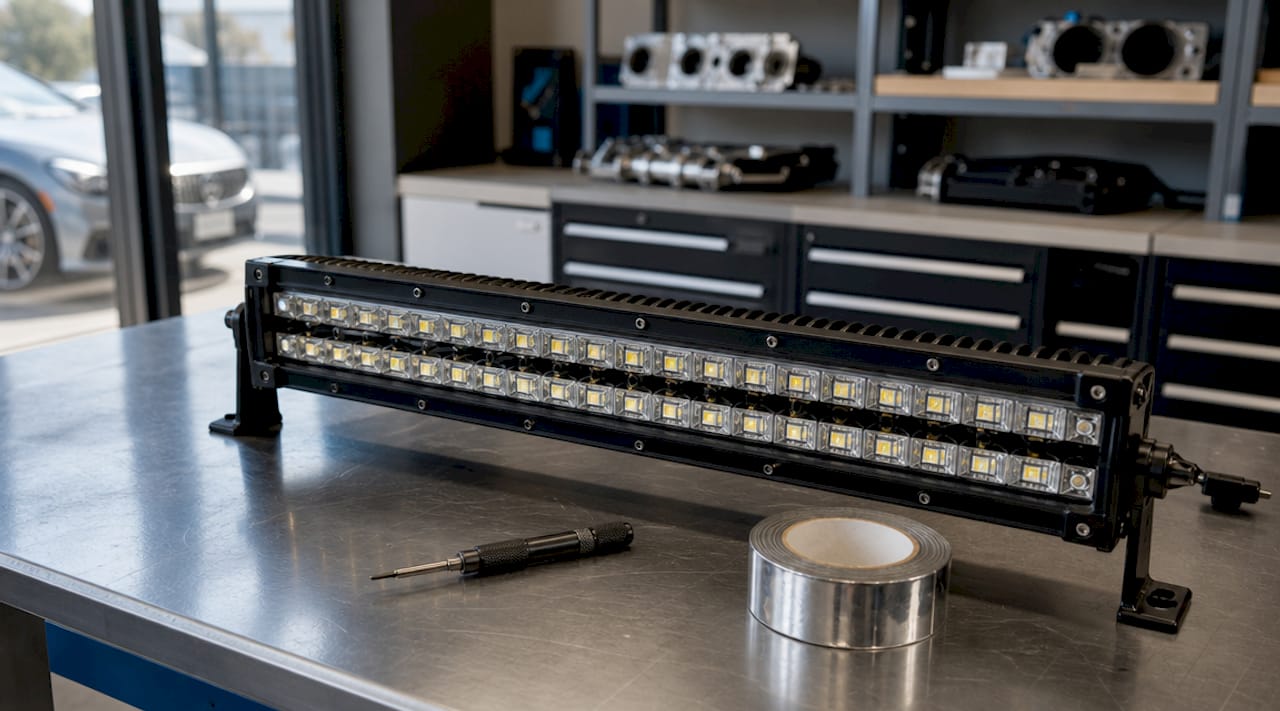
Double-row LEDs are defined by their stacked configuration: two parallel rows of LED chips mounted on a single PCB, delivering roughly twice the lumen output of a single-row bar of the same length. For automotive enthusiasts building out a custom lighting setup, this distinction is not cosmetic. Products like the Black Oak LED Pro Series 3.0, which uses top-bin OSRAM LEDs, can output over 50,000 lumens from a double-row configuration. That level of output changes what you can see on a dark trail, a back road, or a custom show build. Understanding why double-row LEDs shine brighter comes down to three factors: LED count, thermal management, and beam geometry.
How does LED density affect brightness in double-row configurations?
LED density is the primary driver of lumen output in any LED strip or light bar. More chips per foot means more photons per second, and the math scales quickly. Increasing LED density from 9 LEDs per foot to 60 LEDs per foot boosts perceived brightness by nearly 800%. That figure puts the double-row advantage in clear perspective: you are not getting a marginal improvement, you are multiplying output in a way the human eye registers immediately.
Color temperature, by contrast, produces only a 5 to 15% difference in brightness between warm white and cool white LEDs. That range is often unnoticeable without direct comparison. Enthusiasts who spend time chasing the “right” Kelvin rating while ignoring LED count are optimizing the wrong variable. Density wins every time.
The PCB underneath those LEDs matters just as much as the chip count. PCB widths of at least 10 mm are required to manage heat and electrical current at densities of 120 LEDs per meter. Tests show peak luminous efficacy at 169.6 lm/W when both heat dissipation and current capacity are properly engineered. A narrow PCB crammed with LEDs will throttle itself within minutes.
Pro Tip: When comparing double-row LED bars, check the PCB width specification before the lumen rating. A wider PCB at the same lumen count indicates better thermal and electrical engineering, which translates to sustained brightness over time.
| LED density | Approximate brightness gain |
|---|---|
| 9 LEDs/ft baseline | Reference point |
| 30 LEDs/ft | ~300% increase over baseline |
| 60 LEDs/ft | ~800% increase over baseline |
| Double-row (120+ LEDs/m) | Maximum output, requires 10mm+ PCB |
For automotive applications, this means a double-row LED strip mounted on a bumper or roof rack is not just visually fuller. It is producing measurably more usable light across the beam spread.
What design and thermal advantages help double-row LEDs maintain brightness longer?
Raw lumen output at startup means nothing if the bar dims after 10 minutes on the trail. Thermal management is where double-row bars separate from budget alternatives, and the gap is significant.
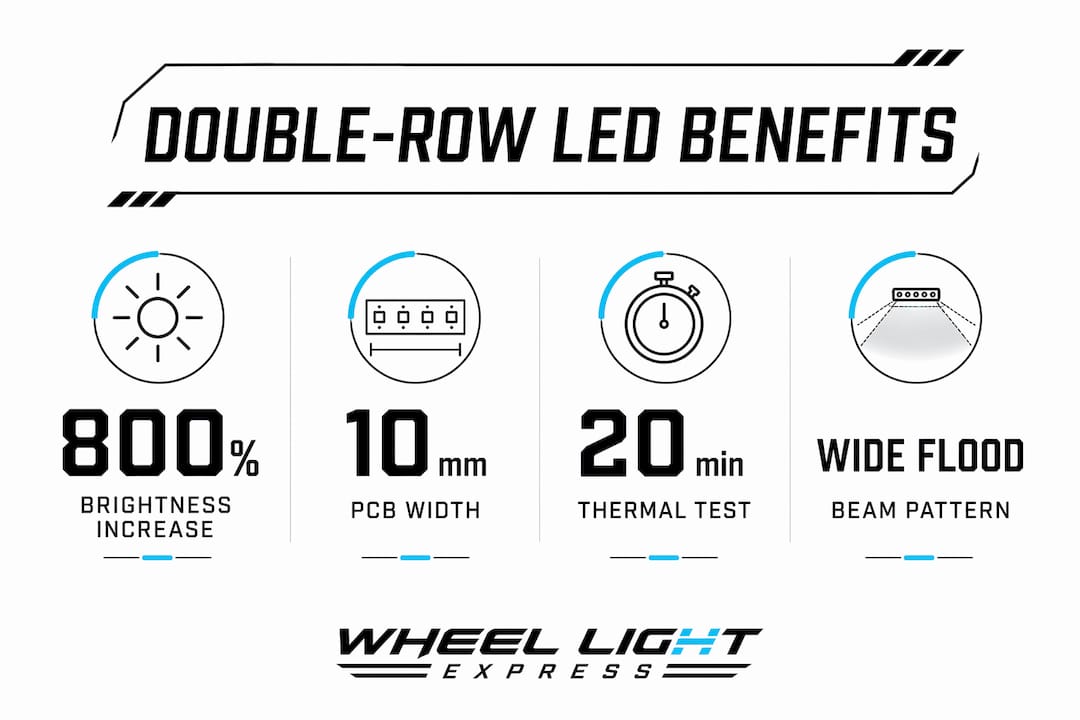
Cheaper double-row bars lose 20 to 30% of their brightness within 10 to 15 minutes due to heat buildup. That is not a minor inconvenience. It means the bar you bought for off-road visibility is operating at 70% capacity during the stretch of road where you need it most. Premium bars counter this with oversized aluminum heat sinks featuring deep cooling fins designed for continuous high-power operation.
Here is what separates well-engineered double-row bars from the rest:
- Oversized aluminum heat sinks with deep fin profiles that pull heat away from the LED array continuously
- Wide PCB trace widths that reduce electrical resistance, preventing voltage drop that causes brightness loss at high densities
- Top-bin LED selection, such as OSRAM chips used in the Pro Series 3.0, which are binned for consistent output and 50,000+ hour operating life
- Precision driver circuitry that regulates current delivery to each LED row independently, preventing one row from starving the other under load
- IP-rated enclosures that protect the PCB from moisture and debris without trapping heat inside the housing
The double-row physical format helps here too. A bar that is approximately 3 inches tall has more surface area for heat sink contact than a single-row bar of the same length. That extra height is not wasted space. It is thermal real estate that keeps your output stable.
Pro Tip: After installing a new double-row bar, run it at full power for 20 minutes and then check the housing temperature. A bar with adequate thermal management will be warm but not painful to touch. If it is too hot to hold, the heat sink is undersized for the LED density.
Thermal throttling in poorly designed bars is one of the most common causes of brightness degradation in the field. Choosing a bar with verified heat sink specifications protects your investment and your visibility.
How do double-row and single-row LED bars compare in beam pattern and real-world use?
The brightness advantage of double-row LEDs is real, but beam pattern determines how that brightness is actually delivered to the road or terrain in front of you. Double-row bars produce wider flood-style beams, while single-row bars generate tighter spot beams that reach longer distances. Neither is universally better. The right choice depends on your driving conditions and mounting position.
| Feature | Double-row bar | Single-row bar |
|---|---|---|
| Beam type | Wide flood coverage | Tight spot projection |
| Lumen output | Higher (2x LED count) | Lower at same length |
| Bar height | ~3 inches | ~1.5 inches |
| Best use case | Trail navigation, terrain coverage | Highway, long-distance projection |
| Perceived fullness | High optical depth | Concentrated intensity |
| Mounting space needed | More vertical clearance | Fits tighter spaces |
Double-row bars also create greater optical depth and visual fullness by vertically staggering LEDs. Peripheral vision perceives the volume of light from two rows as substantially brighter than a single row of equal wattage. This is why double-row wheel lights and accent strips look more impactful on a custom build, even when the raw lumen numbers are close.
For touring and off-road driving, double-row bars provide stronger forward projection and wider terrain coverage, making them the preferred choice for trail navigation. Single-row bars remain the better option for urban driving or builds where mounting height is limited. Understanding this tradeoff before you buy saves you from remounting a bar twice.
What practical factors should you consider when choosing double-row LEDs for your vehicle?
Selecting the right double-row bar for your build requires more than checking the lumen spec. Here are the practical factors that determine whether a bar actually works on your vehicle:
- Mounting clearance. Double-row bars are approximately 3 inches tall. Measure your bumper, roof rack, or A-pillar mounting location before ordering. A bar that physically fits will not vibrate loose or obstruct your hood line.
- Power draw and wiring. Higher LED density means higher current draw. Verify your vehicle’s electrical system can support the bar’s wattage, and use a proper wire harness rated for the load. Undersized wiring causes voltage drop that dims the bar and creates a fire risk.
- Beam pattern match. If you are mounting on a roof rack for trail use, a flood-dominant double-row bar covers terrain effectively. For a bumper-mounted bar aimed at highway driving, a combo beam or single-row spot may serve you better.
- IP rating for your conditions. Off-road builds need IP67 or IP68 rated bars. Wash-down exposure, mud, and water crossings will destroy an unsealed housing within one season.
- Aerodynamic and noise impact. A taller double-row bar creates more wind resistance at highway speeds. Some enthusiasts report audible wind noise from roof-mounted bars above 65 mph. Factor this in if the vehicle doubles as a daily driver.
- Verified thermal specs. Ask for heat sink dimensions or operating temperature ranges before purchasing. A bar rated for continuous duty at high ambient temperatures is built for sustained use, not just peak output on a cool day.
Checking these six factors against your specific vehicle and use case eliminates most post-purchase regret. The LED strip applications guide from Wheellightexpress covers mounting and selection in detail for common vehicle types.
Key takeaways
Double-row LEDs shine brighter because they combine higher LED density, superior thermal management, and greater optical depth, making them the most effective choice for automotive lighting upgrades.
| Point | Details |
|---|---|
| LED density drives output | Going from 9 to 60 LEDs per foot increases perceived brightness by nearly 800%. |
| Thermal management sustains brightness | Poor heat dissipation causes 20 to 30% brightness loss within 15 minutes of operation. |
| PCB width matters | A minimum 10 mm PCB width is required to support high-density LED operation without voltage drop. |
| Beam pattern affects real-world use | Double-row bars produce wider flood coverage; single-row bars deliver tighter long-distance spot beams. |
| Optical fullness adds perceived brightness | Vertically staggered LEDs create a fuller light volume that the human eye perceives as brighter. |
What I’ve learned from years of double-row LED builds
I have seen a lot of enthusiasts make the same mistake: they buy the bar with the highest advertised lumen count, bolt it on, and wonder why it looks dim after 20 minutes on the trail. The lumen number on the box is almost always a peak figure measured at startup in a controlled environment. What you experience in the field is what the thermal management delivers, not what the spec sheet promises.
The builds I have seen hold up best over multiple seasons share one trait: the heat sink is visibly oversized relative to the bar’s length. If the fins look substantial and the aluminum housing feels heavy for its size, the manufacturer invested in thermal engineering. If the bar feels light and the fins are shallow, the lumen rating is aspirational.
Beam pattern is the other factor most people underestimate. A double-row flood bar mounted on a roof rack transforms how you read terrain at night. The wide coverage fills in the edges of the trail that a tight spot beam leaves dark. For wheel lights and accent strips, the optical fullness of a double-row arrangement creates a visual impact that single-row strips simply cannot match, regardless of wattage.
My recommendation: prioritize verified thermal specs and PCB width over peak lumen claims. A bar that delivers 80% of its rated output continuously will outperform a bar that claims 120% and throttles to 70% within minutes. The types of automotive LED lighting guide is a solid starting point if you are still sorting out which configuration fits your build.
— Christopher
Upgrade your build with Wheellightexpress double-row LED lighting
At Wheellightexpress, we design all of our LED lighting products in Louisiana, and every product is built for automotive enthusiasts who want real performance, not just a bright number on a spec sheet. Our double-row wheel lights are engineered with high lumen output, proper thermal management, and the optical depth that makes a custom build stand out.
Whether you are upgrading your wheel lights, adding accent strips, or outfitting a truck for off-road use, our full range of automotive lighting solutions covers every application. We back every product with a satisfaction guarantee and offer financing options so you can build the way you want without waiting. Browse the catalog and find the right double-row LED setup for your vehicle today.
FAQ
Why do double-row LEDs produce more lumens than single-row?
Double-row LED bars contain twice the number of LED chips in the same bar length, directly doubling the light-emitting surface area and total lumen output. Products like the Black Oak LED Pro Series 3.0 achieve over 50,000 lumens using this configuration with top-bin OSRAM LEDs.
How much brighter are double-row LEDs compared to single-row?
Increasing LED density from 9 to 60 LEDs per foot boosts perceived brightness by nearly 800%, and double-row bars effectively double the chip count of a single-row bar at the same length. The actual brightness advantage depends on thermal management, since poorly cooled bars lose 20 to 30% of output within 15 minutes.
Do double-row LED bars use more power than single-row bars?
Yes. More LEDs mean higher wattage draw, so double-row bars require a properly rated wire harness and a vehicle electrical system that can support the load. Undersized wiring causes voltage drop that reduces brightness and creates safety risks.
What beam pattern does a double-row LED bar produce?
Double-row bars produce wider, flood-dominant beams that cover more terrain laterally, making them ideal for trail navigation and off-road use. Single-row bars generate tighter spot beams suited for long-distance highway projection.
Are double-row LEDs worth it for wheel lights and accent strips?
Yes. The vertically staggered LED arrangement in double-row wheel lights creates greater optical depth and visual fullness that the human eye perceives as significantly brighter, even when raw lumen counts are similar to single-row alternatives. For custom builds where visual impact matters, the double-row configuration delivers a noticeably fuller effect.