

For high-current, always-on, or animation-critical lighting like wheel lights and rock light sequences, a wired controller is the safer choice. For low-current accent lighting where convenience matters more than precision, such as portal lights or cab accents, a wireless controller is acceptable. The reasons come down to power handling and PWM stability on one side, and pairing reliability on the other. A short checklist below helps you match the right controller to your build.
TL;DR:
- Wired controllers are better suited for high-current, synchronized lighting like wheel and rock lights, due to their power handling and signal stability.
- PWM frequency above 200 Hz is essential to prevent flickering, and automotive-grade drivers support programmable PWM up to 23.4 kHz for reliable dimming.
- Controllers must tolerate vehicle voltage swings during cold-crank and load-dump events, with diagnostics like open-circuit detection to prevent damage or silent failures.
- Proper wiring, fusing, and mounting are critical for performance, and fuses should be rated for the actual load, not just controller maximums.
- Bluetooth and RF controllers are vulnerable to interference and connection drops, so placement and shielding are key for consistent response times in real-world use.
Table of Contents
- Weighing wired and wireless controllers for car, truck, and off-road builds
- How PWM frequency and automotive-grade drivers shape your choice
- Getting the wiring, fusing, and mounting right
- A checklist before you buy or install a controller
- What our builds have taught us about controller choice
- Latency and response time differences affecting real-time control
- Battery life and power source considerations for wireless controllers
- Compatibility with various LED types and vehicle systems
- Why the convenience debate misses the real question
- Find the right harness or remote setup for your build
- FAQ
- Sources
Weighing wired and wireless controllers for car, truck, and off-road builds
Wired controllers connect directly into your vehicle’s electrical system, which gives them an advantage in current capacity and signal stability. They draw power through a dedicated harness, so there is no pairing step and no risk of a dropped connection mid-animation. Wireless controllers, by contrast, use Bluetooth or RF to communicate with an app or remote, which makes them attractive for installs where running a signal wire to a control panel is impractical.
Each approach has its own strengths and weak points depending on what you are lighting.
- Wired controllers handle higher current loads reliably, integrate cleanly with ignition or parking-lamp triggers, and offer easier diagnostics when something stops working.
- Wireless controllers give you app-based color and mode control without running a signal wire, which speeds up retrofits on vehicles with limited interior access.
- Wired weak points include the extra labor of running and securing harness wire, which adds install time on tight builds.
- Wireless weak points include pairing drops from interference and dependence on a phone or remote being present when you want to trigger a mode.
For wheel lights and rock lights, which often run at higher current and benefit from synchronized animations, wired setups tend to perform better. For portal lights or single-zone accent strips where brightness and mode-switching matter more than millisecond timing, wireless control is a reasonable trade for easier installation.
How PWM frequency and automotive-grade drivers shape your choice
Pulse-width modulation (PWM) is the standard method for dimming automotive LEDs, and the frequency a controller uses determines whether your lights flicker or hold steady. According to Texas Instruments dimming guidance, frequencies above roughly 200 Hz are typically needed to avoid visible flicker, and automotive-grade drivers commonly support programmable PWM from about 200 Hz up to 23.4 kHz. PWM also reduces the color shift that can occur with analog dimming, where LED color temperature drifts as current changes.
Automotive-grade LED driver ICs, such as the NEX1316X-Q100, are AEC-Q100 Grade 1 qualified and support programmable PWM across that same 200 Hz to 23.4 kHz range, which matters because a controller rated for consumer electronics rarely survives automotive voltage swings.
Vehicles are harsh electrical environments. Voltage can drop to roughly 5 volts during cold-crank and spike well above normal during load-dump events when the alternator disconnects under load. TI’s precision PWM dimming reference design is built to operate down to 5 volts to simulate cold-crank conditions and to survive ISO 7637-2 load-dump transients, which is the kind of tolerance a controller buried in your dash or frame rail needs to have.

Diagnostics matter too. Open-circuit detection, short-circuit detection, and fail-safe states let a driver shut down safely or report a fault rather than cooking a connector. Multi-channel automotive drivers that expose UART or CAN interfaces for coordinating several lighting zones favor wired, deeply integrated setups over simple wireless modules, since that level of diagnostic feedback generally rides on a hardwired data line rather than a Bluetooth link.
Getting the wiring, fusing, and mounting right
A controller only performs as well as the harness feeding it. Size your wiring and fuse to the LED load you are actually running, not just the controller’s maximum rating, and leave margin for future additions like a second rock light zone or extra wheel light rows.
- Match wire gauge to the total current draw of your LED strips plus a safety margin, then fuse close to the power source rather than at the controller.
- Use sealed, automotive-rated connectors at every harness joint, and route wiring away from exhaust heat and wheel well spray.
- Mount the controller somewhere accessible for diagnostics and, if it is wireless, somewhere that keeps it within reliable pairing range of your phone or remote.
- Label harness runs at both ends so a future repair or upgrade does not turn into a guessing game.
Physical trigger wires tied to the parking lamp or ignition circuit tend to be more dependable than app-based triggers for startup animations, since an animation tied to a hardwired signal fires every time the vehicle powers on, while one relying on a paired phone can fail silently if Bluetooth drops or the phone is not in range. Our wire harness lighting guide covers harness selection in more depth if you are planning a multi-zone install.
Pro Tip: Run a spare signal wire alongside your main harness during install. Retrofitting a trigger later usually means pulling trim you just put back.
A checklist before you buy or install a controller
Before committing to a controller, confirm it matches the actual demands of your install rather than just the marketing copy.
- Total current capacity: does the controller’s rated output cover your LED load with margin for growth?
- PWM frequency range: does the spec sheet state a frequency high enough to avoid flicker at low dim levels?
- Input voltage range: can it tolerate cold-crank dips and load-dump spikes without resetting?
- Diagnostics and protection: does it report open or short circuits, or just stop working silently?
- Environmental rating: is the housing sealed against moisture and road spray where you plan to mount it?
- Control method and fallback: if wireless, is there a manual override if pairing fails?
Ask any vendor directly about cold-crank handling and PWM frequency range if the spec sheet does not list them. As a general rule, prioritize wired controllers for high-current, animation-critical, or multi-zone systems, and reserve wireless for low-current, convenience-first installs. Our custom lighting integration overview walks through how these pieces fit together on a full build.
What our builds have taught us about controller choice
Our harnesses and lighting kits are designed with attention to wire gauge and connector quality, favoring durability over generic overseas parts. We back every order with a satisfaction guarantee to help ensure customers have a lasting, reliable experience.
The most common troubleshooting calls we get trace back to a controller mounted somewhere too hard to reach for pairing or a fuse that was undersized for the load. We always recommend mounting wireless controllers where you can physically reach them, checking fuse ratings against your actual LED draw, and reading our Bluetooth vs RF comparison before choosing a wireless control method for a build with metal body panels nearby.
Latency and response time differences affecting real-time control
Response time is where wired and wireless controllers diverge most noticeably in daily use. A wired controller reacts to a trigger signal essentially the moment the circuit closes, since there is no handshake or signal translation standing between the trigger wire and the LED driver. That immediacy matters for synchronized animations across wheel lights or rock lights, where even a small delay between zones breaks the visual effect.

Wireless controllers introduce an extra step: the app or remote has to send a command over Bluetooth or RF, and the controller has to receive and process it before the lights respond. In good conditions that delay is minor, but interference from a vehicle’s own electrical system, nearby metal panels, or other RF-emitting accessories can add noticeable lag or cause a command to be missed entirely.
For mode changes and color adjustments, that lag is rarely a problem. For a precise, synchronized light show tied to music or a startup sequence, it is worth testing before you commit to a wireless setup. Our guide to preventing Bluetooth controller interference walks through placement and shielding steps that reduce the gap between command and response, though a hardwired trigger remains the more predictable option when timing is the priority.
Battery life and power source considerations for wireless controllers
Wireless controllers for vehicle LED kits are almost always powered directly from the vehicle’s electrical system rather than running on internal batteries, since a battery-powered controller would need regular recharging or replacement to keep working. The “wireless” part refers to the communication link between the controller and your phone or remote, not the power source for the controller itself.
That distinction matters because it shifts the real power concern away from battery drain and toward the vehicle’s own voltage stability. A wireless controller still needs to tolerate the same cold-crank dips and load-dump spikes a wired controller does, since it draws from the same circuit. The remote or key fob that pairs with it, however, often does run on a small battery, and a dead remote battery is one of the more common reasons a wireless system suddenly “stops working” when the controller itself is fine.
If you are relying on a handheld remote rather than a phone app, keep a spare battery on hand and check the remote’s battery level as part of routine maintenance, the same way you would check a tire pressure sensor battery. Our remote harness products are built with this in mind, pairing a vehicle-powered controller with a remote that is simple to maintain.
Compatibility with various LED types and vehicle systems
Not every controller works with every LED strip, and mismatches here cause more support calls than almost any other issue. Single-color LED strips need only basic on-off or dimming control, while RGB and RGBW strips need a controller capable of addressing multiple color channels independently, which is a meaningfully different electrical and firmware requirement.
Vehicle integration adds another layer. A controller wired to tap into your parking lamp or ignition circuit needs to match your vehicle’s voltage behavior and trigger logic, which varies between gas and diesel platforms and between older and newer electrical architectures. Multi-channel automotive drivers with UART or CAN interfaces are built to coordinate several lighting zones from one control point, which is useful if you are running wheel lights, rock lights, and portal lights together and want them to respond as one system rather than as separate installs.
Before buying a controller, confirm it is rated for the specific LED type you are running (single-color, RGB, or RGBW) and that its voltage and trigger requirements match your vehicle. Our lighting controller basics guide breaks down the terminology if you are comparing specs across different brands. For auxiliary marker lighting that needs to meet DOT standards alongside your custom kit, DOT-compliant marker lights from All Star Truck Parts are a useful reference point for hardware built to survive the same road conditions.
Why the convenience debate misses the real question
Most advice on this topic treats wired versus wireless as a convenience decision, weighing app control against running wire. That framing undersells what actually determines whether a lighting install still works a year from now: voltage tolerance, diagnostic protection, and PWM frequency stability matter more than how you send the command.
A wireless controller with weak voltage handling will fail the same way in a cold-crank event whether or not it has a slick app, and a wired controller with no fault diagnostics will leave you guessing when a zone goes dark. The electronics inside the box deserve more scrutiny than the interface on top of it.
Our take: prioritize the spec sheet over the marketing photos. Ask about PWM frequency range and cold-crank tolerance before you ask about app features. Convenience is real, but it should be the second decision you make, not the first.
— Christopher
Find the right harness or remote setup for your build
Whether you need a wired harness for a high-current install or a remote-based setup for an easier retrofit, we build both to hold up in real driving conditions.
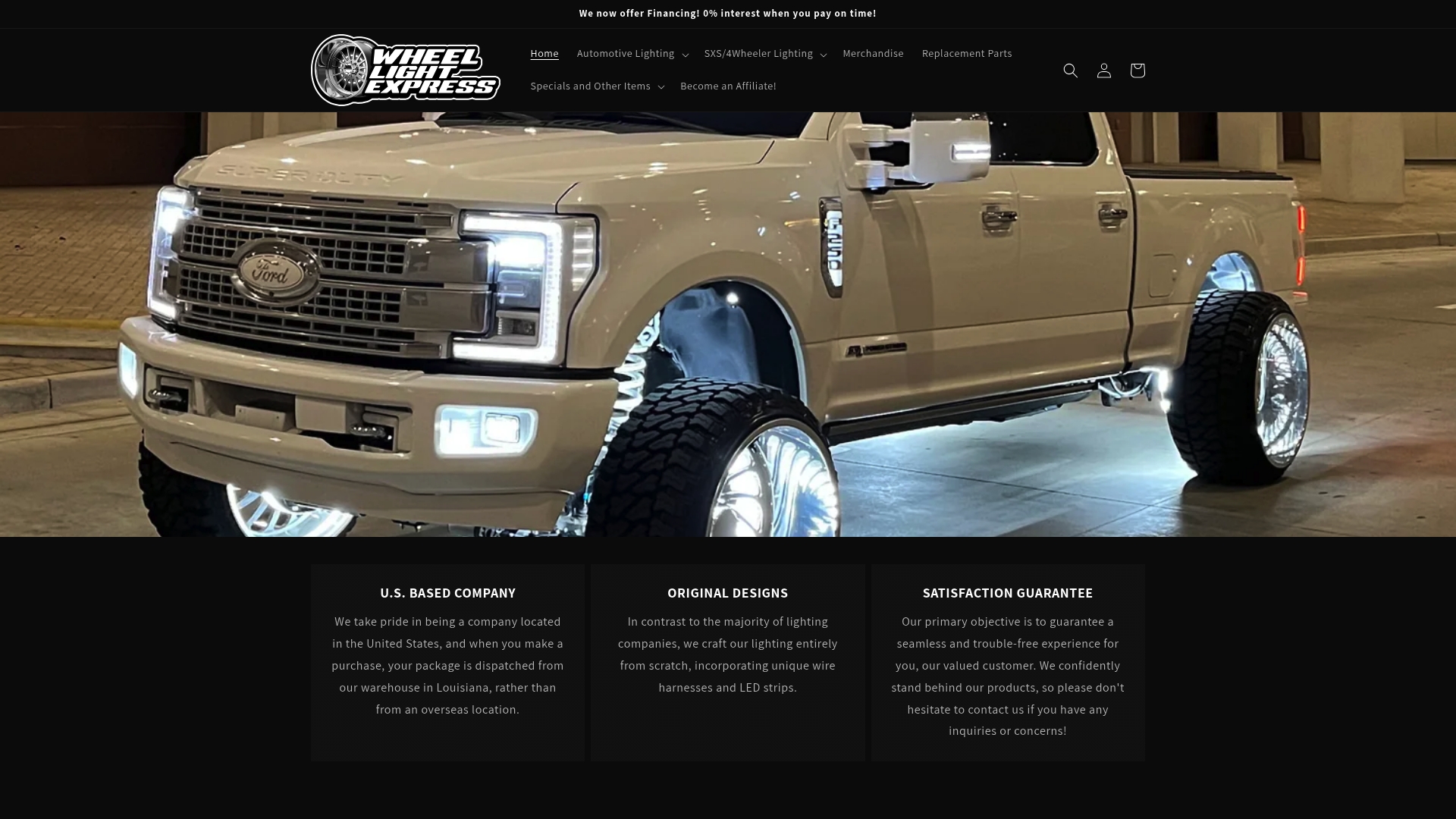
- For wheel light installs where current draw and synchronized animation matter, pair a wired harness with our Wheel Lights, High Density Wheel Lights, and Ultra High Density Wheel Lights collection.
- For rugged, high-current rock light setups, our Rock Lights and High Density Rock Lights collection uses heavy-duty harness components built for off-road conditions.
- For lower-current accent lighting where a wireless remote fits your install better, our Portal Lights collection is a straightforward fit.
Check the current draw and mounting layout of your vehicle against each product’s specs, and reach out through Wheel Light Express if you want help matching a harness to your build before you order.
FAQ
Are wired controllers better than wireless for LED lighting kits?
Wired controllers generally handle higher current loads and animation timing more reliably, which makes them the stronger choice for wheel lights and rock lights. Wireless controllers work well for lower-current accent lighting where easier installation matters more than precise synchronization.
What PWM frequency do automotive LED controllers need?
Frequencies above roughly 200 Hz are typically needed to avoid visible flicker, and many automotive-grade drivers support programmable PWM up to 23.4 kHz. A spec sheet that does not list a frequency range is worth questioning before you buy.
Why do wireless LED controllers lose connection in a vehicle?
Interference from nearby metal panels, other RF-emitting accessories, or signal range limits can cause Bluetooth or RF controllers to drop connection or require a power cycle to re-pair. Mounting the controller somewhere accessible and shielded from interference reduces this issue significantly.
Can a wireless controller survive cold-crank voltage drops?
A wireless controller still needs to tolerate the same voltage swings a wired controller faces, since both draw power from the vehicle’s electrical system. Automotive-grade drivers are typically built to operate down to about 5 volts to survive cold-crank conditions.
Does Wheel Light Express sell both wired and wireless controller options?
We offer product collections built around wired harness installs, including our Wheel Lights and Rock Lights lines, along with remote harness options for more convenience-focused installs. Checking the specs on each collection page helps confirm which fits your current and mounting needs.