
For most U.S. truck, SUV, car, and bike owners, Wheellightexpress U.S.-designed wheel light rings and strips are the top pick for waterproof wheel lighting. The reason is straightforward: explicit IP-rated waterproofing, vehicle-specific fitment options, a satisfaction guarantee, and products designed in Louisiana rather than sourced generically overseas.
Before you buy anything, lock in these three decisions:
- IP rating: Require IP67 (withstands temporary immersion up to 1 meter for 30 minutes) or IP68 (rated for deeper or longer submersion) for any wheel-mounted light. Anything labeled only “waterproof” without an IP number is a marketing claim, not a tested standard.
- Mounting type by vehicle: Ring or strip mounts for cars, trucks, and SUVs; hub or valve-cap mounts for bikes. Rings and strips deliver the most consistent full-wheel glow on automotive wheels.
- Power source: A wired 12V harness for vehicles driven regularly; rechargeable or replaceable batteries for bikes and occasional-use setups.
Pro Tip: Check the LED wheel lights benefits guide on the Wheellightexpress site before finalizing your order. It covers IP rating verification, harness compatibility, and installation steps in one place.
Key Takeaways
IP67 or IP68 is the single most important spec on any waterproof wheel light listing, and a wired 12V harness with sealed connectors is the most durable power solution for vehicles driven regularly.
| Point | Details |
|---|---|
| Require an explicit IP rating | IP67 or IP68 must appear on the product page; “waterproof” without an IP number is unverified. |
| Match mount type to vehicle | Ring or strip for cars and trucks; hub or valve-cap for bikes. |
| Choose power source by use | 12V wired harness for daily drivers; rechargeable Li-ion for cyclists (10–40 hours runtime). |
| Maintain connectors and seals | Apply dielectric grease at install, inspect monthly, and rinse salt after winter driving. |
| Wheellightexpress for automotive use | U.S.-designed double-row rings and harness kits with a satisfaction guarantee and replacement parts available. |
Table of Contents
- What types of waterproof wheel lights are available, and which fits your vehicle?
- Specs to check on any waterproof wheel light listing
- How to install wheel lights on cars, trucks, SUVs, and bikes
- How waterproof wheel lights hold up in real conditions, and how to maintain them
- Are wheel lights legal in the U.S., and what safety rules apply?
- A buying checklist for choosing the right waterproof wheel light
- Wheellightexpress recommended kits: specs and buying details
- Why U.S. design and testing matter for waterproof wheel lights
- What to expect on price, warranty, and return policy
- How to maintain waterproof seals and extend product lifespan
- Choosing wheel lights based on how you actually use your vehicle
- How Wheellightexpress compares among U.S.-designed waterproof wheel light brands
- An honest take on what actually matters when buying wheel lights
- Ready to order from Wheellightexpress? Here is what to know
- Sources
What types of waterproof wheel lights are available, and which fits your vehicle?
Not all wheel lights mount the same way, and the wrong type for your vehicle creates fitment headaches or poor visibility. Here is how the main categories break down.
Valve-cap lights screw directly onto the tire valve stem. They are the easiest to install (under five minutes per wheel) and work on bikes, cars, and trucks alike. The downside: they spin with the wheel, so the light pattern depends entirely on rotation speed. At low speeds, the effect is minimal. Battery life is typically short with small coin cells, and color restrictions in some states apply to street use.
Hub-mounted lights clamp onto the wheel hub and produce a full-circle glow even at lower speeds, which makes them popular for bike wheel lighting. Rechargeable hub lights commonly deliver a range of hours of runtime depending on design and LED density. Most hub-mounted units list a maximum hub clamp diameter, so measure your hub before ordering.
Spoke-mounted and strip lights wrap around spokes or attach along the inner rim. These are common on bicycles and produce colorful patterns as the wheel spins. Many are listed as water-resistant tire lights rather than IP-rated, meaning they handle rain but not immersion. Battery life on spoke strip designs can be substantial from replaceable CR2032 cells, but the “water-resistant” label means you should keep them off vehicles that regularly drive through standing water.
Bolt-on ring and halo lights are the standard for automotive use. A rigid or semi-rigid LED ring mounts inside the wheel well or around the hub face, producing a consistent 360-degree glow. These are the format Wheellightexpress specializes in, and they suit trucks, SUVs, and show cars best. Installation requires more steps than valve or hub options, but the result is far more durable and visually consistent.
Pod-mounted lights attach to suspension or brake components rather than the wheel itself. They are common in off-road builds and rock-crawling rigs where wheel-mounted lights risk damage from trail debris. Clearance from moving parts is the primary fitment concern.
A few fitment limits to keep in mind across all types:
- Deep-set or concave rims may not accommodate ring mounts without custom spacers.
- TPMS (tire pressure monitoring) sensors on the valve stem can conflict with valve-cap lights on most modern cars and trucks.
- Hub clamp lights need a clean, round hub surface; damaged or non-standard hubs may not seat correctly.
Specs to check on any waterproof wheel light listing
The word “waterproof” on a product listing tells you almost nothing on its own. Many marketplace listings use the term without specifying any IP rating, which hides a real performance gap between a light that handles road spray and one that survives a puddle.
IP rating: IP67 means the unit can be submerged up to 1 meter for 30 minutes without damage. IP68 means it is rated for deeper or longer immersion, with the exact depth and duration specified by the manufacturer. For wheel-mounted automotive lights that regularly encounter road spray, standing water, and car washes, IP67 is the practical minimum. IP68 is worth the premium for off-road or truck use.
Power source:
- Replaceable coin-cell batteries (CR2032): low upfront cost, easy to swap, but frequent replacement adds up and cells can leak if left in a wet environment.
- USB-rechargeable Li-ion: better long-term value for cyclists who ride regularly; runtime of 10–40 hours is typical for hub-mounted designs.
- Wired 12V harness: the most reliable option for vehicles driven nightly. A properly fused harness eliminates battery swaps and powers higher-density LED rings consistently.
Brightness and LED density: Lumens matter less than LED density for wheel lights, because the goal is even coverage around the ring rather than a spotlight beam. A double-row, high-density ring produces noticeably more even glow than a single-row strip at the same lumen rating.
Color modes and control: Single-color options are simpler and often brighter per LED. RGB modes with remote or app control let you match colors to your build. Wired switch control is the most reliable for daily drivers; Bluetooth app control adds convenience but introduces one more point of potential failure.
Fitment specs to verify:
- Hub diameter limit (common spec: ≤30mm for hub-mounted lights)
- Ring inner and outer diameter for bolt-on rings
- Adhesive type for strip lights (3M VHB tape vs. generic adhesive)
- Harness connector compatibility with your vehicle’s 12V system
Warranty and IP test claims: A credible product page states the IP rating explicitly, describes the test method or certification standard, and lists warranty terms and a return policy. If a listing only says “waterproof” with no IP number, treat it as water-resistant at best.
Pro Tip: When comparing listings, search the product page for “IP67” or “IP68” as a text string. If neither appears, the product has not been rated to either standard regardless of what the marketing copy says.
How to install wheel lights on cars, trucks, SUVs, and bikes
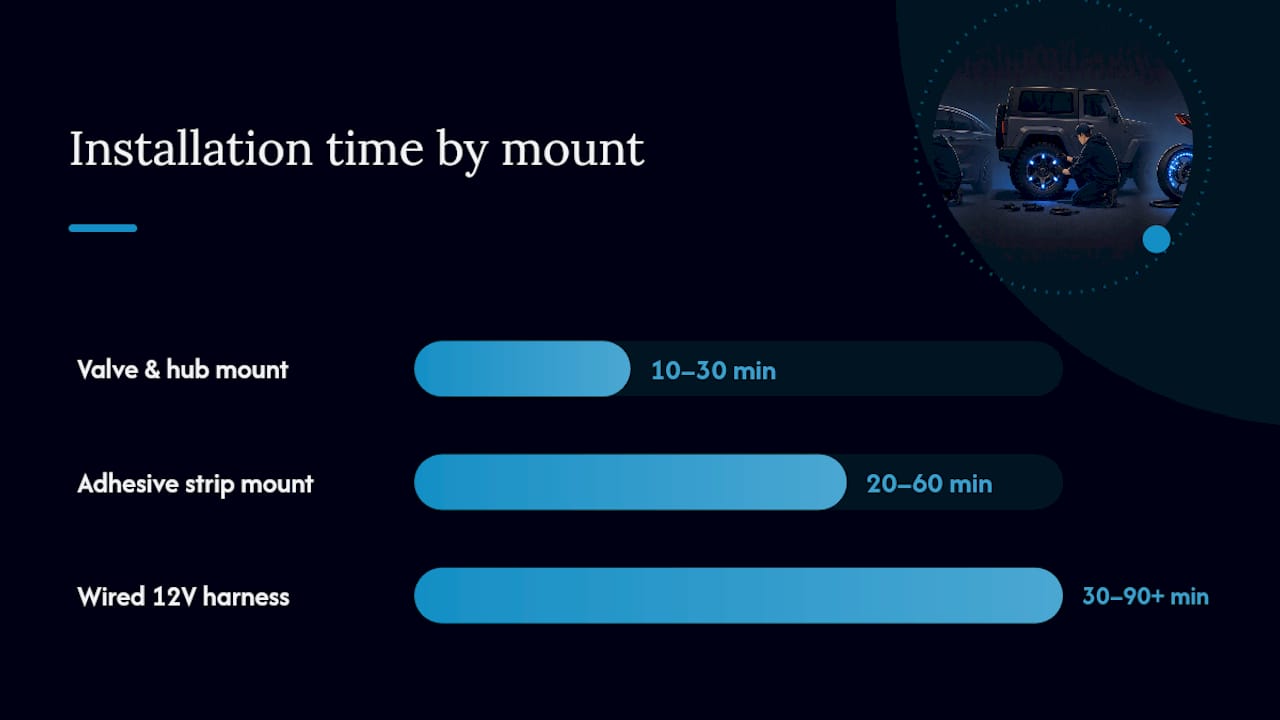
Installation complexity varies widely by mount type. Setting realistic expectations before you buy saves time and avoids returns.
Pre-install checklist:
- Measure hub diameter and ring inner/outer diameter against your wheel specs.
- Check brake caliper and rotor clearance for ring or pod mounts.
- Locate your 12V power source (fuse box or accessory circuit) for wired installs.
- Inspect rim finish (painted, powder-coated, chrome) to confirm adhesive compatibility.
- Confirm TPMS sensor position if you are adding valve-cap lights.
Valve and hub mount installation (10–30 minutes):
- Remove the existing valve cap or hub cover.
- Thread or clamp the light unit onto the valve stem or hub.
- Tighten to the manufacturer’s specified torque (finger-tight plus a quarter turn is typical for valve caps).
- Insert batteries or connect the USB charge cable.
- Test rotation and light function before driving.
Note: hub-mounted lights that list a maximum hub diameter (such as ≤30mm) must be measured against your actual hub before purchase, as noted on product pages like the ROCKBROS hub light. Even products marketed as waterproof may carry a caution against prolonged soaking, so mounting position matters.
Adhesive strip installation (20–60 minutes, surface prep required):
- Clean the rim surface with isopropyl alcohol and let it dry fully.
- Dry-fit the strip to confirm length and coverage.
- Peel the adhesive backing and press firmly, starting at one anchor point and working around the rim.
- Allow the adhesive to cure for the time specified (typically 24 hours before driving in wet conditions).
- Route the power lead away from the brake rotor and secure with zip ties.
Wired 12V harness installation (30–90+ minutes, basic electrical skill required):
- Disconnect the vehicle battery negative terminal.
- Route the harness from the wheel well to the fuse box, keeping leads clear of suspension travel and heat sources.
- Connect to an accessory circuit using a fuse tap; add self-tappers and fuses as required by the harness kit.
- Ground the harness to a clean chassis point.
- Mount the switch or connect the remote receiver in the cab.
- Reconnect the battery, test all lights, and verify brake and turn signal function before driving.
Fitment gotchas to watch for:
- Deep-set or concave rims may require extended mounting hardware for ring lights.
- Off-road vehicles need extra clearance checks for mud, rocks, and suspension flex.
- Motorcycles have tighter clearances near brake calipers and chain runs; measure twice.
- TPMS sensors on the valve stem are incompatible with most valve-cap light designs on modern trucks and SUVs.
How waterproof wheel lights hold up in real conditions, and how to maintain them
IP67 and IP68 ratings are tested in controlled lab conditions. Real-world wheel use adds centrifugal force, vibration, road salt, and temperature cycling that no lab test fully replicates. Understanding where the failure points are lets you get years of use rather than months.
What IP67 and IP68 mean in practice:
IP67 handles rain, road spray, and brief puddle contact without issue. A car wash is fine. Sustained submersion (a flooded road, a deep off-road water crossing) is where IP67 reaches its limit. IP68 extends that tolerance, but the specific depth and duration still vary by manufacturer, so read the product page rather than assuming all IP68 products are equal.
Common failure points:
- Wire harness connectors are the most frequent failure point on automotive wheel lights. Connectors exposed to road salt and vibration corrode faster than the LED strip itself.
- Adhesive strips lose bond strength over time, especially on painted or powder-coated rims that flex slightly under load.
- Valve-thread corrosion on valve-cap lights is common in winter climates where road salt is heavy.
- Spoke-mounted strip lights described as water-resistant rather than IP-rated are more vulnerable to moisture ingress over time than IP-rated alternatives.
Maintenance routine:
- Inspect harness connectors and seals monthly, especially after winter driving.
- Rinse wheel wells with fresh water after driving on salted roads.
- Reapply adhesive or replace adhesive-backed strips when edges start to lift.
- Charge rechargeable units before storage; do not leave Li-ion cells fully discharged for extended periods.
- Check replacement strip availability before buying a kit, so you know spare parts are accessible when needed.
Pro Tip: Apply a thin bead of silicone dielectric grease to all harness connectors at installation. It displaces moisture and slows corrosion significantly, extending connector life well beyond what the IP rating alone guarantees.
Are wheel lights legal in the U.S., and what safety rules apply?
Wheel lights occupy a legal gray area in the U.S. Federal vehicle lighting standards (FMVSS) govern required lights (headlights, brake lights, turn signals) but do not specifically address decorative wheel lighting. That leaves enforcement to individual state statutes, and the rules vary.
The short answer: Wheel lights are legal in many states for off-road, show, and display use. Street legality depends on color, placement, and whether the lights could be confused with emergency vehicle lighting or obscure required signals. Check your state’s DMV statutes before driving on public roads.
Common restrictions to know:
- Blue and red lights are restricted or prohibited on non-emergency vehicles in most states. Using blue or red wheel lights on a public road can result in a traffic stop or citation.
- Flashing white lights are restricted in several states because they can be confused with emergency vehicles.
- Obstruction of required signals is a violation everywhere. If a wheel light installation obscures your brake lights or turn signals, it is illegal regardless of color.
- Valve-cap and small battery-powered lights face the same color restrictions as wired lights when used on public roads.
Practical safety checklist:
- Use proper fusing on all wired installations to prevent electrical fires.
- Secure harness leads away from suspension travel, brake components, and exhaust heat.
- Test brake light and turn signal function after every installation before driving.
- Verify that no light is mounted where it could contact a moving part under full suspension compression.
Show use vs. street use: Many enthusiasts install wheel lights specifically for car shows, track events, or off-road use where street-legal restrictions do not apply. If your primary use is show or off-road, color choice is largely unrestricted. For daily street driving, stick to amber, green, or white in most states, and confirm your state’s specific rules before you drive.
A buying checklist for choosing the right waterproof wheel light
Use this checklist while comparing product pages to avoid common buying mistakes.
Step-by-step shopping checklist:
- Confirm vehicle compatibility: measure hub diameter, ring inner/outer diameter, and rim depth.
- Require an explicit IP67 or IP68 rating on the product page, not just the word “waterproof.”
- Choose mounting style: ring/strip for cars and trucks, hub or valve for bikes.
- Select power source: 12V wired harness for vehicles driven regularly, rechargeable for bikes.
- Check LED density and color mode options against your visibility and aesthetic goals.
- Verify harness connector compatibility with your vehicle’s electrical system.
- Confirm warranty terms, return policy, and replacement part availability before checkout.
Decision priorities by buyer type:
- Commuter cyclist: Prioritize IP rating, battery life (10–40 hours for hub-mounted rechargeable units), and ease of removal for indoor storage.
- Show car owner: Prioritize LED density, RGB color modes, remote or app control, and ring diameter fit for your specific wheel size.
- Off-road truck owner: Prioritize IP68 rating, double-row high-density rings, wired 12V harness with proper fusing, and connector corrosion resistance.
Cost and warranty expectations: Entry-level water-resistant bike lights start under $20, but they typically lack IP ratings. IP-rated automotive ring kits from U.S.-designed brands sit in a higher range and include harnesses, installation hardware, and warranty coverage. Look for a minimum 30-day return window and at least a one-year warranty on any kit you buy.
Wheellightexpress recommended kits: specs and buying details
Wheellightexpress builds its wheel lighting line specifically for automotive use, with a focus on trucks, SUVs, and off-road vehicles. Every product is designed in Louisiana, which means fitment specs, warranty terms, and customer support are all handled domestically rather than routed through an overseas distributor.
The double-row ultra-high-density wheel lights are the flagship kit for rugged use. Two rows of high-density LEDs produce even, bright coverage around the full wheel circumference. This is the right choice for trucks and off-road builds where a single-row strip would look thin against large-diameter wheels or in bright ambient light.
The wheel light ring and strip family covers show cars and daily drivers. Ring mounts deliver a clean halo effect; strip configurations work on wheels where a full ring mount is not practical. Both connect to Wheellightexpress’s proprietary wire harness system.
For control, the remote harness system lets you switch colors and modes from inside the cab without reaching under the wheel well.
When ordering, add the correct wire harness leads for your vehicle. Harness compatibility is the most common ordering mistake, and Wheellightexpress lists harness options by vehicle type on the product pages.
Pro Tip: Order a replacement strip at the same time as your kit. Strips are the most likely component to need replacement after a few seasons of road use, and having a spare on hand means a quick swap rather than a shipping wait.
Why U.S. design and testing matter for waterproof wheel lights
Products designed and assembled in the U.S. tend to carry more specific technical documentation than generic imports. That matters for waterproof wheel lights because IP rating claims are only meaningful when the manufacturer can describe the test method behind them.
Wheellightexpress designs its products in Louisiana and publishes explicit technical specs, installation photos, and warranty terms on every product page. That combination, explicit IP rating plus installation documentation plus a domestic warranty process, is what separates a credible product listing from a generic “waterproof” claim.
Trust signals to look for on any product page:
- Explicit IP67 or IP68 designation (not just “waterproof”)
- Description of sealing method (potted connectors, gasketed housing, or sealed adhesive backing)
- Voltage and LED density specifications
- Photos of the product installed on an actual vehicle
- Warranty terms stated in plain language
- U.S.-based customer support contact
When shopping, ask the vendor directly: “How are the connectors sealed?” Potted connectors (filled with epoxy or silicone compound) are more durable than simple rubber gaskets, especially under the vibration and thermal cycling that automotive wheel lights experience. A vendor who cannot answer that question has likely not tested the product under real conditions.
The Wheellightexpress site lists wire harnesses, double-row rings, and replacement strips with the kind of spec detail that lets you verify fitment before ordering rather than discovering a mismatch after delivery.
What to expect on price, warranty, and return policy
Pricing for waterproof wheel lights spans a wide range depending on mount type, LED density, and whether the kit includes a harness. Entry-level water-resistant spoke lights for bikes start under $20. IP-rated hub lights for cyclists typically run $25–$60. Automotive ring kits with wired harnesses from U.S.-designed brands sit higher, reflecting the LED density, harness engineering, and domestic design overhead.
A few benchmarks worth knowing when you compare listings:
- A kit that includes the ring, harness, and installation hardware is a better value than a ring-only listing that requires separate harness purchases, even if the sticker price looks higher.
- Financing options, like those available through Wheellightexpress, make higher-quality kits accessible without a large upfront payment.
- A 30-day return window is a reasonable minimum. Shorter return windows on automotive lighting are a red flag, because fitment issues often surface during installation rather than immediately on delivery.
- Warranty length of one year or more is standard for quality automotive LED products. A 90-day warranty on a product marketed for rugged off-road use is not adequate coverage.
Always verify that the warranty covers water ingress specifically. Some warranties exclude damage from “improper installation” in language broad enough to deny a claim on a product that simply failed at its IP rating.
How to maintain waterproof seals and extend product lifespan
The IP rating on your wheel lights is accurate at the time of manufacture. Keeping it accurate over years of road use requires a few deliberate maintenance habits.
Silicone-based sealants and dielectric grease are your primary tools. Dielectric grease on connectors prevents moisture from wicking into the connection point, which is where most automotive LED failures start. A thin application at installation, reapplied annually, costs almost nothing and extends connector life considerably.
Adhesive-backed strips need attention at the edges. Road vibration and temperature cycling cause the adhesive to creep, and once an edge lifts, water gets underneath and accelerates corrosion on the LED substrate. Check strip edges every few months and press them back down with a heat gun and firm pressure if you catch lifting early. If the adhesive has failed, replace the strip rather than patching it.
For wired harness systems, inspect the full harness run once per season. Look for chafing where the harness passes through grommets or over sharp edges, and replace any section showing cracked insulation. Wheellightexpress offers replacement harnesses for exactly this scenario.
Winter driving adds road salt to every surface under the vehicle. A fresh-water rinse of the wheel wells after driving on salted roads removes the salt before it can attack connectors and adhesive bonds. This single habit does more for long-term waterproof performance than any other maintenance step.
Choosing wheel lights based on how you actually use your vehicle
The right waterproof wheel light for a daily commuter cyclist is a different product from the right choice for a show truck or a weekend off-road rig. Matching the product to the use case saves money and avoids buying the wrong kit twice.
Commuting (bike or daily driver car): Prioritize reliability and low maintenance. For cyclists, a rechargeable hub-mounted light with 10–40 hours of runtime handles a full week of commuting between charges. For cars, a wired 12V ring with a simple on/off switch is more reliable than a battery-powered option that requires regular swaps. IP67 is sufficient for rain and road spray.
Off-road and truck use: This is where IP68 and double-row LED density earn their premium. Off-road vehicles encounter standing water, mud, and sustained vibration that stress every seal and connector. The double-row ultra-high-density rings from Wheellightexpress are built for this environment. Pair them with a properly fused 12V harness and sealed connectors. For small electric utility vehicles and cargo platforms, similar wiring principles apply.
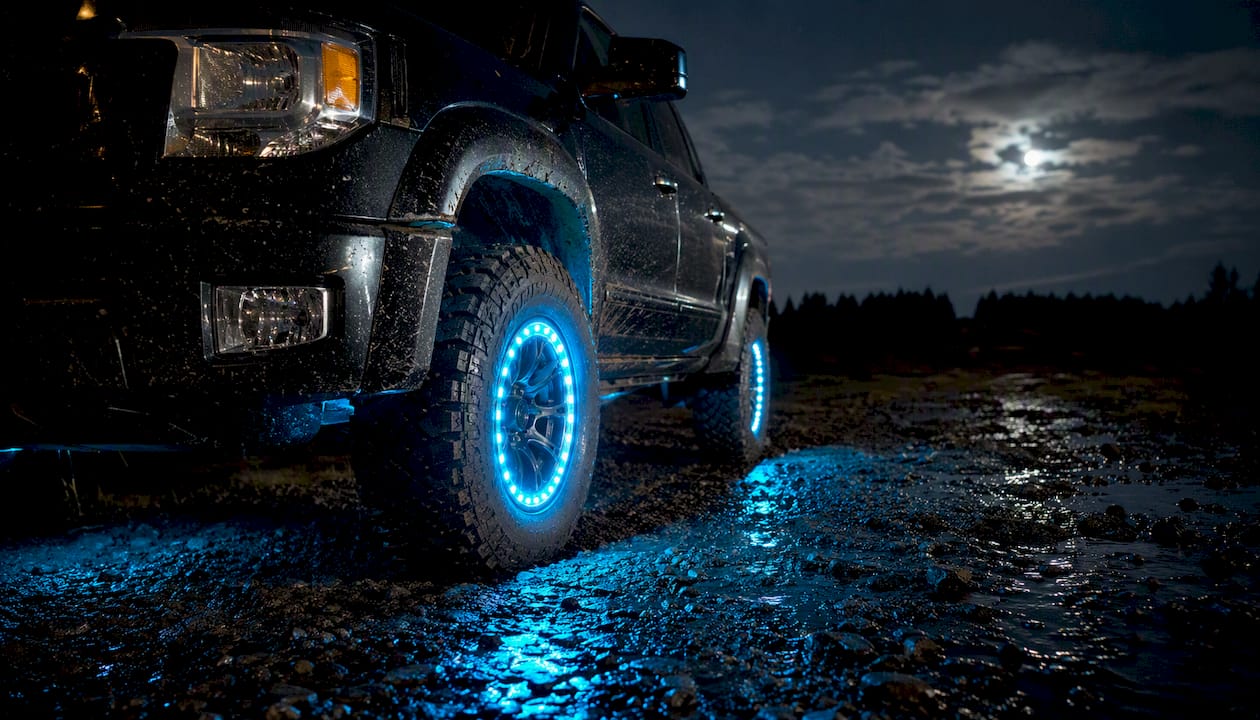
Show and custom builds: LED density and color range matter most here. RGB modes with remote control let you match lighting to the event or the build’s color scheme. The wheel lighting aesthetics guide on the Wheellightexpress site covers color selection and ring sizing for show applications. For mopeds and small-displacement bikes where wheel lighting is part of a broader LED build, a pre-lit platform like the ZINGER 200 moped shows how factory LED integration can inform aftermarket choices.
How Wheellightexpress compares among U.S.-designed waterproof wheel light brands
The U.S.-designed automotive wheel lighting segment is smaller than the generic import market, and that is precisely the point. Brands that design domestically tend to publish more specific technical documentation, offer clearer warranty terms, and provide fitment support that generic listings cannot match.
Wheellightexpress stands out in this segment for three reasons. First, every product is designed in Louisiana, which means the engineering decisions (connector sealing method, harness gauge, ring diameter options) reflect actual U.S. vehicle fitment requirements rather than generic global specs. Second, the product line is purpose-built for automotive use, covering trucks, SUVs, and off-road vehicles with double-row high-density rings and proprietary harness systems. Third, the satisfaction guarantee and financing options lower the purchase risk for buyers who want quality without a large upfront commitment.
Generic import listings on large marketplaces frequently omit IP ratings, list no warranty terms, and offer no replacement parts. When a connector fails six months after installation, there is no harness replacement to order and no support contact to call. That gap is where U.S.-designed products with documented specs and domestic support consistently outperform the cheaper alternative.
For truck owners who want custom rim upgrades alongside their lighting build, aftermarket accessories like custom rim and tint upgrades can complement a Wheellightexpress ring installation by giving the full wheel assembly a cohesive custom look.
An honest take on what actually matters when buying wheel lights
There is a tendency in automotive lighting content to treat IP ratings as the whole story. They are not. IP ratings describe a controlled lab test. They say nothing about how a product handles the combination of centrifugal force, road vibration, thermal cycling between cold nights and hot brake rotors, and road salt that a wheel-mounted light experiences over a full year of driving.
The connector is where most products fail, not the LED strip itself. A strip potted in silicone and sealed at the factory will outlast a strip with a rubber-gasketed connector that loosens after six months of vibration. When we evaluate wheel lighting products, connector sealing method is the first thing we look at after the IP rating, because it predicts real-world durability better than any single spec.
The other underrated factor is replacement part availability. A kit that costs $40 more upfront but offers replacement strips and harnesses is a better long-term investment than a cheaper kit where the entire assembly must be replaced when one component fails. Wheellightexpress’s approach of offering replacement strips and harnesses as separate purchases reflects an understanding of how these products actually age in service.
For buyers who are primarily motivated by aesthetics, the LED density and color uniformity of a double-row ring versus a single-row strip is a more meaningful difference than the color mode count. A ring with 60 LEDs per foot produces a noticeably smoother glow than one with 30 LEDs per foot at the same brightness setting, and that difference is visible from across a parking lot.
Ready to order from Wheellightexpress? Here is what to know
Wheellightexpress offers U.S.-designed wheel light rings and strips built for trucks, SUVs, and cars, with a satisfaction guarantee and financing options that make the full kit accessible without paying everything upfront.
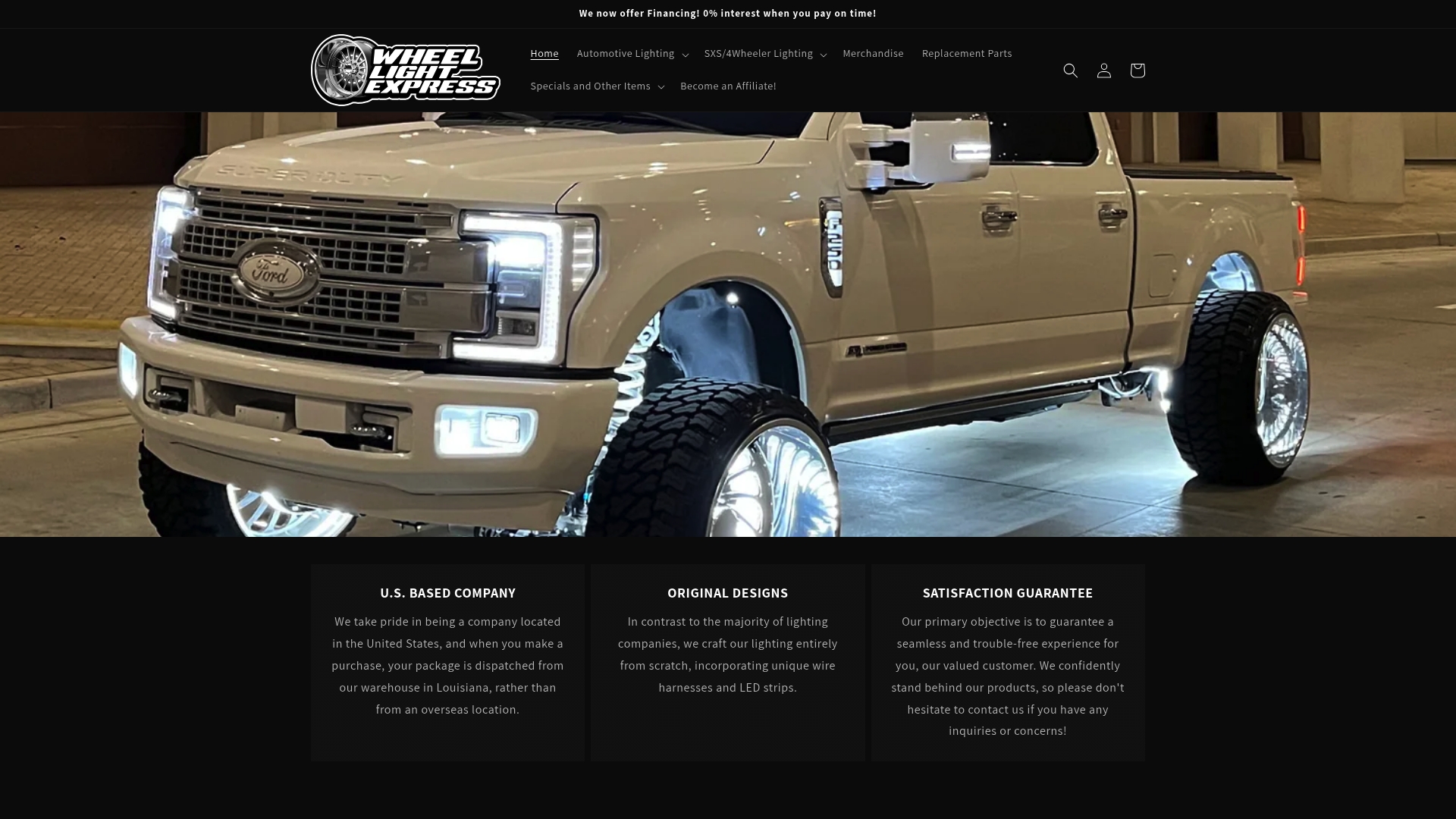
When you place your order, confirm three things: the correct ring diameter for your wheel size, the matching wire harness leads for your vehicle’s electrical system, and whether you want to add a replacement strip to your order now rather than waiting until one is needed. The product pages list fitment specs clearly, and the support team can answer fitment questions before you check out. Visit Wheellightexpress to browse the full catalog and find the kit that fits your build.
Sources
Before finalizing any purchase, verify these resources directly:
When reviewing any product page, look for: the IP rating stated as a number (not just “waterproof”), a description of the sealing method, installation photos showing the product on an actual vehicle, and warranty terms that specifically address water ingress.