

If you think customizing your car’s lights means pulling out the old bulb and pushing in a new one, you’re missing most of the picture. Car lighting customization basics cover a lot more ground than that, touching on electrical compatibility, beam optics, legal compliance, and design choices that affect both safety and style. Get it wrong, and you’re looking at dashboard error codes, blinding oncoming drivers, or a citation from law enforcement. Get it right, and you have a vehicle that looks exactly the way you want and performs better after dark.
Table of Contents
- Key takeaways
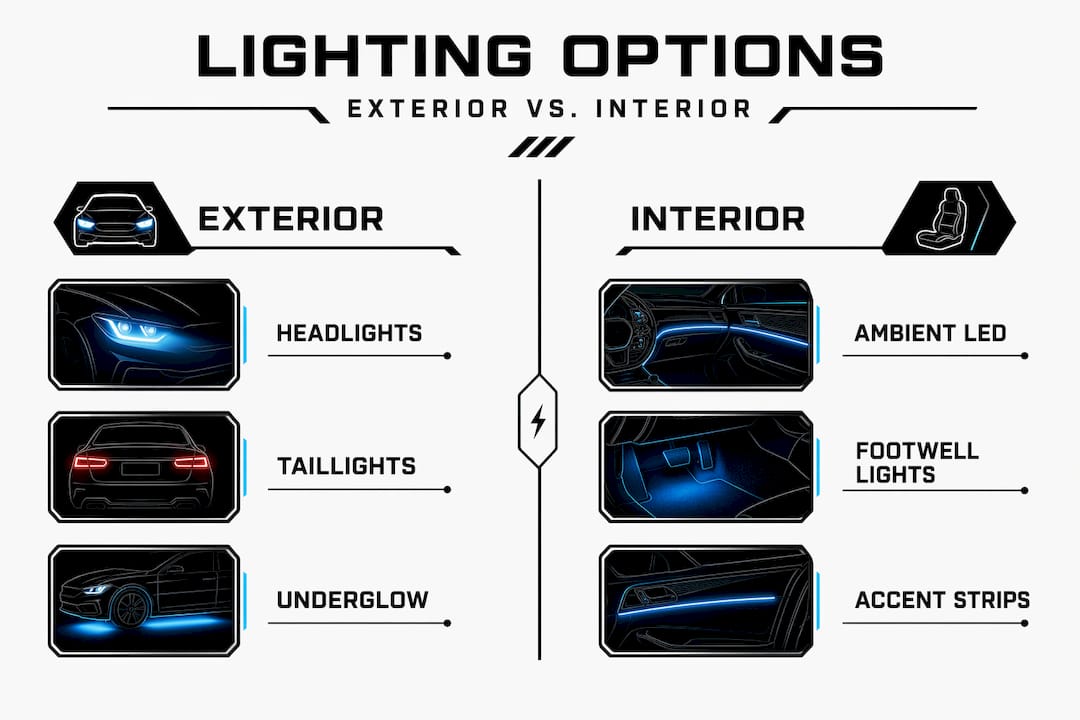
- Car lighting customization basics: types and options
- Legal considerations you cannot ignore
- Technical selection and installation basics
- Interior and accent lighting for style and function
- Maintenance, upgrades, and avoiding common mistakes
- My honest take on getting this right
- Get started with Wheellightexpress
- FAQ
Key takeaways
| Point | Details |
|---|---|
| Legality matters first | Many aftermarket LED drop-in bulbs are not street legal; certified replacement housings are the compliant choice. |
| Beam pattern beats brightness | Optical control and proper beam cutoff protect other drivers and keep you legal. |
| Electrical compatibility is critical | CANBUS vehicles need LED-specific products to prevent flickering and dashboard warning lights. |
| Wiring safety prevents fires | Always use a relay and fuse near the battery for any auxiliary or accent lighting install. |
| Accent lighting has legal limits | Underglow and exterior accent colors are regulated by state law; check local rules before installing. |
Car lighting customization basics: types and options
Before you buy anything, you need to know what you’re working with. Automotive lighting breaks down into several categories, and each one has its own customization path.
Here’s a quick look at the main lighting types and how they’re typically upgraded:
| Lighting type | Common customization methods | Complexity level |
|---|---|---|
| Headlights | Bulb swap, complete housing replacement | Medium to high |
| Fog lights | Bulb swap, housing upgrade | Low to medium |
| Brake and tail lights | LED bulb swap, full LED assembly | Low to medium |
| Turn signals | LED bulb swap, resistor addition | Low |
| Interior ambient | LED strip kits, dome light swaps | Low |
| Underglow and accent | LED strip kits, puddle lights | Low to medium |
The simplest upgrades are interior and accent lighting. You’re dealing with low-voltage strips, easy tap connections, and no beam optics to worry about. Exterior lighting like headlights and fog lights is a different story. The complexity jumps significantly once you get into anything that affects how your car is seen by other drivers or how well you see the road.
Popular upgrade categories include:
- Bulb replacements: Swapping halogen bulbs for LED or HID alternatives in existing housings
- Full housing upgrades: Replacing the entire headlight or tail light assembly with an aftermarket unit
- Accent and underglow kits: Adding LED strips under the body, in wheel wells, or around interior panels
- Puddle lights: Upgrading door-mounted lights with LED puddle lights for both function and style
Each path carries a different level of effort, cost, and legal exposure. Knowing which category you’re in before you spend money saves a lot of headaches later.
Legal considerations you cannot ignore
This is the section most beginner guides skip, and it’s the one that gets people in trouble. The United States regulates automotive lighting through Federal Motor Vehicle Safety Standard 108 (FMVSS 108), and individual states layer additional rules on top of that.
Here’s what catches people off guard: LED headlights are only legal when they come as original factory equipment or as complete certified replacement housings. That cheap LED drop-in bulb you found online for $20? Technically not street legal in most cases, even if the product listing says otherwise.
The core issues with non-compliant setups include:
- Glare to other drivers: Drop-in LED bulbs fail to replicate the filament position of halogens, scattering light in uncontrolled directions
- Color temperature violations: Many states restrict headlight color to white or selective yellow; blue-tinted bulbs above 6,000K are frequently flagged
- Brightness limits: Lumens and candela output are regulated; brighter does not always mean legal
- Positioning rules: Accent and auxiliary lights must not be positioned where they could be mistaken for emergency vehicle lighting
- Exterior accent color restrictions: Red and blue exterior lights are almost universally prohibited for non-emergency vehicles
Pro Tip: Before purchasing any aftermarket lighting, search your state’s DMV or motor vehicle code for specific color and brightness restrictions. Rules vary significantly from state to state, especially for accent and underglow lighting.
DOT-compliant housings carry a stamp of certification. That stamp is your proof that the product meets federal standards for beam pattern, brightness, and durability. It’s the safest way to upgrade your headlights without legal risk.
Technical selection and installation basics
Choosing the right product is half the job. Installing it correctly is the other half. Both require understanding a few technical concepts that most beginners overlook.
-
Match your bulb to your housing. Not all LED bulbs work well in all halogen housings. The housing’s reflector and projector optics are designed around a specific filament position. Some LED bulbs have adjustable clamp rings that let you fine-tune diode position to better align with the housing’s focal point, which meaningfully improves beam quality.
-
Understand color temperature. For daily driving, the sweet spot is 4,000K to 5,000K. This range produces clean white light with strong visibility. Going above 6,000K adds a blue tint that can actually reduce contrast in rain or fog.
-
Check your vehicle’s electrical system. Modern vehicles, especially post-2010 models, often use CANBUS systems that monitor circuit load. CANBUS-incompatible LEDs trigger flickering and dashboard error lights because the system detects abnormal resistance. Buy LEDs labeled as CANBUS-compatible or add load resistors to solve this.
-
Use quality LED assemblies with proper heat management. Good LED bulbs use aluminum heat sinks and regulated power drivers. Cheap units overheat, fail early, and sometimes cause wiring damage.
-
Wire auxiliary lights correctly. Any auxiliary or accent light needs its own relay and fuse wired near the battery. Running high-draw lights through the vehicle’s dashboard wiring can overload the circuit and create a fire risk.
-
Aim your headlights after installation. Headlight misalignment is one of the most common problems after an upgrade. Even a few degrees off center reduces your forward visibility and can blind oncoming drivers. Use a wall at 25 feet to check your beam height, or take the vehicle to a shop for professional aiming.
Pro Tip: For a clean, safe wiring foundation on any lighting install, a replacement wire harness designed for your specific setup eliminates the guesswork and protects your vehicle’s electrical system.
The automotive LED lighting guide from Wheellightexpress covers specific product types and compatibility notes worth reviewing before you finalize your choices.
Interior and accent lighting for style and function
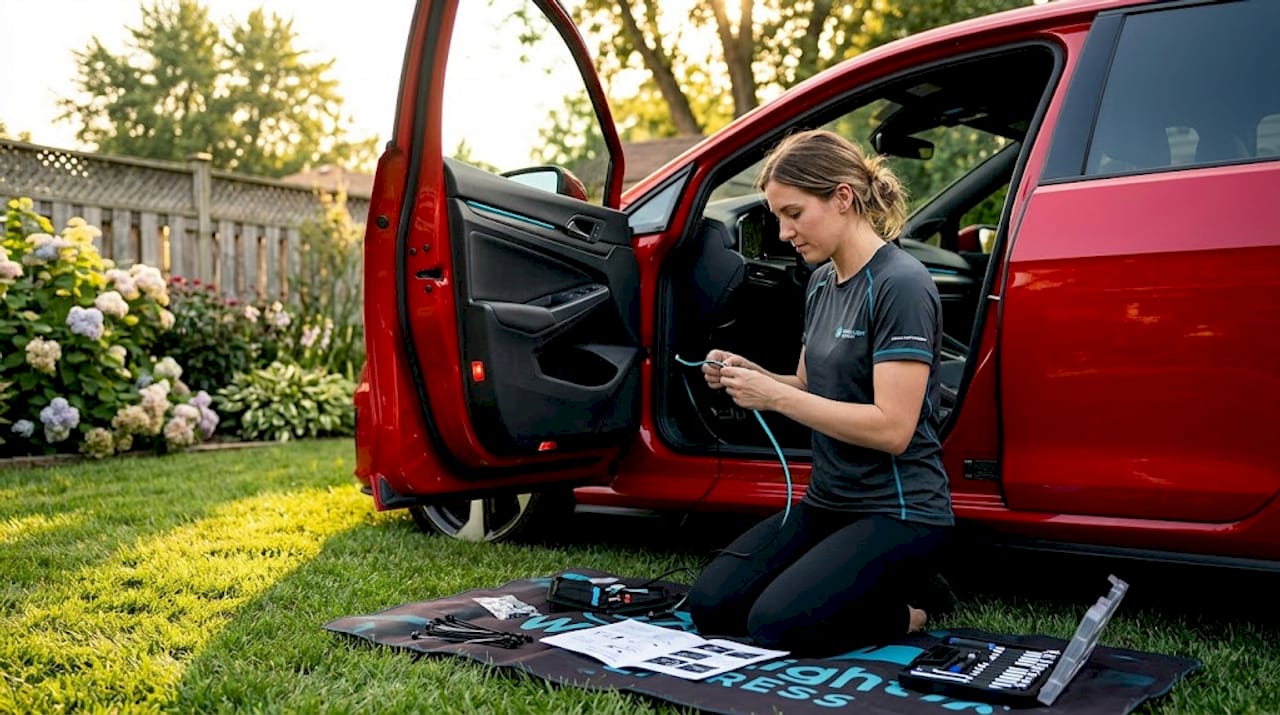
Interior and accent lighting is where most enthusiasts start, and for good reason. The installs are more forgiving, the products are more affordable, and the visual payoff is immediate.
Popular options in this category include:
- Footwell LED strips: Tucked under the dash, these cast soft color onto the floor without creating glare or distracting the driver
- Ambient door and panel lighting: Thin LED strips that trace door panels or center consoles, often controllable via app or remote
- Dome and map light upgrades: Simple LED swaps that produce brighter, cleaner white light compared to stock incandescent bulbs
- Underglow kits: LED strips mounted under the chassis for ground-level color effects, highly popular at car shows
- Puddle lights: Door-mounted lights that project onto the ground when you open the door, combining function and style
The interior lighting accessories segment is growing at 8 to 10% annually, driven by consumer demand for personalized, ambient interiors. RGB color-changing strips with smartphone app control are now standard offerings at multiple price points.
That said, exterior accent colors carry legal risks. Red and blue should never appear on non-emergency vehicles when the car is in motion. Amber and white are generally the safest choices for exterior accents. Underglow is legal in many states but restricted or outright banned in others. Always verify local laws before you install anything on the exterior.
Glare management matters indoors too. Mounting LED strips directly in the driver’s sightline or reflecting them off the windshield creates distraction. Diffused strips and indirect mounting channels solve this cleanly.
Maintenance, upgrades, and avoiding common mistakes
A well-installed lighting setup takes minimal ongoing maintenance, but there are a few things worth doing consistently.
Inspect and clean regularly. Oxidized headlight lenses scatter light and reduce output dramatically. Clean them with a dedicated restoration kit every year. For LED strips and accent lights, check adhesive bonds and connector points for corrosion, especially on exterior installs.
Know when to upgrade your wiring. If you’re adding multiple lighting accessories, the factory wiring may not be rated for the additional load. Upgrading to a dedicated aftermarket harness keeps your installation safe and reduces the chance of intermittent failures.
Common beginner mistakes that cost people money and frustration:
- Buying the cheapest LED bulbs available. Low-cost units often skip proper heat sinks and drivers, leading to early failure and sometimes electrical damage.
- Ignoring beam pattern. Raw lumen numbers look impressive in a spec sheet. What actually matters is beam pattern and optical control, which directs light where it’s useful and keeps it off oncoming drivers’ eyes.
- Skipping the aiming step. Many people finish an install without ever checking beam height. This single oversight accounts for a large percentage of post-upgrade complaints.
- Assuming “all LEDs are the same.” CANBUS compatibility, color temperature, and housing fit all vary by product and vehicle.
Pro Tip: If your new LEDs cause dashboard warning lights, start by checking CANBUS compatibility before assuming a defective product. Adding a set of load resistors matched to your bulb’s wattage often resolves the issue in under 30 minutes.
Troubleshooting flickering is straightforward once you understand the cause. Flickering on CANBUS vehicles is almost always a resistance mismatch. Flickering at startup that clears up is usually a power regulation issue with cheap LED drivers. Persistent flicker on non-CANBUS vehicles often means a loose ground connection.
My honest take on getting this right
I’ve watched a lot of enthusiasts make the same sequence of mistakes. They buy the brightest LED kit they can find, skip the legal research, install everything in an afternoon, and then spend the next two months dealing with error codes, headlight tickets, or poor visibility they can’t explain.
The core problem is that most car lighting upgrades are sold on brightness and aesthetics without any mention of the technical and legal layer underneath. I get why. Brightness sells. But in my experience, the builds that actually satisfy people long-term are the ones where beam pattern and compliance were treated as non-negotiable before anything else.
What I’ve learned is that electrical compatibility is becoming more important, not less. As vehicles get more sophisticated, the margin for incompatible components shrinks. A CANBUS error in a 2012 truck is a minor annoyance. The same error in a 2024 vehicle with integrated driver-assist systems can cascade into something much more disruptive.
Interior ambient lighting is genuinely a great entry point. The risk is low, the legal exposure is manageable, and the results are visible immediately. If you want to work your way up to headlight upgrades, start there, build your confidence with wiring and connectors, and then approach the more technical exterior work with a solid foundation.
The enthusiasts I respect most aren’t the ones with the brightest setups. They’re the ones whose builds look great, pass inspection, and still work perfectly two years later.
— Christopher
Get started with Wheellightexpress
When you’re ready to move from research to real hardware, Wheellightexpress has you covered. Every product in the aftermarket lighting collection is designed in Louisiana with a focus on quality, originality, and legal compliance. You won’t find generic overseas sourced kits here. You’ll find purpose-built lighting solutions backed by a satisfaction guarantee.
Whether you’re starting with interior LED strips, looking for replacement wire harnesses, or upgrading exterior accent lights, Wheellightexpress offers financing options that make quality accessible without waiting. Browse the full catalog, find products matched to your vehicle, and reach out to the team with any compatibility questions. Quality lighting doesn’t have to be complicated or expensive.
FAQ
Are aftermarket LED headlight bulbs street legal?
In most cases, no. LED headlights are legal only as original factory equipment or complete DOT-certified replacement housings. Drop-in LED bulbs installed in halogen housings are technically non-compliant under FMVSS 108.
What color temperature is best for driving visibility?
The recommended range is 4,000K to 5,000K for daily driving. Color temps above 6,000K introduce a blue tint that reduces visibility in rain and fog.
Why do my new LED lights flicker or trigger warning lights?
CANBUS systems interpret LED bulbs as circuit faults due to low resistance. Using CANBUS-compatible LEDs or adding load resistors matched to your bulb’s wattage resolves this in most cases.
Is underglow lighting legal?
It depends on your state. Underglow is legal in many states but banned or heavily restricted in others, particularly when it involves red or blue colors. Always check your local vehicle code before installing any exterior accent lighting.
How do I check if my headlights are aimed correctly after an upgrade?
Park 25 feet from a flat wall in the dark and mark the center of each beam on the wall. The beam centers should sit at or slightly below the headlight height of your vehicle. If they’re off, adjust the aiming screws on the housing or have a shop set them professionally.