
Off-road lighting durability comes down to four engineering factors: housing material and structure, ingress protection at both the housing and the connectors, thermal management inside the fixture, and mounting hardware built to resist vibration. A light engineered around all four typically runs 30,000 to 50,000 hours before real output loss. Before you buy, check three things on the spec sheet: the IP rating (housing and connector, listed separately), the housing alloy, and how long the warranty actually runs.
TL;DR:
- Off-road light durability depends heavily on housing material, with die-cast aluminum and thicker walls providing better resistance to impacts and vibration.
- An IP67 rating is the minimum to consider; higher ratings like IP68 or IP69K are necessary for frequent mud, water, or pressure wash exposure.
- Effective thermal management using copper-core boards and proper thermal interface materials can extend LED lifespan beyond 30,000 hours.
- Mounting hardware should be reinforced and vibration tested to SAE J1455 standards to prevent failure from repeated trail shocks.
- Connectors are often the weakest link; waterproof, properly sealed, and strain-relieved wiring prolongs system reliability more than housing ratings alone.
Table of Contents
- Housing Materials and Mechanical Construction That Hold Up
- What Does an IP Rating Actually Protect Against Off-Road?
- Thermal Management and Realistic LED Lifespan
- Mounting Hardware, Vibration Resistance, and Fatigue
- Wiring, Connectors, and the Weak Link in the System
- Maintenance Habits That Extend Service Life
- How to Read Lumen Claims and Warranty Fine Print
- Why This Matters From the Workbench, Not Just the Spec Sheet
- Standards and Guides Worth Checking Before You Buy
- Get Lighting Built Around the Parts That Actually Fail First
- Sources
Housing Materials and Mechanical Construction That Hold Up
Housing material sets the ceiling for every other durability factor. A well-built off-road light starts with die-cast aluminum, usually ADC12 or A380 alloy, because it dissipates heat and shrugs off rock strikes better than injection-molded plastic. Wall thickness matters more than most buyers realize. Thin castings crack at mounting points long before the LED itself fails.
Lens material is the next decision point, and it’s a real tradeoff:
- UV-stabilized polycarbonate with a hard coat resists impact well and won’t shatter on a rock strike, but cheaper versions yellow and haze under years of UV exposure.
- Tempered glass holds optical clarity longer and scratches less, but it’s more prone to cracking from direct impact.
- Stainless steel hardware at brackets and stress points prevents the corrosion that turns a stuck bolt into a snapped mount.
You can verify most of this without a lab. Ask the seller for the specific alloy designation, not just “aluminum,” and look for a stated wall thickness around the mounting bosses. Vague answers here usually mean the housing wasn’t engineered with vibration in mind. Some manufacturers design and assemble their housings domestically, which may be worth asking about when a competing product can’t name its own alloy grade.
What Does an IP Rating Actually Protect Against Off-Road?
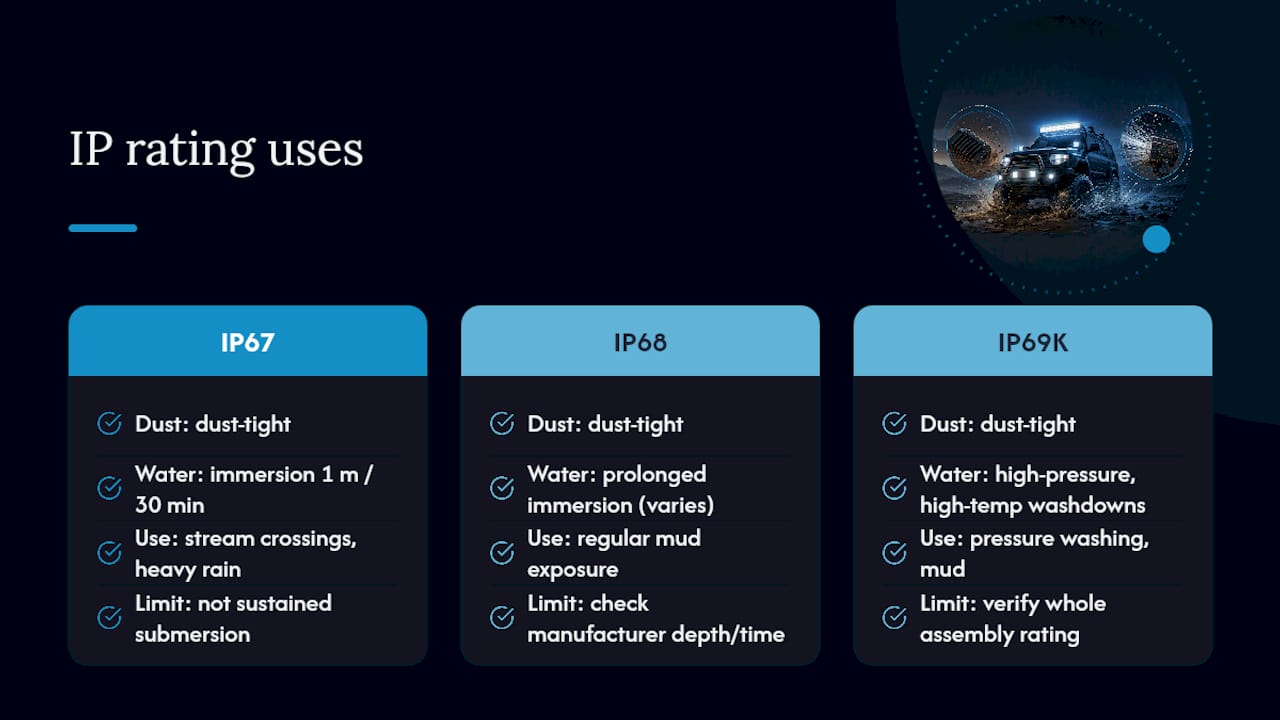
An IP67 rating is the practical minimum for serious trail use. IP67 means the housing is dust-tight and can survive brief immersion, up to one meter for 30 minutes, which covers stream crossings and heavy rain but not sustained submersion. If you’re running rock lights that regularly sit in mud or take a pressure washer, look for IP68 or IP69K, since IP69K specifically adds resistance to high-pressure, high-temperature washdowns.
The rating on the housing box tells you less than most buyers assume. IP67 is commonly recommended for off-road use, but that rating only applies to the sealed housing tested in a lab, not necessarily to the connector hanging off the back of it.
A light rated IP67 with an unrated pigtail connector is only as waterproof as its weakest seal.
Ask for third-party test certificates, not just a marketing claim on a product page. Then check whether the connector and cable entry carry their own separate rating. A common failure mode is gasket compression, where the rubber seal flattens out after repeated heat cycling and vibration, leaving a gap that lets moisture creep in over months rather than failing all at once.
Thermal Management and Realistic LED Lifespan
Heat, not miles, is what kills LED lighting early. High-quality fixtures are engineered for a 30,000 to 50,000-hour service life, but that number only holds if the heat generated at the LED junction gets pulled away efficiently. Thermal management is widely considered the single most predictive factor for how long a light actually lasts in harsh conditions, more predictive than the lumen count on the box.
Copper-core MCPCBs (metal-core printed circuit boards) pull heat away from the LED junction faster than standard aluminum boards, and that difference compounds over thousands of hours of use.
Copper-core boards and proper thermal interface material can meaningfully lower junction temperature compared to aluminum boards, and that lower operating temperature is what preserves lumen output over the fixture’s life rather than letting it fade within the first year.
Ask a supplier for the junction temperature at maximum drive current in a 40°C ambient environment. That single figure separates an engineered thermal design from a light that just looks good on a spec sheet. Also ask about the driver: constant-current drivers with a wide input voltage range handle the voltage swings common in off-road electrical systems far better than cheap linear drivers. Realistically, expect the high end of that hour range only when heat and moisture are both controlled. Off-road stress, vibration, dust intrusion, thermal cycling from cold starts to hot runs, shortens that lifespan faster than steady-state use ever would.
Mounting Hardware, Vibration Resistance, and Fatigue
Mounting failures show up more often in the field than LED failures do, and they’re almost always preventable.
- Choose brackets with reinforced mounting bosses and stainless hardware. Cheap zinc bolts corrode and lose clamping force within a season or two.
- Look for products tested against SAE J1455, the vibration testing standard for heavy-duty vehicle equipment. It’s a meaningful benchmark for whether a light was engineered for sustained off-road shake rather than just a lab drop test.
- Torque mounting bolts to spec rather than “snug.” Under-torqued hardware works loose under vibration; over-torqued hardware cracks the casting around the boss.
- Inspect mounts after any heavy trip. Look specifically at the mounting interface wall thickness area for hairline cracks, since that’s where fatigue shows up first.
Guidance on keeping voltage drop under 3% when mounting a light bar is also worth following, since poor mounting often goes hand in hand with poor wiring routing.
Wiring, Connectors, and the Weak Link in the System
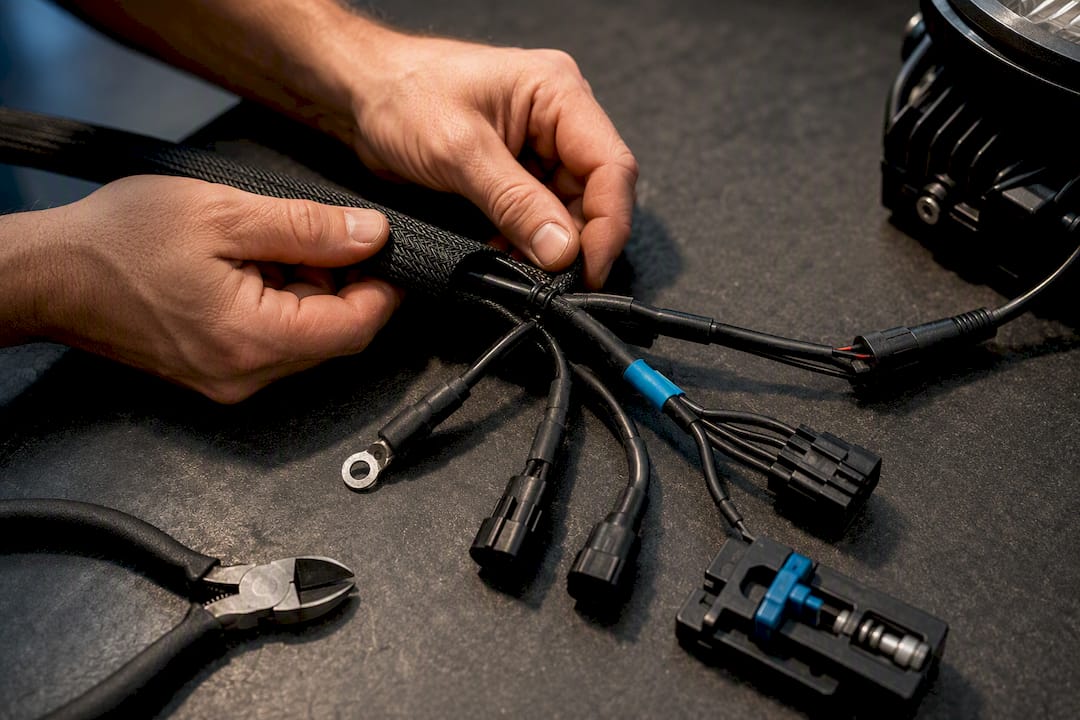
Connectors fail more often than the LEDs they power. A housing rated IP68 means nothing if the pigtail feeding it isn’t rated to match. Look for crimped waterproof connectors, proper heat-shrink with adhesive lining, and real strain relief where the cable exits the housing, not just a bare wire hole.
- Ask for the IP rating of the cable entry point specifically, separate from the housing rating.
- Favor integrated sealed glands or potted cable entries over add-on grommets.
- Confirm the harness is properly fused and sized to keep voltage drop low, since sustained voltage drop stresses the driver and shortens its life.
Pro Tip: Pull back the heat-shrink on any connector you’re inspecting and look for corrosion or green oxidation on the crimp. That’s the earliest visible sign of a seal that’s already failing, often months before you’d notice a flicker.
A harness engineered for the environment it’s running in, rather than a generic universal adapter, is one of the cheaper upgrades that meaningfully extends the life of an otherwise well-built light.
Maintenance Habits That Extend Service Life
A durable light still needs periodic attention, especially after hard use.
- Check lens clarity for haze or micro-cracking every few months, and after any rock strike.
- Press gently on housing gaskets to check for compression or hardening; a gasket that’s lost its give is no longer sealing properly.
- Re-torque mounting hardware after washboard roads or heavy trail runs.
- Inspect wiring for abrasion anywhere it passes near moving suspension components or sharp frame edges.
- If you have access to a thermal camera or infrared thermometer, spot-check driver temperature periodically, since a driver running hotter than usual often signals a failing thermal path.
Pressure washing deserves a caution: only units rated IP69K are built for high-pressure, high-temperature washdowns. Hitting a lower-rated fixture with a pressure washer can force water past seals that were never tested for that kind of pressure. When gaskets do show compression or cracking, reseal or replace them before the next wet trip rather than after water intrusion shows up as a flickering light.
How to Read Lumen Claims and Warranty Fine Print
Raw lumen numbers on a box are the least reliable spec on it. A photometric report showing lux or candela at a specified distance, taken under stated test conditions, tells you far more about real-world throw and spread than a marketing lumen figure alone.
- Ask what ambient temperature and drive current were used to generate the “50,000 hour” claim, since that number means little without the test conditions behind it.
- Compare warranty length against what it actually covers. Many warranties exclude connector failure or “improper installation,” which conveniently covers the two most common failure points.
- A manufacturer willing to document IP68 protection and warranty terms clearly on the product page, rather than burying it in fine print, is generally more confident in its own build quality.
Longer warranties tend to correlate with better-engineered products, simply because a company won’t back a five-year warranty on a light it expects to fail in two.
Why This Matters From the Workbench, Not Just the Spec Sheet
Most durability marketing leans on a single flashy number, usually lumens or a headline IP rating, while glossing over the connector that’s actually going to fail first. That’s backwards. The mounting bracket and the pigtail connector cause more field failures than the LED chip itself, yet they get a fraction of the attention on most product pages.
Some lighting manufacturers build their products with a focus on wiring durability as part of the system design, rather than as an afterthought bolted on after the light itself was designed. That’s the piece most flexible LED strip failures actually trace back to: a strip or fixture that looked fine on paper but shipped with a connector nobody stress-tested.
If there’s one lesson from digging into IP codes, thermal specs, and vibration standards, it’s that durability is rarely one dramatic failure. It’s a slow accumulation of small compromises, a thinner wall here, an unrated pigtail there, that catch up with a light around month eight on the trail.
— Christopher
Standards and Guides Worth Checking Before You Buy
Verify claims against the DOE’s LED lighting facts program for lifespan basics, the IP rating and durability guide for ingress protection, and SAE J1455 documentation for vibration testing standards. These are references to check claims against, not endorsements of any single product.
Get Lighting Built Around the Parts That Actually Fail First
Certain companies design and assemble their lighting kits domestically, which may allow customers to ask direct questions about alloy grade, IP rating, and harness construction and get detailed answers rather than vague marketing lines. That matters most in the two places this guide flagged as the weak links: the housing seal and the connector behind it. Our wheel light ring and strip kits pair sealed housings with harnesses engineered for trail conditions, not repurposed from a generic parts bin.
If your current setup is failing at the connector rather than the LED, our replacement wire harnesses are built to the same sealing standard as our complete kits, so you’re not trading one weak pigtail for another. We also offer financing, so upgrading to gear built for the abuse you actually put it through doesn’t require paying the full cost upfront. Browse the current lineup and find the kit that matches your rig at Wheellightexpress.
Sources
- DOE: LED lighting facts (Solid‑State Lighting program)
- IP rating & durability guide: buying rugged LED off‑road spot lights — Carneon Lighting