

Stacking LED strips for extra brightness is the practice of layering two or more LED strip runs in parallel to multiply total lumen output across a vehicle’s lighting zones. The industry term for this approach is “parallel LED strip stacking,” and it works only when your wiring, LED type, and driver are all sized to match the combined load. Done right, you get a dramatic, uniform light output that single-strip installs simply cannot match. Done wrong, you get dim ends, color shifts, and overheated connectors. This guide covers every variable that separates a stunning result from a frustrating one, including voltage management, COB versus SMD selection, secondary optics, and controller calibration.
How do wiring and voltage strategies impact brightness in stacked LED strips?
Voltage drop is the dominant cause of uneven brightness and color shifts in stacked LED strips, more so than LED count or density alone. When you stack strips and double the current draw, resistance in your wiring multiplies the voltage loss at the far end of each run. The result looks like a power deficiency but is actually an engineering problem you can solve with the right wire gauge and feeding strategy.
Why 24V systems outperform 12V in stacked builds
A 24V system carries the same wattage at half the current of a 12V system. Lower current means lower resistive loss across the same wire, which means the LEDs at the end of your run receive voltage close to what the LEDs at the start receive. For automotive stacked builds, 24V over 12V is the practical standard because vehicle wire runs are long and connector resistance adds up fast. Keep your voltage drop below 3% across any single run to maintain consistent color and brightness.
Power injection and center-feeding explained
Center feeding halves electrical travel distance, which is the single most effective wiring change you can make on runs longer than 10 feet. Instead of powering your strip from one end, you run a feed wire to the midpoint and supply power in both directions. For stacked strips on a full vehicle underbody or door sill, this technique prevents the gradual dimming that makes one side of the car look noticeably different from the other.
| Strategy | Wire Gauge | Voltage Drop Reduction | Best For |
|---|---|---|---|
| Single-end feed, 18 AWG | 18 AWG | Baseline | Short runs under 5 ft |
| Single-end feed, 14 AWG | 14 AWG | Moderate | Runs up to 10 ft |
| Center-feed, 14 AWG | 14 AWG | Significant | Runs 10 to 20 ft |
| Center-feed, 12 AWG | 12 AWG | Maximum | Long stacked runs over 20 ft |
| Power injection at multiple points | 12 AWG | Maximum | Full vehicle underbody builds |
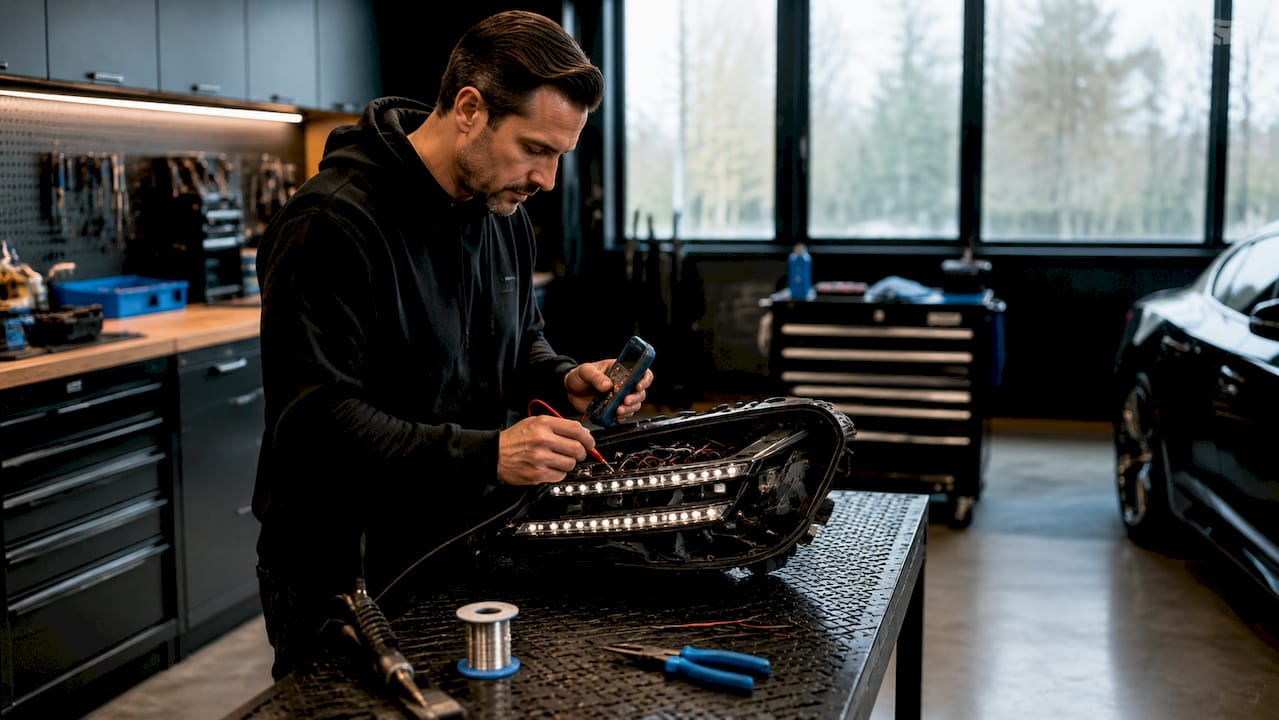
Pro Tip: Use a multimeter to measure voltage at both the start and end of each stacked strip run before finalizing your install. A reading difference greater than 0.36V on a 12V system signals a wiring problem that will show up as visible dimming under load.
What LED types and densities best support extra brightness in stacked strips?
COB LED strips distribute light evenly and often appear brighter than SMD strips with similar lumen ratings because of their dot-free continuous light line. A 900 lm/m COB strip looks brighter than a 900 lm/m SMD strip in most automotive viewing conditions, particularly at angles, because the eye perceives a continuous glow rather than a series of individual points. This matters enormously for wheel wells, door sills, and underbody lighting where the viewer rarely looks straight on.
SMD strips, particularly high-density 5050 or 2835 configurations, still have a place in stacked builds where raw lumen output is the priority over visual smoothness. The trade-off is heat. Higher LED density means more heat per linear foot, and in enclosed automotive channels, that heat has nowhere to go unless you use aluminum extrusion or a heat-sink backing.
Integrated chip strips like the aspectLED Endless™ use constant current technology to deliver up to 330 lumens per foot with no dim spots across runs up to 32 feet. That technology eliminates the traditional voltage drop problem at the LED level, making it a strong choice for stacked RGBW builds where color accuracy and brightness uniformity matter as much as peak output. For comparing lumen output across strip types before you buy, reviewing a side-by-side breakdown saves you from a costly mismatch.
| LED Type | Lumen Output | Visual Effect | Heat Level | Best Application |
|---|---|---|---|---|
| COB (Chip-on-Board) | 800 to 1000 lm/m | Smooth, dot-free | Moderate | Door sills, wheel wells |
| SMD 2835 High Density | 1000 to 1400 lm/m | Bright, slight dot pattern | Moderate to high | Underbody accent runs |
| SMD 5050 RGB | 600 to 900 lm/m | Vivid color, visible dots | High | Interior color effects |
| IC Addressable (WS2812B) | 400 to 700 lm/m | Dynamic effects | Moderate | Chase and animation effects |
| aspectLED Endless™ RGBW | Up to 330 lm/ft | Even, no dim spots | Moderate | Long uniform runs |
Pro Tip: In enclosed automotive channels, COB strips on aluminum-backed tape dissipate heat far better than bare SMD strips. If your channel runs hot to the touch after 20 minutes, you need either a thicker aluminum extrusion or a lower-density strip in that zone.
How can secondary optics and beam shaping improve effective brightness?
Advanced optical components yield more dramatic brightness improvements than simply increasing wattage or LED count. Secondary optics are lenses or reflectors placed over LED emitters to control where the light goes after it leaves the chip. In automotive applications, this means the difference between light that washes out in all directions and light that hits exactly the surface or zone you want to illuminate.
Dense optical arrays reduce light spill and increase directional intensity. A strip producing 800 lumens spread across a 120-degree beam angle delivers far less perceived brightness at any given point than the same 800 lumens focused into a 40-degree beam. For wheel well lighting or ground effects, tighter optics make the light feel significantly more intense without drawing any additional power from your vehicle’s electrical system.
Practical optical options for automotive LED strips include:
- Narrow-beam lens covers (30 to 40 degrees): Best for ground projection and puddle lighting where you want a defined pool of light beneath the vehicle.
- Wide-angle diffuser covers (120 degrees): Ideal for interior ambient lighting where even, shadow-free coverage matters more than intensity.
- Linear reflector channels: Aluminum extrusion with a reflective interior bounces light forward and outward, increasing perceived brightness on door sills and rocker panels.
- Frosted diffuser tape: Reduces hot spots on high-density SMD strips and creates a COB-like appearance at lower cost.
Pro Tip: For wheel well lighting, a 30-degree narrow-beam lens cover on a stacked COB strip produces a sharper, more dramatic arc of light than a bare high-density SMD strip at twice the wattage. Optics are the most underused tool in automotive LED builds.
What role do drivers and controllers play in managing brightness for stacked strips?
Dimmable drivers that adjust current at the semiconductor layer provide smoother dimming and brightness control compared to low-cost PWM dimmers on the low-voltage side. For stacked automotive LED setups, this distinction is practical. A cheap PWM dimmer running at low frequency produces visible flicker, especially on camera, which matters if you document your build or compete in car shows. A quality dimmable driver eliminates that flicker entirely.
Driver sizing is the other critical factor. When you stack two strips in parallel, you double the current draw. A driver rated for a single strip will overheat, throttle output, or fail outright when asked to power two. Size your driver to at least 120% of the combined wattage of all stacked strips on that circuit.
For addressable LED strips, brightness perception varies across lighting modes, and controller current limiting affects produced brightness differently in complex effects. A chase animation that lights only 30% of the LEDs at any moment draws far less current than a full-white static mode. Your driver must handle the peak draw, not the average. Calibrate your controller’s brightness ceiling per mode to avoid thermal stress during high-output static scenes.
Troubleshooting checklist for flicker and uneven dimming in stacked builds:
- Flicker at low brightness: Replace the PWM dimmer with a current-adjusting dimmable driver.
- Uneven brightness across two stacked strips: Check that both strips share the same power feed point and that connector resistance is equal on both runs.
- One strip dimmer than the other: Measure voltage at the end of each strip separately. A difference greater than 0.3V points to a wiring or connector resistance imbalance.
- Brightness drops under acceleration: Your vehicle’s alternator voltage fluctuates. Add a voltage regulator or use a driver with input voltage tolerance above 15V on a 12V system.
What are common mistakes when stacking LED strips for extra brightness?
The most common mistake in stacked LED strip builds is treating the project as a simple doubling of a single-strip install. Stacking strips without addressing voltage drop leads to end-of-strip dimming that looks like a power deficiency but is actually a wiring and connector resistance problem. Heavier gauge home-run wiring and power injection at multiple points are the fix, not a bigger driver.
Thermal management is the second most overlooked factor. High-density stacked strips in enclosed channels generate enough heat to degrade adhesive backing, reduce LED lifespan, and shift color temperature over time. Always mount stacked strips on aluminum extrusion or a metal surface that conducts heat away from the LEDs.
- Undersizing the driver: Calculate total wattage for all stacked strips, then add 20% headroom. A driver running at 100% capacity throttles brightness and fails early.
- Using mismatched strips: Stacking a 24V strip with a 12V strip on the same circuit produces uneven brightness and potential damage. Match voltage and LED type across all layers.
- Ignoring connector resistance: Each connector adds resistance. On a stacked build with multiple connectors per run, that resistance compounds. Solder connections wherever possible.
- Skipping optical control: Raw lumen output without beam direction produces washed-out, low-impact lighting. Add diffusers or reflector channels to direct the light where it creates the most visual effect.
- No temperature monitoring: After a 30-minute run, touch the strip backing. If it is too hot to hold for three seconds, your thermal management is inadequate.
Pro Tip: Run your stacked build at full brightness for 30 minutes before finalizing the install. Check strip temperature, measure end-of-run voltage, and inspect every connector. Problems that appear under sustained load are far easier to fix before the trim panels go back on.
Key takeaways
Stacking LED strips for extra brightness requires parallel wiring, matched LED types, proper driver sizing, and optical control to deliver uniform, high-intensity results across your vehicle.
| Point | Details |
|---|---|
| Voltage drop is the primary issue | Keep drop below 3% and use center-feeding or power injection on runs over 10 feet. |
| COB outperforms SMD visually | COB strips appear brighter at equal lumen ratings due to dot-free continuous light output. |
| Driver sizing must cover peak load | Size your driver to 120% of combined stacked strip wattage to prevent throttling and failure. |
| Optics multiply perceived brightness | Narrow-beam lens covers increase directional intensity without adding any wattage to the circuit. |
| Thermal management protects longevity | Mount stacked strips on aluminum extrusion to conduct heat away and preserve LED lifespan. |
What I’ve learned from real stacked LED builds in vehicles
The part that surprises most builders is how much voltage sag shows up in a vehicle that looks perfectly wired on paper. In automotive installs, wiring and connection resistance cause subtle voltage sag that reduces LED current at strip ends, mimicking brightness failures despite correct driver sizing and LED specs. I have seen builds where the driver was perfectly sized, the strips were high quality, and the end result still looked uneven because three inline connectors added enough resistance to drop 0.5V across a 10-foot run.
The builds that genuinely impress at car shows combine electrical discipline with optical thinking. A stacked COB strip in a reflector channel, fed from the center with 12 AWG wire, produces a result that looks like twice the hardware. The optics do work that extra wattage cannot. Quality dimmable drivers also make a real difference in dynamic builds. A smooth fade or pulse effect on a stacked strip looks intentional and polished. The same effect through a cheap PWM dimmer looks like a wiring problem.
My honest advice: spend as much time planning your wiring and optics as you spend choosing your strips. The strips are the visible part, but the wiring and driver are what determine whether the result holds up over time and looks consistent from every angle.
— Christopher
Upgrade your vehicle’s lighting with Wheellightexpress

Wheellightexpress designs every LED strip and wire harness in Louisiana, specifically for automotive enthusiasts who want original, high-quality results. If you are ready to build a stacked LED setup that delivers real brightness and holds up under daily driving conditions, our automotive LED lighting collection includes high-lumen strip options, purpose-built wire harnesses, and wheel light kits engineered for vehicle customization. Our Wheel Light Ring and Strip is built for brightness stacking with durable construction and compatibility with standard automotive power systems. We back every product with a satisfaction guarantee, and financing options mean you can build the setup you want without waiting.
FAQ
What does it mean to stack LED strips for extra brightness?
Stacking LED strips means running two or more strips in parallel on the same lighting zone to multiply total lumen output. Uniform brightness depends on matching voltage, wire gauge, and driver capacity to the combined load.
How do I prevent uneven brightness when stacking LED strips?
Keep voltage drop below 3% by using 24V systems, 12 to 14 AWG wire, and center-feeding power on runs longer than 10 feet. Solder connections instead of using inline connectors wherever possible.
Are COB or SMD strips better for stacked automotive builds?
COB strips appear brighter than SMD strips at equal lumen ratings because their continuous light line reads as more intense under angled viewing conditions common in vehicles. SMD strips offer higher raw lumen output but require better thermal management.
What driver size do I need for stacked LED strips?
Calculate the total wattage of all stacked strips on the circuit, then select a driver rated for at least 120% of that figure. Running a driver at full capacity reduces its lifespan and causes brightness throttling under sustained load.
Can I use addressable LED strips in a stacked build?
Yes, but brightness varies by lighting mode because controller current limiting affects output differently across effects. Size your driver for peak draw, which occurs during full-white or full-brightness static modes, not average draw across dynamic animations.