
Most U.S. states allow underglow lighting with real conditions attached. A handful ban it outright, and the wrong color or a flashing pattern can turn a simple equipment fix into a criminal charge. Before you flip a switch on public roads, check your state’s vehicle code and stick to the universal red flags: no red or blue, no flashing, and no visible diodes.
TL;DR:
- Most states restrict underglow to static white or amber colors when on public roads, with flashing modes and emergency colors mostly banned nationwide.
- Nearly every jurisdiction requires the underglow source to be concealed so only reflected glow is visible, reducing glare and distraction risks.
- Enforcement typically results in a fix-it ticket for equipment violations, but running red or blue lights intentionally can lead to misdemeanor charges of impersonation.
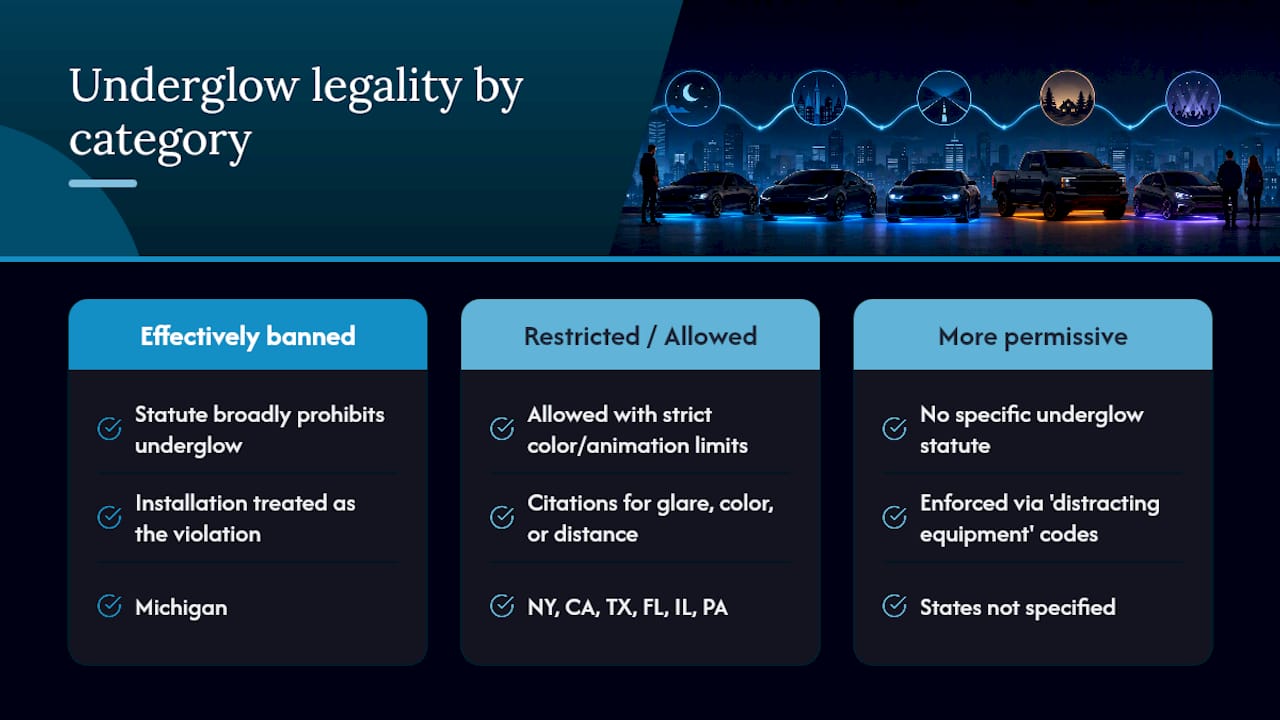
- Michigan outright bans underglow on public roads, while states like New York and California permit it under strict color and mode limitations.
- Installing a kill switch and proper concealment of diodes significantly lowers the risk of citations and ensures compliance in most states.
Table of Contents
- Underglow Laws USA: What “Underglow” Means Under State Statutes
- Why Underglow Gets Regulated in the First Place
- The Rules Almost Every State Shares
- Underglow Laws by State: Where It’s Banned, Restricted, or Allowed
- What Happens If You Get Pulled Over
- How to Keep Your Underglow Street-Legal
- Underglow at Car Shows, Tracks, and on Private Property
- Built in Louisiana, Designed for Compliance
- Why the Real Risk Isn’t the Law, It’s the Habit
- Sources
Underglow Laws USA: What “Underglow” Means Under State Statutes
Underglow refers to LED strips or neon tubing mounted beneath a vehicle’s frame, wired through a controller that lets you switch colors and patterns, often through an app or a wireless remote. Most kits sold today use flexible LED strips rather than glass neon tubes, but the statutes regulating them were mostly written decades ago with neon in mind. That older language, terms like “lighting device” or “auxiliary lighting,” still gets applied to modern RGB kits, so a strip that cycles through rainbow colors falls under the same rules as a 1990s neon tube kit.
You’ll sometimes see kits marketed with a “for off-road use only” or “for show use only” disclaimer. That label doesn’t exempt the product from state law once it’s mounted on a vehicle driven on a public road. It just shifts liability onto the installer and driver, not the manufacturer. Read your vehicle LED lighting setup’s documentation with that distinction in mind.
Why Underglow Gets Regulated in the First Place
Underglow rules exist mostly because of glare and confusion, not aesthetics. A bright strip reflecting off wet pavement at night can distract drivers behind or beside you, and colored light bouncing off a hood or a curb reads differently to the human eye than a steady headlight beam.
The bigger issue is color reservation. Red and blue are set aside for police, fire, and emergency vehicles in nearly every state, and a car flashing those colors, even accidentally, risks being mistaken for law enforcement. That’s the scenario legislators actually worry about. Combine that with public nuisance principles, which let local governments regulate disruptive lighting beyond what the state vehicle code covers, and you get a patchwork of statutes built around one goal: keeping decorative light from being mistaken for a signal that matters.
The Rules Almost Every State Shares
Despite the state-by-state variation, a few patterns hold up almost everywhere. FindLaw’s review of underglow statutes confirms that most states allow underglow only when the light source stays covered or unlit while you’re on public roads, and that flashing or emergency colors get flagged regardless of the state.
Here’s what shows up across nearly every code:
- Red and blue are off-limits almost everywhere, and some states also restrict amber or green depending on where the light sits on the vehicle.
- Flashing, rotating, or oscillating modes are banned on public roads in the vast majority of states, even when steady color isn’t.
- Visible diodes or tubes frequently draw citations on their own; the light needs to be concealed so only the glow reflecting off pavement is visible, not the source itself.
- Static white or amber is the safest default color combination in states without explicit underglow statutes.
Pro Tip: Wire a physical kill switch into your harness and label it “street legal.” Flip it before you leave your driveway, not after you spot a patrol car in your mirror.
If an officer flags your setup, the usual remedy is a citation ordering you to fix the equipment, not an arrest. But that assumes you’re running a compliant color and mode. Push past that line, and the consequences change fast, which the state breakdown below makes clear.
Underglow Laws by State: Where It’s Banned, Restricted, or Allowed
No federal law addresses underglow directly. LegalOverview’s analysis of state vehicle codes confirms that legality comes down entirely to state statutes, which typically classify underglow as “auxiliary lighting” and then attach conditions state by state. That leaves three rough categories.
States that effectively prohibit underglow
Michigan is the textbook example. MCL 257.698 restricts non-standard vehicle lighting broadly enough that decorative underglow on public roads is functionally banned, not just color-restricted. Enforcement there treats the installation itself as the violation, regardless of whether the lights are switched on.
A few other states take a similarly hard line, generally by listing permitted lighting colors and locations so narrowly that RGB underglow kits don’t fit anywhere in the code. If your state’s statute reads like an exhaustive list rather than a set of restrictions, assume underglow isn’t an option on public roads at all.
States that allow it, but only within tight limits
This is where most of the country lands. New York’s Vehicle and Traffic Law Section 375 is a good representative: white underglow is generally tolerated, but flashing, rotating, or emergency colored lights are explicitly banned. California, Texas, Florida, and Illinois follow a similar structure, permitting underglow but drawing hard lines around color and animation. Washington and Massachusetts add wording about glare and visibility distance, meaning even a compliant color can draw a citation if it’s bright enough to distract drivers at a distance.
Pennsylvania’s code leans on similar auxiliary lighting language, restricting colors visible from the front of the vehicle more tightly than colors visible only from below or behind. That front/rear distinction shows up in several states and often gets missed by installers who mount strips symmetrically without checking which color is legal at which position.
More permissive states
A smaller group of states either lacks specific underglow language or defers heavily to general equipment codes that don’t call out underbody lighting by name. That’s not a green light for red or flashing lights; it just means enforcement is more likely to hinge on general “distracting equipment” clauses rather than a dedicated underglow statute. Treat the absence of a specific law as ambiguity, not permission.
Because these categories shift as legislatures amend vehicle codes, verify your state’s current language directly. The California DMV and equivalent DOT and DMV sites in other states publish the actual equipment rules enforcement relies on, and that’s a more reliable source than a general web search.
What Happens If You Get Pulled Over
Most underglow citations start and end as equipment violations, similar to a cracked taillight lens. An officer writes what’s often called a “fix-it” ticket: correct the equipment, sometimes show proof to a court clerk or DMV office, and the citation gets dismissed. Fines for a first offense are typically modest compared to moving violations, though they climb with repeat citations in the same jurisdiction.
The risk escalates when color or behavior suggests impersonation. FindLaw notes that deceptive use, running red or blue lights that could be mistaken for a police vehicle, can shift a routine equipment stop into a misdemeanor charge in some states. That’s a meaningfully different outcome than a fine and a fix.
If you’ve been cited more than once for the same setup, or if an officer suggests the charge could involve impersonation, that’s the point to talk to a traffic attorney rather than just swapping a controller setting.
How to Keep Your Underglow Street-Legal
- Set a static, neutral default color, white or amber, and disable any show or rainbow mode before you leave private property.
- Mount your strips so the diode itself is hidden, letting only the reflected glow show on the pavement, not the light source.
- Use a proper harness and secure fasteners so nothing shifts loose and exposes wiring or diodes at speed.
- Install a labeled kill switch and get in the habit of flipping it to street-legal mode every time you pull off a lot or a show field.
- Confirm your state’s exact rules through your DMV or DOT site, and keep a printout or screenshot of the statute in your glovebox if you ever need to address a citation.
Pro Tip: Programmable RGB controllers make it easy to forget you left “show mode” running. Lock your controller’s default setting at the hardware level so switching back to legal white takes one motion, not a menu.
Following this order matters: color and concealment first, kill switch second, verification last. Skipping the switch is the single most common way compliant hardware turns into a citation anyway.
Underglow at Car Shows, Tracks, and on Private Property
Private property is where full-color, animated underglow is genuinely fair game in most states, since public vehicle codes generally stop applying once you’re off the public road. That said, HOAs and municipal nuisance ordinances can still limit it, particularly for lighting visible from neighboring properties at night, so check local zoning rules if you live somewhere with an active HOA. Car shows and closed tracks are the classic legal outlet for show modes. Just flip that kill switch back to your street-legal default before you pull back onto the road.
Built in Louisiana, Designed for Compliance
Wheellightexpress designs and assembles its lighting kits in Louisiana, not overseas, which means our harnesses and diffusers are engineered with U.S. mounting and concealment standards in mind from the start. Our wire harnesses and diffuser channels help keep diodes hidden, supporting the “concealed source” guidance most states expect. Every kit ships with our satisfaction guarantee, and financing options mean you don’t need to pay the full cost upfront to get street-legal hardware installed correctly the first time.
Pro Tip: Pair a concealed-mount diffuser with a hardware kill switch, and you’ve covered the two most common citation triggers in one install.
Why the Real Risk Isn’t the Law, It’s the Habit
The legal picture here is more forgiving than most owners assume. Underglow itself isn’t the problem in the vast majority of states; the problem is drivers who install a compliant white or amber kit and then leave the RGB show mode running out of habit. That’s a hardware and workflow failure, not a legal one, and it’s entirely preventable with a kill switch and a locked default color.
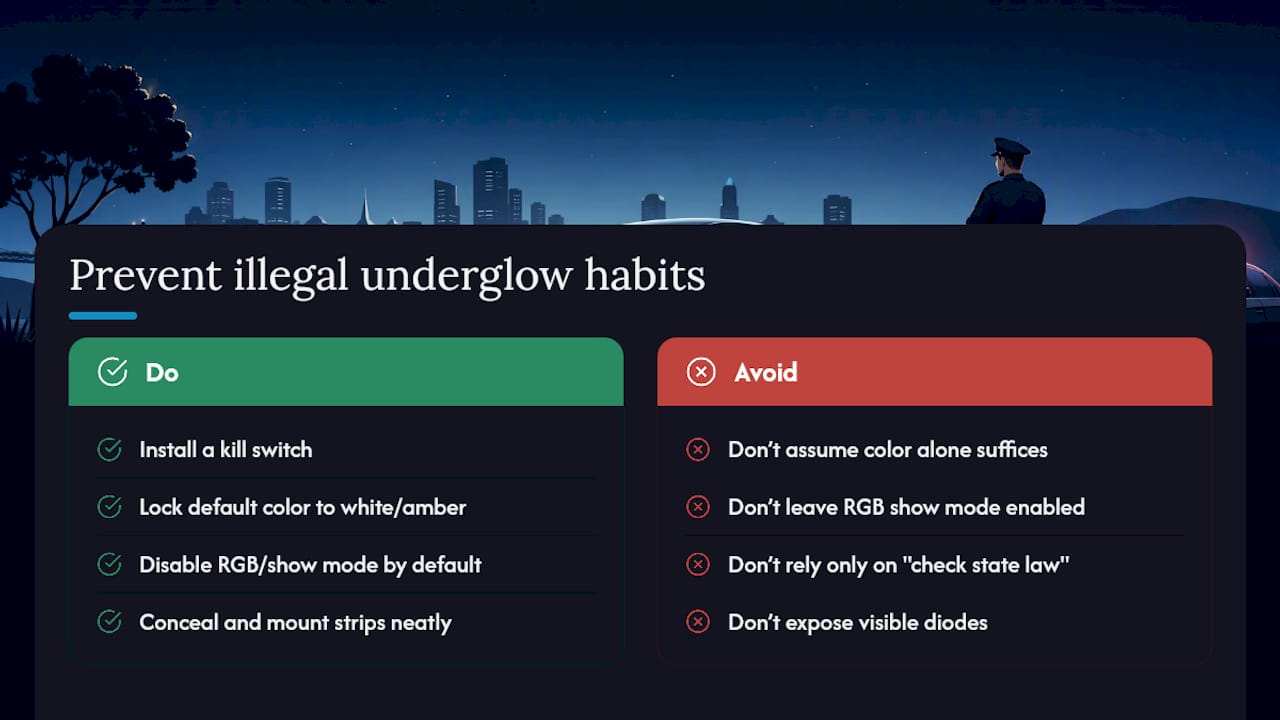
Where I’d push back on conventional advice: too many guides treat “check your state law” as the finish line, when installation quality matters just as much as color choice. A visible diode running perfectly legal white light can still draw a citation in some jurisdictions, while a well-concealed amber strip rarely does. Concealment and mounting discipline deserve equal billing with color compliance, and most articles on this topic bury that point.
If you take one thing from this, prioritize the kill switch. It’s the cheapest, fastest fix for the single most common way legal hardware turns into an illegal citation.
— Christopher
Sources
- Neon ‘Underglow’ Lighting Laws — FindLaw
- Is It Illegal to Have Lights Under Your Car 2026 — LegalOverview
- Michigan Compiled Laws §257.698
- Public nuisance — Cornell Legal Information Institute