
Wheel lights are conditionally legal in the United States. You can install and use them in many situations, but driving on public roads with them illuminated is where state law draws the line. As state laws vary widely, what is fine in one state can earn you an equipment citation in the next.
Quick-scan summary:
- Allowed in most contexts: parked display, private property, closed-course events, and car shows
- Commonly restricted on public roads: red or blue colors, flashing or strobing patterns, and any placement that obscures turn signals or reflectors
- Federal floor: NHTSA’s FMVSS No. 108 prohibits aftermarket lamps that impair required lighting by brightness, color, location, or activation pattern — this applies in every state
Key Takeaways
Wheel lights are conditionally legal in the U.S.: your state’s vehicle code, your color choice, and whether the lights are on while driving determine whether you’re compliant or facing a citation.
| Point | Details |
|---|---|
| Check your state code first | State vehicle codes vary widely; search for “auxiliary lamps” or “underglow” in your state’s statute database. |
| Avoid red, blue, and flashing patterns | These colors and activation modes are restricted on public roads in virtually every U.S. state. |
| Turn lights off in traffic | Operating lights while driving draws enforcement; having them installed while parked is usually legal. |
| Keep OEM lamps unobstructed | Any mount that blocks a turn signal, reflector, or brake light is a violation regardless of color. |
| Wheellightexpress kits are U.S.-designed | Steady-burn modes, white/amber palettes, and clean harness routing reduce legal risk at every stage. |
Table of Contents
- How wheel lights legal USA rules actually work: federal vs. state authority
- Which colors and placements draw the most legal attention
- How to check your specific state law before you install
- How law enforcement typically handles wheel lights
- A practical compliance checklist for staying street-legal
- When wheel lights are fully legal: shows, private property, and events
- What to do if you’re stopped or cited for wheel lights
- Our perspective on designing wheel lights that stay street-legal
- Compliant wheel lighting options from Wheellightexpress
- Sources
How wheel lights legal USA rules actually work: federal vs. state authority
Two layers of law govern aftermarket lighting in the U.S., and understanding both saves you from a ticket.
At the federal level, NHTSA’s interpretation of FMVSS No. 108 sets the baseline. The “make inoperative” provision prohibits any aftermarket lamp that impairs a required lighting device through brightness, color, location, or activation pattern. Steady-burning auxiliary lamps that don’t mask required lamps are far less likely to trigger this rule. Color-changing or front-facing lights that could confuse other drivers are a different story.
State vehicle codes sit on top of that federal floor. Each state writes its own rules about permitted colors, flashing restrictions, and equipment standards, and the variation is real. FindLaw’s state-by-state coverage confirms that many states allow some accent or underglow lighting but routinely restrict flashing patterns and the colors red and blue. Violations are typically civil equipment infractions, not moving violations, but they still go on your record and cost money.
Municipal ordinances add a third layer. Cities and counties can layer additional restrictions on top of state law, particularly around flashing lights and emergency-color bans. Always check local code, not just the state statute.
Which colors and placements draw the most legal attention
Not all colors carry equal risk. Red and blue are the highest-risk choices for any exterior accent lighting because they’re reserved for emergency vehicles in virtually every state. Green is conditional in several jurisdictions. White and amber are the safest options for on-road use in most states.
Placement matters just as much as color. Front-facing lights draw more scrutiny than side or rear placements. Wheel-well and underbody positions have different rules by state, and any mounting that blocks a turn signal, reflector, or brake light is a clear violation regardless of color.
For color selection guidance that accounts for legal risk, the general principle is simple: the closer a color gets to emergency-vehicle signaling, the higher the risk.
| Color | Typical legality (front) | Typical legality (side/rear) | Common exceptions |
|---|---|---|---|
| White | Generally allowed | Generally allowed | Must not impair required lamps |
| Amber | Generally allowed | Generally allowed | Some states restrict forward-facing amber |
| Red | Prohibited | Prohibited or restricted | Rear steady-burn sometimes allowed |
| Blue | Prohibited | Prohibited | Law enforcement only in all states |
| Green | Conditional | Conditional | Some states allow steady green on sides |
| Flashing (any color) | Prohibited | Prohibited | Emergency vehicles only |
Pro Tip: Choose steady-burning white or amber tones and mount lights so every OEM lamp, reflector, and turn signal stays fully visible. That single decision eliminates the two most common legal triggers.
Activation patterns are where many enthusiasts get caught off guard. Sequential and flashing lighting modes that look great in a parking lot are frequently illegal in traffic. Steady-on is the safe default for public roads.
How to check your specific state law before you install
Checking your state’s rules takes about 15 minutes and is worth every second.
- Go to your state’s DMV or Department of Public Safety website and search for “vehicle equipment” or “lighting.”
- Search your state’s official statute database for terms like “ground effect lighting,” “underglow,” or “auxiliary lamps.” Most states publish searchable codes at no cost.
- Check your city or county municipal code at municode.com or your local government site. Cities like Los Angeles and Chicago have additional restrictions beyond state law.
- Review NHTSA interpretive letters for federal guidance on specific lamp types.
- Use Expresslane to locate state statute texts and municipal ordinances when your state’s own site is hard to navigate.
| Context | What you’ll commonly find |
|---|---|
| Private property | Allowed in nearly all states; no vehicle code applies |
| Parked or display use | Allowed in most states; some require lights off when on a public street |
| Driving on public roads | Restricted by color, flash pattern, and placement in most states |
As a concrete example: California’s Vehicle Code Section 25102 permits certain auxiliary lamps but restricts colors visible from the front to white or amber. Texas restricts flashing lights and prohibits red or blue visible from the front. Florida allows underglow but bans red, blue, and flashing patterns. These are representative patterns, not legal advice. Always read your state’s current statute directly.
How law enforcement typically handles wheel lights
The distinction officers make most often is possession versus operation. Having lights installed is frequently legal; driving with them illuminated in traffic is what draws enforcement action. That gap is where most citations happen.
Common outcomes when an officer stops you for wheel lights:
- Warning: most common outcome for first-time stops with non-emergency colors
- Equipment citation: a non-moving infraction requiring correction within a set period
- Fix-it ticket: common in California and similar states; correct the issue, show proof, and the fine is reduced or dismissed
- Impoundment: rare, but possible in states with strict equipment laws or when lights actively mimic emergency signals
The two triggers officers cite most often are emergency-color confusion (red or blue visible from the front) and distraction caused by flashing or rapidly cycling patterns. Law-enforcement guidance consistently points to these two factors as the primary reasons decorative lighting draws a stop.
Turning your lights off before entering traffic is the single most reliable way to avoid an equipment citation. It costs nothing and eliminates the risk entirely.
A practical compliance checklist for staying street-legal
Follow these steps at each stage and you’ll cover the most common legal triggers.
Before buying:
- Choose steady-burning white or amber as your default color palette
- Confirm the product supports a steady-on mode, not just flashing or color-cycling
- Verify brightness levels won’t wash out adjacent OEM lamps at night
- Check that the mounting hardware won’t block reflectors or turn signals
During installation:
- Use a proper wire harness kit to keep wiring clean and prevent shorts that could affect OEM signals
- Follow a sizing guide to confirm the strip or ring fits without covering required reflectors
- Route wiring away from brake lines, suspension components, and heat sources
- Test all OEM lamps after installation to confirm nothing is obscured
When driving:
- Turn wheel lights off before pulling onto a public road
- Never use flashing or color-cycling modes in traffic
- Reserve multi-color or emergency-adjacent colors for private property and shows only
Pro Tip: Keep your installation receipts, product documentation, and photos of the completed install. If you’re ever cited, this documentation shows the lights were mounted to avoid obscuring required lamps, which can support a reduced or dismissed infraction.
When wheel lights are fully legal: shows, private property, and events
Private property is the clearest safe zone. Most states do not apply vehicle equipment codes to lighting used on private land, which means your driveway, a private lot, or a closed course is generally fair game for any color or pattern.
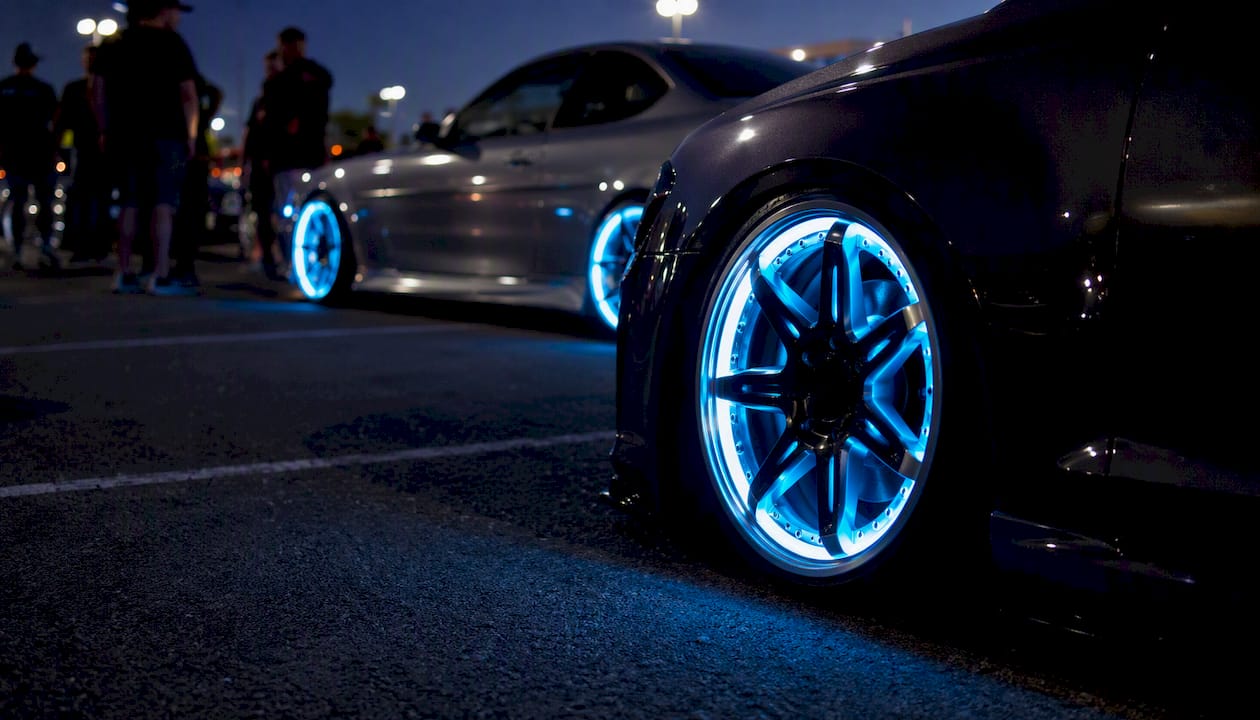
Car shows, parades, and off-road events typically permit decorative lighting, but the rules aren’t automatic.
Off-road events on closed courses are the most permissive context. No public road, no public road rules. That said, even at private events, avoiding red and blue is a practical habit worth keeping. Officers present at public car shows or parades may still approach if they see emergency-adjacent colors, even when no citation is warranted.
What to do if you’re stopped or cited for wheel lights
- At the stop: stay calm, turn off the lights immediately if it’s safe to do so, and ask the officer for the exact statute number cited. Note whether it’s an equipment violation or a moving infraction.
- Document everything: photograph your vehicle and the lighting setup from multiple angles before making any changes. Keep the photos timestamped.
- Gather your paperwork: pull together purchase receipts, the product’s installation guide, and any manufacturer documentation showing the lights are designed to mount without obscuring OEM signals.
- Read the cited code: look up the exact statute the officer referenced. Many equipment citations are narrowly written, and the specific wording matters for a contest.
- Consider a traffic attorney: for any citation that could affect your insurance or driving record, a traffic attorney familiar with equipment violations is worth a consultation. Many offer free initial calls.
- Negotiate a fix-it ticket: in states that allow it, correcting the equipment issue and showing proof to the court often results in a reduced fine or dismissal.
Pro Tip: If the citation is for a non-moving equipment infraction, ask the court about a “correction and proof” option before paying the fine. Many jurisdictions reduce or waive the penalty when you show the issue has been corrected.
Our perspective on designing wheel lights that stay street-legal
The appeal of wheel lighting is real. A well-lit set of rims at a show or on a trail looks sharp, and we understand why enthusiasts want that look on the road too. But the legal picture is clear enough that designing around it isn’t a compromise. It’s just smart.
At Wheellightexpress, every kit we design in Louisiana starts with the same question: does this install interfere with anything the driver or other road users depend on? Our wire harnesses are built to route cleanly without touching OEM signal wiring. Our default color palettes lean toward white and amber precisely because those are the colors that hold up across the widest range of state codes. We recommend steady-burn modes for any on-road use, and our sizing guide is built to help you confirm fitment before you install, not after you get a ticket.
The enthusiasts who get the most out of wheel lighting are the ones who treat the legal side as part of the build, not an afterthought. Check your state code, pick compliant colors, use a proper harness, and keep the show modes for the show. That approach lets you run the lights you want without the risk.
Compliant wheel lighting options from Wheellightexpress
You’ve done the research. Now the practical question is finding a kit that holds up legally and looks the part.
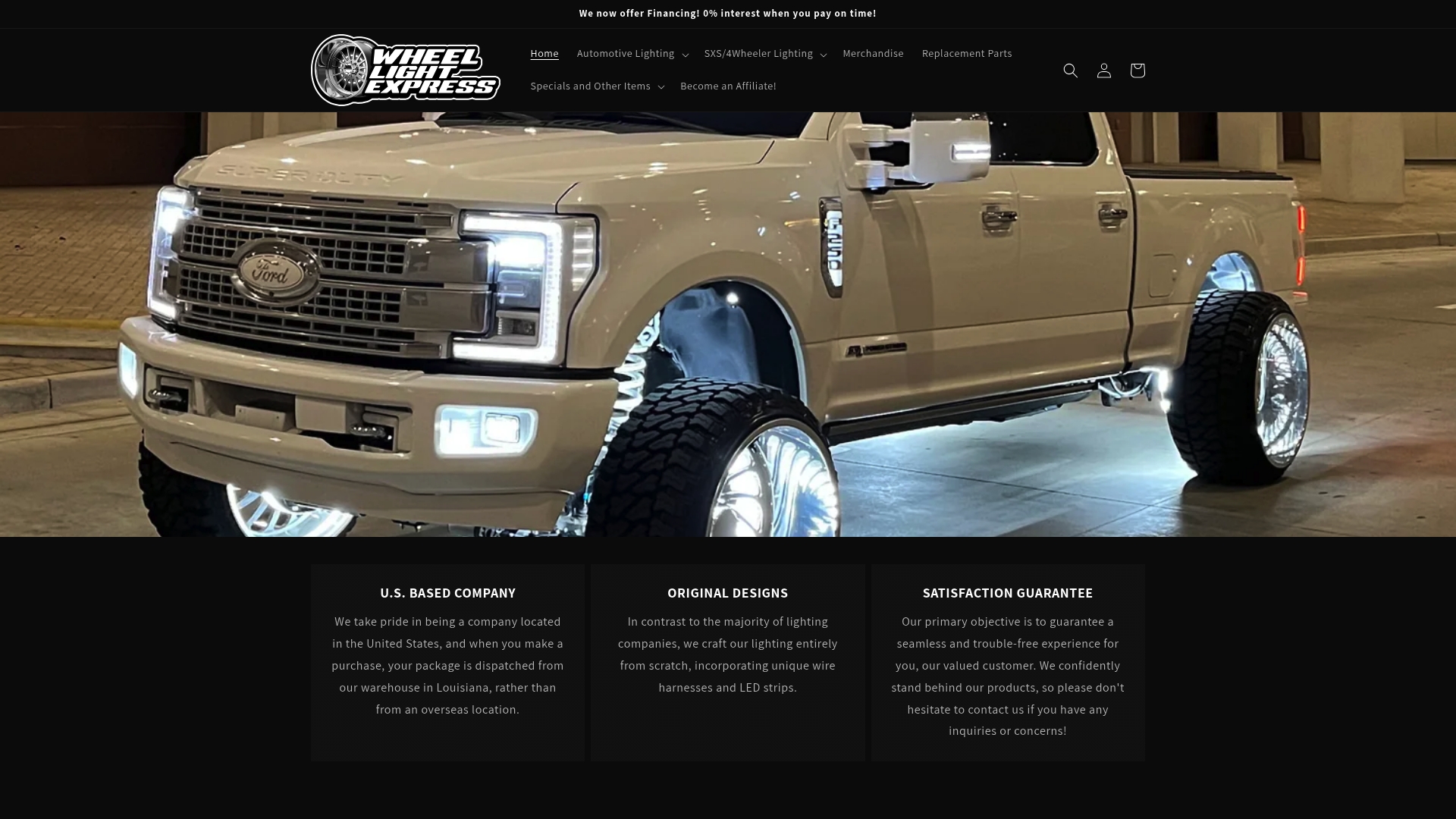
Wheellightexpress designs and assembles all lighting kits in the U.S., with steady-burning modes as the default and white/amber palettes that work across most state codes. Our wheel light ring and strip kits are sized for trucks and off-road vehicles, and every kit ships with a compatible wire harness designed to route cleanly without interfering with OEM signals. We also offer replacement wire harnesses separately for owners who want to upgrade an existing install. Financing is available, so you don’t have to wait to get the build right. Browse the full lineup and use our sizing guide to confirm fitment for your specific wheels before you order.
Sources
Start with primary sources whenever you need a definitive answer for your jurisdiction.
- 571.108 – AMA – Schaye–front color changing light | NHTSA
- Neon “Underglow” Lighting Laws - FindLaw
- Lighting up your vehicle!!!
- Wheel lights on my truck. Are they legal or illegal to have? | YourMechanic
- Are Car Wheel Lights Legal? | Kingshowstar
This article provides general information about U.S. lighting laws and is not legal advice. Confirm current rules with your state’s official statutes or a qualified traffic attorney before installing or operating aftermarket lighting on public roads.
This article is general information, not a substitute for advice from a qualified lawyer. Consult a qualified legal professional about your own circumstances before acting on anything here.