
IP68 certifies dust-tight protection plus continuous immersion under conditions the manufacturer defines and states on the datasheet. IP69K certifies resistance to close-range, high-temperature, high-pressure jets, the kind used in industrial and food-processing washdown. Neither implies the other. If your product faces both submersion risk and pressure washing, you need test reports for both, not a single higher-sounding number.
TL;DR:
- Matching the correct IP rating depends on whether the product faces static immersion or high-pressure jet exposure, with IP68 suited for submersion and IP69K for washdowns.
- IP68 specifications vary by depth and duration tested, which are manufacturer-defined, while IP69K involves harsh jet spray testing at high temperature and pressure from multiple angles.
- A product claiming both ratings requires dual certification and thorough verification through official test reports to ensure genuine protection against both threats.
- Relying solely on rating labels is risky; always request specific test data, certificates, and material details to confirm the protection claims.
- Higher IP numbers do not necessarily indicate better overall protection, as each rating tests different physical stressors that may impact seal longevity differently.
Table of Contents
- IP68 vs IP69K at a Glance
- What the IP code actually measures
- The exact lab numbers behind each test
- Matching the rating to the environment
- How to verify a supplier’s rating claim
- Why “higher number” doesn’t mean “better protection”
- Our take on IP ratings for vehicle lighting
- Standards worth requesting from any supplier
- Sources
IP68 vs IP69K at a Glance
The two ratings measure different physical stresses, and the numbers that define each test tell you why they aren’t interchangeable.
| Parameter | IP68 | IP69K |
|---|---|---|
| Governing standard | IEC 60529 | ISO 20653 / DIN 40050-9 |
| Test type | Static immersion | Dynamic high-pressure jet |
| Water temperature | Not fixed by standard | ~80°C |
| Pressure | Manufacturer-defined depth | 80 to 100 bar |
| Nozzle distance | Not applicable | 10–15 cm |
| Typical exposure | Submersion, rain, splash | Washdown, steam cleaning, spray-rinse cycles |
Choose IP68 for immersion risk, like a sensor dropped in standing water. Choose IP69K for routine, close-range, high-temperature washdown, like a conveyor sensor hosed off daily on a processing line.
What the IP code actually measures
The IP code in IEC 60529 uses two digits. The first, running from 0 to 6, rates protection against solids like dust and debris. The second, running from 0 to 9, rates protection against liquids. An enclosure rated IP68 has hit the top score on both scales: fully dust-tight, and able to survive continuous immersion.
Here’s the detail most buyers miss: the “8” doesn’t correspond to one fixed depth or duration the way the lower digits do. IEC 60529 leaves those specifics to the manufacturer, which means one IP68 product might be tested to one meter for 30 minutes, and another to three meters for 24 hours. Both are legitimately IP68.
IP69K comes from a different lineage entirely. It originated in German automotive testing practice and now lives in ISO 20653, often paired with DIN 40050-9. It was built for washdown environments, not for submersion, and IEC 60529 doesn’t define it at all.
The exact lab numbers behind each test
An IP68 test report should state a depth and a duration; those two figures are the entire claim. A connector might be verified at 1.5 meters for 30 minutes, or 5 meters for 24 hours. There’s no universal number, so the datasheet is the only place the real spec lives.
IP69K testing is far more specific and, frankly, more brutal. Water is heated to roughly 80°C and sprayed at 80 to 100 bar, with the nozzle held just 10 to 15 centimeters from the specimen. The spray hits from multiple angles, and the part is often rotated during exposure to make sure no seam escapes the jet.
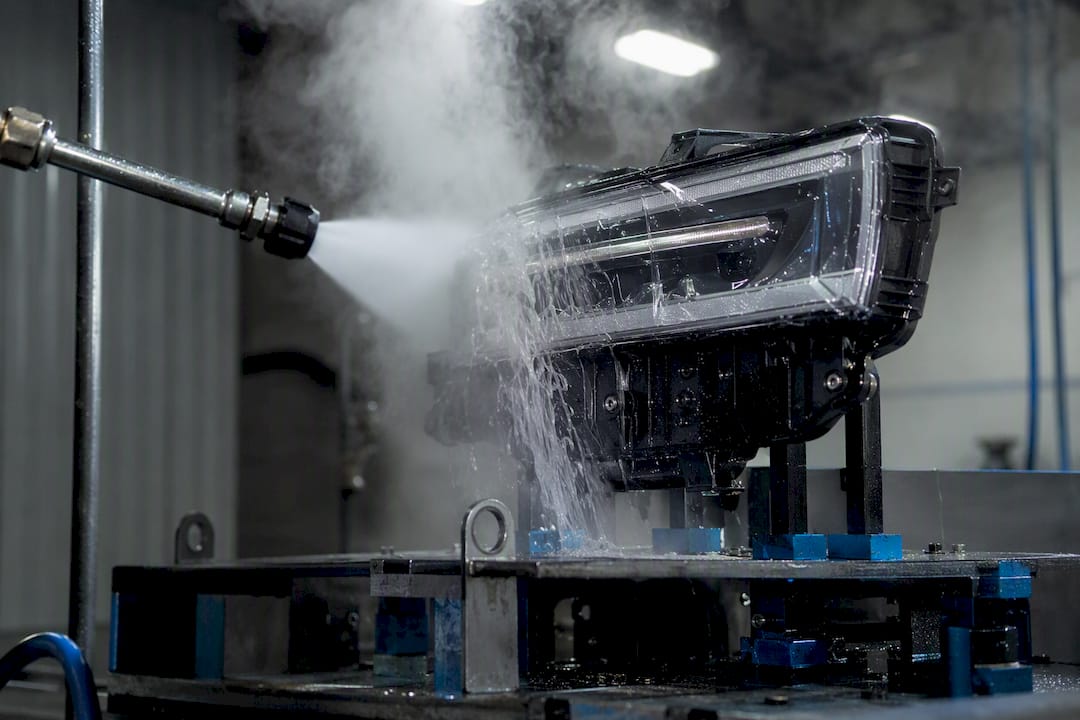
The physical difference matters more than the numbers alone suggest. IP68 tests static hydrostatic pressure, water pushing steadily against seals and housings while the part sits still. IP69K tests dynamic mechanical force, a concentrated jet slamming into a surface, combined with thermal shock as hot water hits a cooler housing. Those are two different failure modes. A gasket that holds up fine under steady pressure can still fail when a jet finds a seam at close range, and a rigid seal built for jet resistance can behave differently once it’s held underwater for hours. That’s exactly why passing one test says nothing about the other.
Matching the rating to the environment
Specifying the wrong rating usually comes from picking a number instead of picking a threat. Match the exposure to the test that actually simulates it:
- Marine sensors and submerged equipment: IP68, with a depth and duration that covers the actual deployment.
- Outdoor junction boxes and rain-exposed housings: IP68 is typically sufficient; IP69K adds little value here.
- Handheld consumer electronics: IP68 covers splash and rain; IP69K is rare in this category and largely unnecessary.
- Food and beverage processing equipment: IP69K, often paired with hygienic design standards from EHEDG, since daily hot washdown is standard practice on those lines.
- Automotive underbody and engine-bay components: IP69K, because pressure washing and engine heat both come into play.
IP69K remains uncommon in mainstream consumer products. It costs more to engineer and test, and most consumer applications simply don’t face washdown conditions, so manufacturers reserve it for industrial and automotive parts. Dual certification, IP68 and IP69K on the same part, makes sense only when a product genuinely faces both threats: a sensor that gets submerged in a flooded pit one week and blasted with a pressure washer the next. Testing both takes more time and more money, so don’t specify dual ratings out of caution alone. Specify them because the application demands it.
How to verify a supplier’s rating claim
A rating printed on a spec sheet is a claim, not proof. Confirm it before you commit to a part.
- Ask for the exact IP68 depth and duration, not just the rating number, and request the test report that backs it.
- Request the ISO 20653 / DIN 40050-9 certificate for any IP69K claim, including the testing lab’s name.
- Confirm both tests ran on the same sample configuration, since a different housing revision can invalidate the comparison.
- For hygienic or corrosive environments, check material grade (316L stainless is common) and surface finish, expressed as an Ra value.
Pro Tip: A supplier who can’t produce a lab report on request usually can’t produce the rating either. Treat “IP68/IP69K certified” on a product page as marketing copy until a document backs it up.
Why “higher number” doesn’t mean “better protection”
The most common mistake in procurement is treating IP68 and IP69K as points on the same scale, where a higher number always wins. They’re not on the same scale. They test different physical events, so a part can pass IP69K and still leak under sustained immersion if it was never tested for that condition.
Gasket behavior explains part of this. Seals experience compression set over repeated mating cycles, meaning they lose some elasticity every time a connector is unplugged and reseated. A rigid, high-compression seal built to resist jet impact can end up performing worse over time. It doesn’t fully rebound after the same number of cycles that a more flexible IP68-style seal would. Some IP69K designs even trade away immersion performance for jet resistance if the two conditions weren’t tested together. The fix is straightforward: demand the actual test report, specify material grades in writing, and require dual testing whenever a part will realistically face both threats.
Our take on IP ratings for vehicle lighting
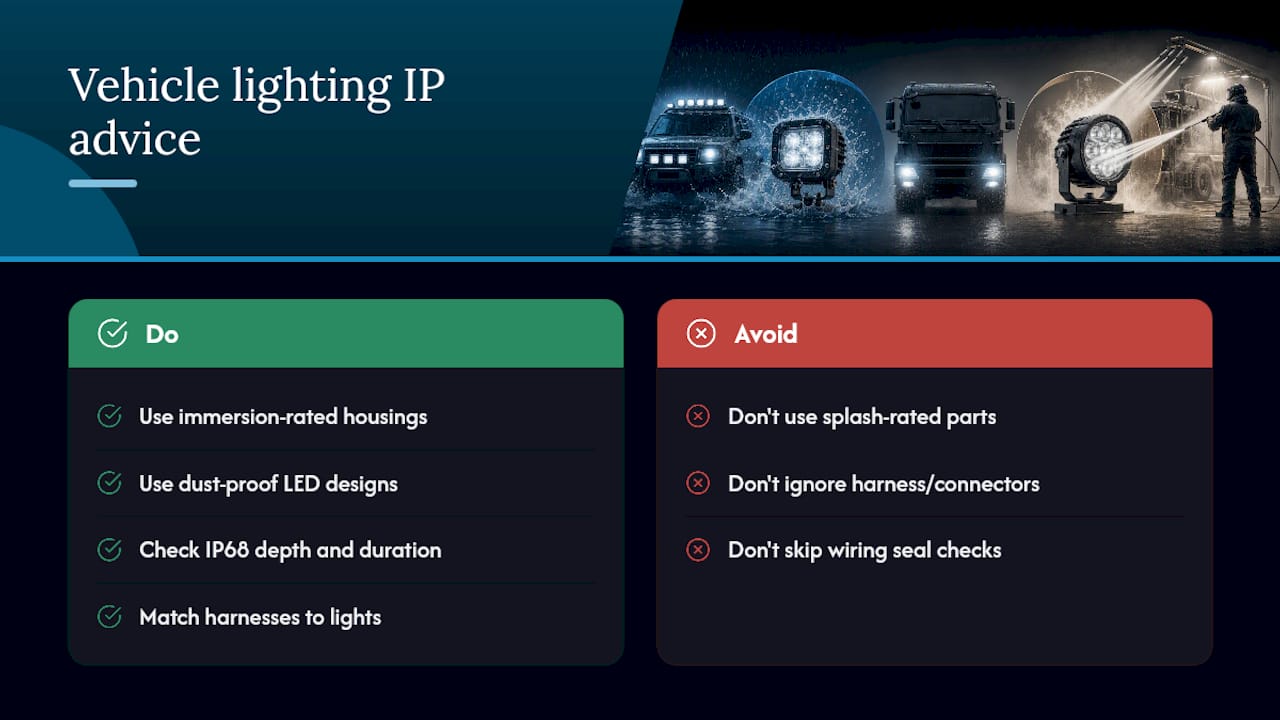
Most exposed vehicle lighting deals with rain, mud, road spray, and the occasional trip through a pressure washer at the car wash. That combination is exactly why we build our wheel lights, rock lights, and cab lights around housings and dust-proof LED strip designs rated for real-world immersion, not just a marketing sticker.
Before you install any exposed lighting, check the manufacturer’s declared IP68 depth and duration. A part rated for shallow splash isn’t the same as one rated for sustained submersion in a mud hole. If you want the engineering reasoning behind how we test and design around these exposures, our breakdown of why US-designed lighting differs covers it in more depth.
— Christopher
If you’re upgrading harnesses or connectors alongside new lighting, and you want components built for the same wet, muddy, high-vibration conditions your lights face, our wire harness leads are designed and assembled in the U.S. to match. For real-world installation context, automotive electrical specialists can also confirm your wiring setup is sealed correctly before you hit the trail or the wash bay.
Standards worth requesting from any supplier
Before you accept an IP68 or IP69K claim, ask for documentation tied to these standards directly:
- IEC 60529 for the IP code and IP68 immersion definitions.
- ISO 20653 / DIN 40050-9 for IP69K jet and washdown testing.
- Original lab certificates, not just a summary line on a spec sheet.
Sources
- IP67, IP68, and IP69K: Which Waterproof Rating Do You Need?
- IP Rating for Electronics: The IP67 & IP68 Design Guide - PCBSync
Recommended
- Dust-Proof LED Strip for Vehicles: What You Need to Know – Wheel Light Express
- Why Flexible LED Strips Survive Trails and Rough Roads – Wheel Light Express
- The Best Waterproof Wheel Lights for Your Vehicle in 2026 – Wheel Light Express
- 5050 vs 2835 LED Strips: Which One Fits Your Project? – Wheel Light Express