
Smoked side markers are legal only when the finished lamp assembly still meets the amber (front) and red (rear) color and photometry rules under FMVSS 108. A tinted lens that dims output or shifts color enough to fail those specs is noncompliant, no matter how clean it looks in the driveway. If you want the smoked aesthetic on a car you actually drive on public roads, choose an engineered, DOT/SAE-marked assembly built to pass those tests rather than a DIY tint job.
TL;DR:
- Smoked side markers are only legal if they meet FMVSS 108 color and photometry standards, which their tinting or dimming must not compromise.
- Properly engineered smoked assemblies are built with LED output and lens transmission designed together to pass photometry, unlike aftermarket tinted lenses that often fail.
- Using non-compliant smoked markers can lead to failed inspections, roadside tickets, recalls, and insurance issues if they do not meet safety standards.
- Achieving safety and visibility requires luminance levels of around 102.5 candela per square meter, which aftermarket tints often reduce below recommended thresholds.
- The best way to ensure legal and safe smoked side markers is to choose DOT or SAE-marked, fully engineered LED assemblies with documented test data and compatible wiring.
Table of Contents
- How Do U.S. Side Marker Laws Actually Work?
- What Does the Research Say About Visibility and Brightness?
- Engineered Smoked Replacements vs. Tint Film: What Actually Holds Up
- Installing Without Triggering Dash Errors or CAN Bus Faults
- Buying Checklist: Confirm This Before You Install Anything
- A Practitioner’s View: Balancing Aesthetics With Safety and Compliance
- Get the Smoked Look Without the Compromise
- Sources
- FAQ
How Do U.S. Side Marker Laws Actually Work?
Federal Motor Vehicle Safety Standard No. 108 is the rulebook that decides whether any side marker, smoked or amber, can legally sit on a road-going vehicle. It sets color, chromaticity, and photometric output requirements, plus the test procedures manufacturers use to prove a lamp meets them, and you can read the full CFR text of FMVSS 108 if you want the exact language regulators enforce.
The color assignment itself is not up for debate. Front side marker lamps and reflectors must be amber, and every rear and rear side marker lamp or reflector must be red, with a narrow set of permitted exceptions for rear turn signals. This is why the classic “amber vs white side markers” question has a clear answer up front: white is not an option for a side marker position, nor is any smoked treatment that shifts the emitted color outside the amber or red range the standard defines.
Where a lot of enthusiasts get tripped up is the belief that “off-road only” branding sidesteps all of this. It doesn’t. NHTSA’s interpretation 21872.ztv makes clear that replacement lamps have to meet the same requirements as the originals, and that a vehicle manufactured for on-road use doesn’t get a pass just because a seller labels a part for show or off-road use. The agency has gone further, specifically rejecting the idea that a marker lamp can switch to a “show color” like blue and still be sold as compliant replacement equipment for road vehicles.
SAE J578 is the reference standard that defines the color tolerances (chromaticity boundaries) a lamp has to fall within to count as amber or red under FMVSS 108. Lens tint and bulb or LED chip combination both affect where the emitted light lands on that chart, which is exactly why a lens color alone tells you almost nothing about legality.
The enforcement risk is real, not theoretical. NHTSA’s 21214.ztv interpretation points to a case where replacement taillamp lenses lacked required reflex reflectors, which triggered a recall. Consequences of noncompliant markers on the street include:
- Failed state safety inspections where lamp color or output is checked
- Roadside citations for missing or altered required lighting
- Manufacturer or retailer recalls when a part is found to remove required reflectors
- Insurance complications if a modified lamp is tied to an incident
What Does the Research Say About Visibility and Brightness?
Side impacts make up a significant share of crashes, which is part of why regulators care so much about side marker visibility in the first place. Reduced side lighting output doesn’t just look different at night, it changes how fast other drivers spot you.
A 2024 experimental study on side marker lamp effectiveness compared amber and white side contour lamps and found that higher luminance shortened detection time and improved subjective ratings of visibility. The researchers recommended a specific luminance target, around 102.5 cd/m2 for amber lamps, as a benchmark for optimal detection performance.
The luminance floor matters more than the tint depth. A lamp that looks moody at a car meet but falls under that output threshold at night is a lamp doing its job worse, not better.
Here’s the mechanical trade-off enthusiasts often miss: tint depth and LED output are fighting each other. A cheap smoked film or dipped lens blocks a percentage of light output straight across the board, and there’s no way to recover that loss without adding brighter emitters, which most DIY tints don’t do. A properly engineered smoked assembly, by contrast, is designed around the tint from the start. The manufacturer selects LED output and lens transmission together so the finished part still clears the same photometry bar as a clear amber lens.
This is really the whole difference between smoked and amber side markers when you strip away the styling debate: amber (clear) lenses have a built-in margin of light output that smoked lenses eat into. Whether that margin holds up depends entirely on whether the smoked part was engineered to compensate or just tinted after the fact.
The takeaway for anyone weighing which side markers are better for a daily driver is simple. Daytime looks should never come at the cost of nighttime output falling below spec. If a smoked marker can’t produce documented photometry data, treat it as a styling risk, not a proven upgrade.
Engineered Smoked Replacements vs. Tint Film: What Actually Holds Up
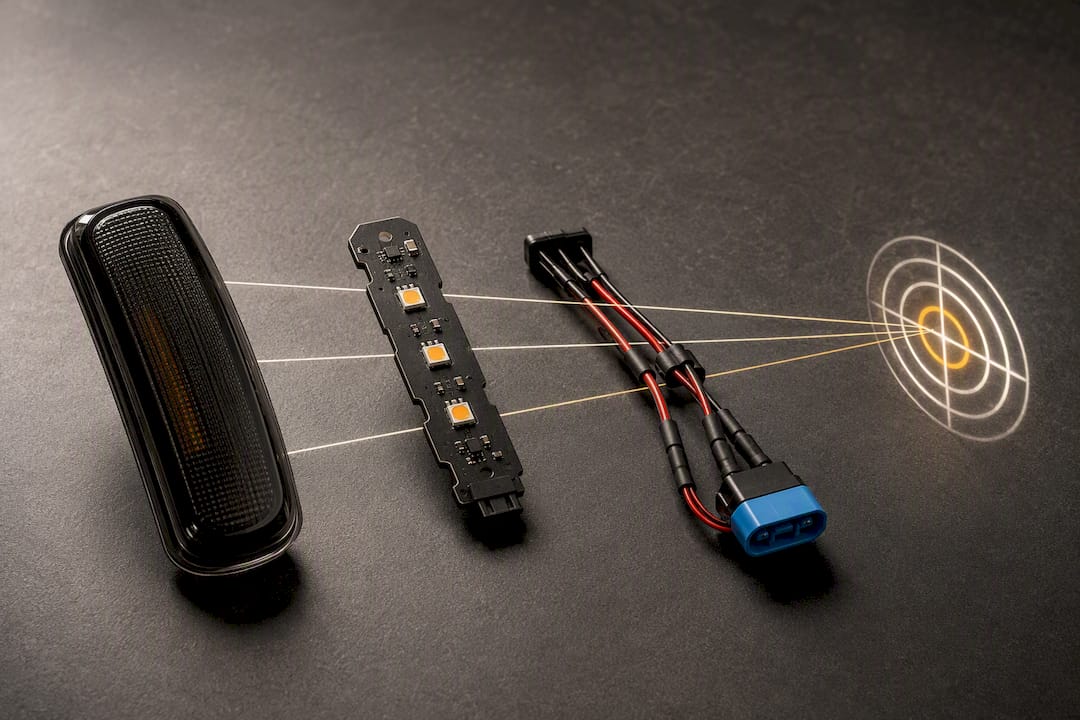
An engineered replacement is a complete lamp assembly, lens, housing, reflector, and LED array, designed and tested as one unit to meet FMVSS 108 photometry and carry DOT or SAE markings. Nothing about the smoked look here is applied after manufacturing. It’s built into the part from the first design pass.
Tint film, spray tint, and generic “smoked” aftermarket lenses that aren’t part of a certified assembly carry several recurring problems:
- Color shift outside the amber or red chromaticity range the lamp needs to hold
- Reduced photometric output that can drop well below the visibility levels researchers recommend
- Missing reflex reflectors when a lens is swapped without replacing the full housing
- No documentation to show a state inspector or insurance adjuster if the part is questioned
Before buying anything marketed as a “smoked” side marker, ask the seller for a short list of proof points. A look at real-world smoked marker installs shows that well-built LED smoked assemblies can actually run brighter than factory equipment, which tells you quality variance in this category is enormous. Verify:
- DOT or SAE markings stamped or molded on the lens or housing
- A photometry or spec sheet showing tested output, not just a marketing claim
- Clear installation instructions and confirmation the reflector is present and intact
- A warranty that covers the part if it fails photometry or fitment expectations
Pro Tip: Don’t judge a smoked marker by how dark it looks under a shop light. Ask for the candela rating or a spec sheet. A part with real photometric data behind it is a completely different product from one that’s just a dark lens with an LED behind it.
U.S.-designed lighting has an advantage here that’s easy to overlook: when the same team designs the lens, the LED board, and the harness together, they can tune all three to hit a target output instead of guessing. That’s the difference between a part built to a number and a part built to a look.
Installing Without Triggering Dash Errors or CAN Bus Faults
Swapping factory side markers for LED assemblies is one of the more common places builds go wrong electrically, not visually. Modern trucks and cars run CAN Bus systems that monitor bulb resistance, and an LED draws far less current than the incandescent bulb it replaces. That mismatch is exactly what triggers hyperflash, bulb-out warnings, or dash error codes even when the new light works perfectly.
A short install sequence avoids most of these headaches:
- Confirm your vehicle’s factory connector and wiring before ordering anything.
- Use a manufacturer-matched harness or CAN-compatible adapter instead of splicing bare wires.
- Test the new marker with the vehicle running, before you seal or clip anything permanently.
- If you have access to a light meter, do a quick bench check to confirm output before final install.
A guide to avoiding CAN Bus errors when swapping cab and marker lights walks through the wiring side of this in more depth if you’re working on a CAN-equipped truck.
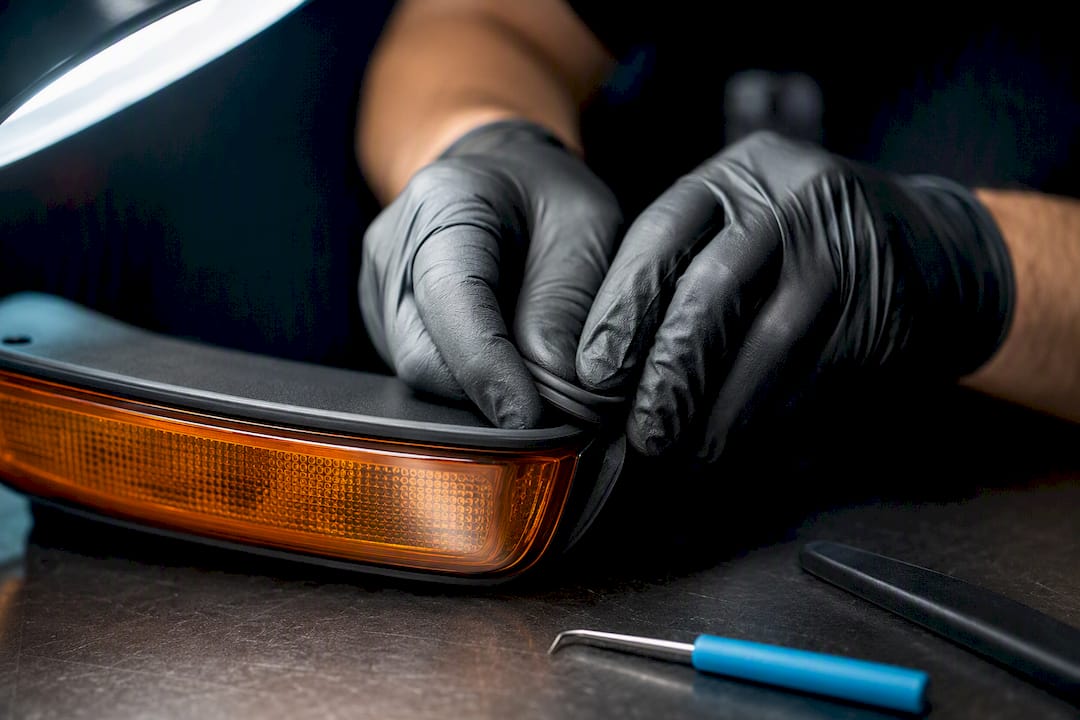
Durability matters just as much once the light is mounted. Look for an IP rating on the housing, UV-stable lens material so the smoked tint doesn’t yellow or crack in sunlight, and a real gasket rather than a thin adhesive seal that lets moisture creep in over a wet winter.
Pro Tip: If your build is on a Ford platform, check whether your specific model has known quirks before you buy. A Ford-specific side marker upgrade guide can save you a return shipment.
Buying Checklist: Confirm This Before You Install Anything
Getting the smoked look without a ticket or a failed inspection comes down to a handful of checks before you ever pick up a screwdriver.
- Ask for the photometry claim and DOT or SAE marking in writing if the listing doesn’t show it clearly.
- Choose a full engineered assembly for anything driven on public roads; if you go with tint film for a show build, keep the original amber lenses to swap back in for street driving.
- Confirm the part’s connector matches your vehicle, and check whether a replacement harness or adapter ships with it or needs to be ordered separately.
- Review the seller’s warranty, mounting hardware, and seal quality, and hold onto your receipt and any spec sheet in case an inspector asks.
| What to verify | Why it matters | Where to check |
|---|---|---|
| DOT/SAE marking | Confirms the assembly was tested to FMVSS 108 | Molded on lens or housing |
| Photometry/spec sheet | Shows actual light output vs. required minimums | Manufacturer product page |
| Harness/connector fit | Prevents CAN Bus faults and dash errors | Vehicle-specific fitment listing |
| Warranty and return policy | Protects you if the part fails inspection or output tests | Seller terms |
A rundown of U.S. side marker color laws and DOT checks is worth bookmarking if you want a state-inspection-level view of what officers and inspectors are actually looking for.
A Practitioner’s View: Balancing Aesthetics With Safety and Compliance
Smoked markers can absolutely finish a build. The mistake is treating the lens color as the whole decision instead of one input into a lamp that still has to do its job at night. A tint that shaves your visible output below what amber achieves is a downgrade wearing a nicer outfit.
Some companies design their assemblies with harness compatibility and photometry in mind from the start, sometimes backed by a satisfaction guarantee and installation content to help avoid CAN Bus issues. If your vehicle sees regular street use, an engineered replacement is the smarter bet. Save uncompensated tint for a car that never leaves the show floor.
— Christopher
Get the Smoked Look Without the Compromise
Wheel Light Express builds the alternative to guessing whether a tinted lens will pass inspection: engineered assemblies designed around photometry and harness compatibility from day one, not tinted after the fact. Our XB LED Side Marker Lights for Silverado HD and Sierra HD (2015 to 2024) show what that looks like in practice: a smoked-style aesthetic built into the lens and LED design together, so brightness isn’t an afterthought.
Every kit we design in Louisiana pairs with harness options built for plug-and-play installs, which matters most on CAN Bus vehicles where a mismatched connector causes dash warnings. If you’re wiring in a replacement or need extra leads for a custom run, our wire harness leads and replacement wire harness options are built to work with our lighting rather than against it. Browse fitment details on your specific product page or reach out to our team before you order if you’re not sure which harness your setup needs.
Sources
- 21872.ztv | NHTSA
- CFR - FMVSS 108 (DOT § 571.108)
- The effectiveness of side marker lamps: An experimental study (2024)
FAQ
Are Smoked Side Markers Illegal?
Not automatically. A smoked marker is illegal only if the tint pushes its color outside the amber or red range FMVSS 108 requires, or drops its output below the standard’s photometry minimums.
What Color Should Trailer Side Marker Lamps Be?
Trailer side marker lamps follow the same FMVSS 108 color rules as passenger vehicles: amber toward the front and red toward the rear, with reflectors matching the same color scheme.
Should I Get Amber or White Ditch Lights?
Ditch lights aren’t governed by the side marker color rules since they’re auxiliary off-road lighting, not required equipment, so this comes down to preference rather than a legal amber vs white side markers question.
What Color Should Side Marker Lights Be?
Front side marker lights must be amber and rear side marker lights must be red under FMVSS 108, regardless of whether the lens has a smoked finish.
Do Engineered Smoked Assemblies From Wheel Light Express Meet These Rules?
Wheel Light Express designs its LED side marker assemblies, including the XB LED Side Marker Lights for Silverado HD and Sierra HD, around photometry and harness compatibility rather than tinting a stock lens after the fact.