
Wheel rings are the show upgrade; rock lights are the trail upgrade. If you want your rig to turn heads at a meet, wheel rings put a glowing halo behind your spokes. If you want to see rocks, ruts, and stumps at night on the trail, rock lights do that job. Plenty of Jeep and truck owners end up running both.
Here’s how to match the light to your goal:
- Show or weekend meet: Wheel rings, mounted behind open-spoke wheels for maximum visual pop.
- Daily driver accent: Wheel rings on steady white or amber, kept subtle for street use.
- Trail visibility at night: Rock lights mounted under the frame rails and wheel wells, rated IP67 or IP68 for mud and water.
- Combo builds: Both systems wired on separate switches, so the underbody lights handle trail duty and the wheel rings handle the parking-lot glow.
We build both categories at Wheel Light Express, and we get the same question constantly: “Which one do I actually need first?” The honest answer depends on how you use your vehicle, but the products themselves solve two completely different problems. Nothing in this guide has anything to do with a regulatory agency like the NHTSA endorsing colored lighting for street use. It has everything to do with how enforcement and state vehicle codes treat colored and flashing lights, which we’ll get into further down.
Key Takeaways
Wheel rings deliver a stationary halo effect for show purposes, while rock lights deliver functional trail illumination, and combining both requires separate wired circuits to avoid legal and battery-drain conflicts.
| Point | Details |
|---|---|
| Purpose split | Wheel rings are aesthetic show pieces; rock lights are functional trail illumination. |
| Waterproofing standard | Insist on IP67 or IP68 ratings for anything mounted in wheel wells or underbody. |
| Wiring basics | Use a fused feed, relay, clean ground, and sealed connectors on every install. |
| Legal default | Run steady white or amber on public roads; save RGB and flashing modes for private property. |
| Combo builds | Wheel Light Express offers wheel ring kits, harnesses, and remotes suited to trail, show, or combined installs. |
Table of Contents
- Wheel Rings vs Rock Lights: The Core Difference
- What Are Rock Lights and How Do They Perform on the Trail?
- What Are Wheel Rings and How Do They Perform for Show?
- Wheel Rings vs Rock Lights: Side-By-Side Comparison
- How Do You Decide Between Wheel Rings and Rock Lights?
- Wiring, Power Draw, and Installation Realities
- Are Wheel Lights and Rock Lights Legal to Drive With?
- What Should You Expect From a Professional Installation?
- What Do Truck Owners Get Wrong About Wheel Lighting?
- If You Want a Ready Solution: How Wheel Light Express Fits These Needs
- Frequently Asked Questions
- Sources
Wheel Rings vs Rock Lights: The Core Difference
Rock lights illuminate the ground. Wheel rings illuminate themselves. That’s the entire distinction, and it drives every other decision in this guide, from mounting location to wiring to whether you’ll get a second look from a police officer.
Rock lights sit under your vehicle, aimed downward or outward, doing a job: showing you what’s under your tires and around your undercarriage when the sun goes down. Wheel rings sit behind your wheel, aimed at your spokes, doing a different job: making your truck look like it belongs in a parking lot full of cameras. One is a tool. One is a statement piece. Neither is better; they’re just built for different moments in your ownership experience.
What Are Rock Lights and How Do They Perform on the Trail?
Rock lights are small LED pods mounted underneath the vehicle, typically along the frame rails, inside the wheel wells, or bolted near the rock sliders. Their entire purpose is usable ground and wheel-path illumination for off-road driving, not decoration.
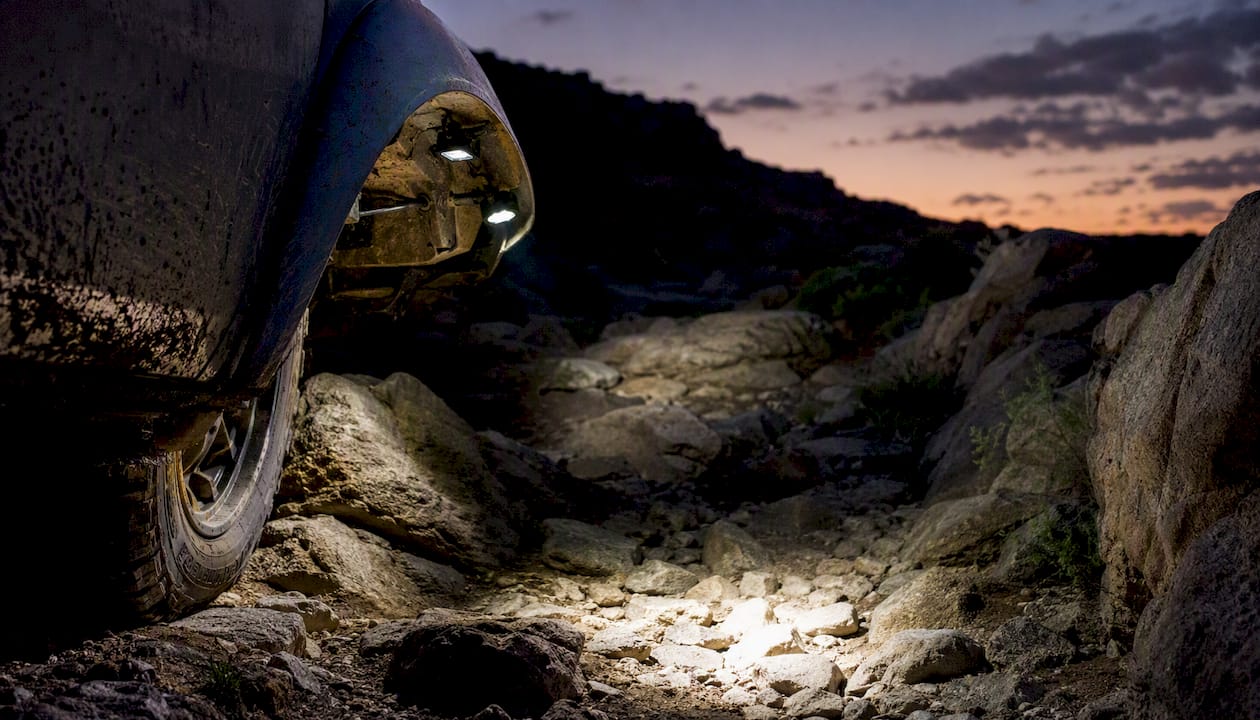
On a night trail run, these lights show you the boulder you’re about to straddle, the ditch on the driver’s side, and exactly where your front tire is relative to a rock ledge. That kind of visibility reduces the odds of undercarriage damage and helps you place your tires with confidence instead of guessing.
Most kits come in white for pure functional light or RGB for a mix of function and style. Brightness and beam spread vary by pod size, but the real spec that matters is the enclosure rating. Underbody lights take a beating from mud, standing water, and pressure washing, so IP67 or IP68 is the standard worth insisting on rather than a vague “water-resistant” label.
Wiring matters just as much as the pod itself. A solid rock light setup runs on a dedicated harness with a fused feed, a relay, and a clean ground point, rather than tapping randomly into an existing circuit. The most common failure mode on the trail isn’t the LED burning out; it’s a connector that wasn’t sealed properly getting flooded with mud and corroding within a season.
- Mounts: frame rails, wheel wells, rock sliders, underbody
- Purpose: functional ground and obstacle visibility
- Color options: white for utility, RGB for utility plus style
- Recommended rating: IP67 or IP68 for trail use
Pro Tip: Route your rock light wiring up and over the frame rail, not along the bottom edge where it can catch on rocks. A wire that dangles below the frame line is the number one cause of a torn-out light on a rough trail.
What Are Wheel Rings and How Do They Perform for Show?
Wheel rings, also called wheel light rings, mount behind the wheel itself, typically on the dust shield, hub assembly, or a custom bracket built to clear your brake caliper. Unlike rock lights, they stay stationary while the wheel spins around them, which is exactly what creates that floating halo effect you see through the spokes.
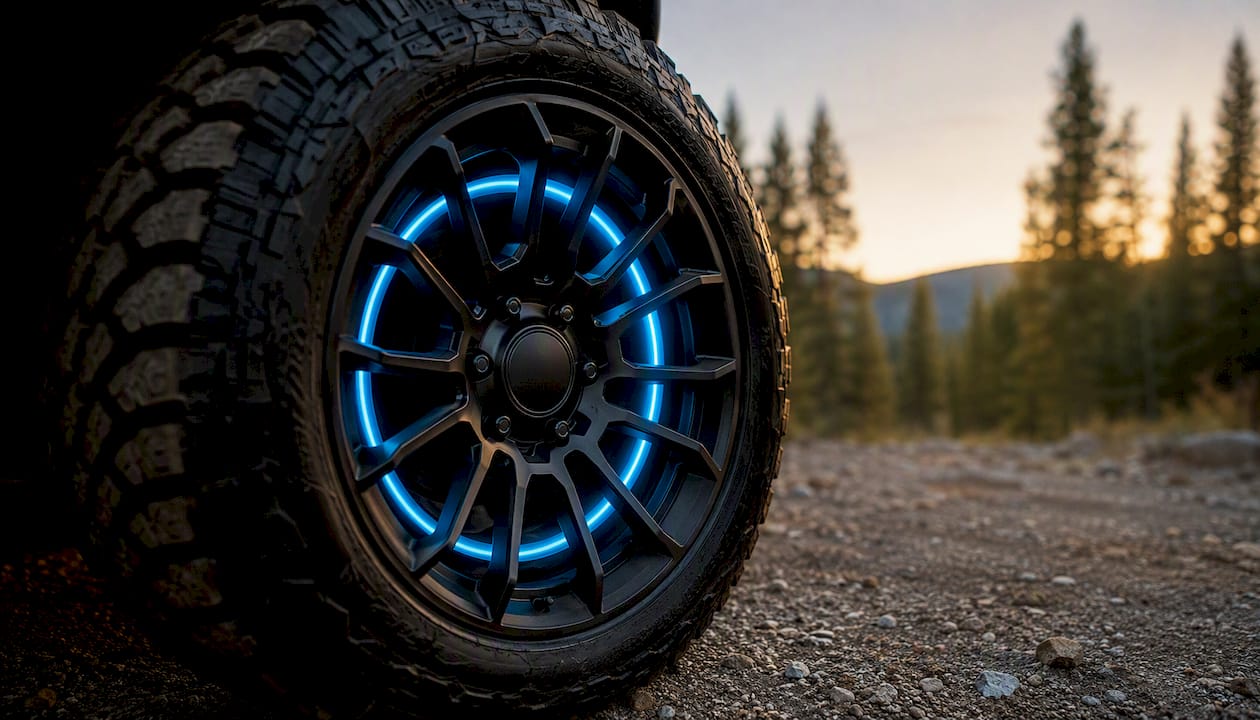
This is a visual product first and a functional one a distant second. A wheel ring isn’t going to help you see a pothole. What it does is create a glow that reads through your wheel’s spokes as you roll down the street or sit parked at a meet, and that effect only works well on open-spoke wheel designs. Solid-face or heavily covered wheels block most of the light and mute the impact considerably.
Because these rings live inside the wheel well, they take on brake dust, road salt, and constant vibration. That means the same waterproofing standard applies here as it does to rock lights: look for IP67 or IP68 construction, sealed connectors, and a mounting bracket rigid enough to survive thousands of miles of vibration without rattling loose.
Fitment precision matters too. If your aftermarket wheels use a center bore larger than your vehicle’s hub, you’ll need hub-centric rings to keep the wheel centered and reduce vibration, which in turn protects your wheel ring’s mounting bracket from working itself loose over time. Match the ring’s inner diameter to your hub and the outer diameter to your wheel bore, or vibration will keep finding its way back.
- Mounts: dust shield, hub assembly, custom bracket behind the wheel
- Purpose: aesthetic halo effect visible through spokes
- Best paired with: open-spoke wheel designs
- Recommended rating: IP67 or IP68 for wheel well exposure
Pro Tip: Choose a rigid, purpose-built ring rather than a flexible strip bent into a circle. A rigid ring holds its shape and clearance through years of brake heat and road vibration; a soft strip tends to sag toward the rotor over time.
Wheel Rings vs Rock Lights: Side-By-Side Comparison
| Dimension | Wheel Rings | Rock Lights |
|---|---|---|
| Primary purpose | Visual halo/show effect | Usable ground and trail illumination |
| Visibility type | Show effect, not functional light | Functional illumination for driving |
| Typical mounting location | Behind wheel spokes, dust shield or hub | Frame rails, wheel wells, underbody |
| Installation complexity | Moderate: bracket fitment, wheel-well routing | Moderate to high: multiple pods, longer harness runs |
| Power draw / battery impact | Low per ring, higher with RGB modes running long | Low per pod, adds up with 6 units |
| Legal/safety considerations | Show colors best kept off public roads | White and amber generally safe for street use |
| Cost range | Moderate per pair | Moderate for a full kit of 6 pods |
| Durability / maintenance | Needs sealed connectors against brake dust and salt | Needs sealed connectors against mud and water |
A few quick calls based on the table above:
- Trail-first owner: Rock lights alone cover your needs; skip the wheel rings unless you also show your rig.
- Show-first owner: Wheel rings alone deliver the visual payoff you’re after.
- Daily driver with occasional meets: Wheel rings on steady white, rock lights optional for winter driving visibility.
- Combo build: Both, wired independently so trail lighting and show lighting never compete for the same switch.
How Do You Decide Between Wheel Rings and Rock Lights?
Run through this checklist before you buy anything:
- What’s the primary use? Trail runs point you toward rock lights. Meets and cruising point you toward wheel rings.
- What’s your wheel design? Open-spoke wheels make wheel rings worth the money. Solid-face wheels blunt the effect, so save your budget for rock lights instead.
- How often do you actually go off-road? Weekly trail use justifies a full rock light kit with relay-fed circuits. Occasional trips might only need two or four pods.
- What colors and effects do you want? RGB adds flexibility but also adds a controller, more wiring, and more places for something to fail.
- What’s your budget and mounting space? Rock lights need real estate along the frame and wheel wells; wheel rings need clearance behind the wheel without touching the caliper or rotor.
Before you check out, ask the seller these questions directly:
- Will these lights ever run while I’m driving on public roads?
- Are my wheels open-spoke enough to actually show off a ring?
- How many amps will my total light count draw, and can my fuse box handle it?
- Am I ready to wire relays and fuses myself, or do I need a professional?
Watch for these red flags on any kit you’re considering:
- A listing with no IP rating at all, or a vague “waterproof” claim with no number attached.
- Connectors that aren’t sealed, especially on anything mounted below the frame line.
- No amperage or wattage specs anywhere in the description.
- Marketing that claims “zero battery drain” without showing actual current draw numbers.
Wiring, Power Draw, and Installation Realities
Every reliable lighting install, wheel ring or rock light, comes down to the same five components: a fused power feed, a relay, a solid ground point, a switch or controller, and properly sealed connectors at every joint. Skip any one of these and you’re building in a future failure point.
Power draw per pod or ring is modest on its own, but it adds up fast across a full kit. If you’re running six to eight rock light pods plus a pair of wheel rings, total current draw and connector quality matter more than any single component’s spec sheet. Cheap kits frequently skip proper strain relief and current regulation, which is exactly why they fail within a season rather than lasting for years.
Most factory batteries and alternators handle a full lighting setup without issue for normal use. Where it gets tricky is extended show use, running RGB chase patterns for hours at a stationary meet with the engine off. If that’s your pattern, wire your show lighting on its own fused circuit, separate from your trail lighting, so a long parking lot session at a show never touches the circuit your rock lights depend on when you’re navigating a trail at 11 p.m.
Installation complexity differs slightly between the two. Wheel rings demand precise wheel-well routing and a bracket that clears your brake components without ever making contact. Rock lights demand more linear wiring runs along the frame, careful waterproofing at every splice, and mounting points that won’t get knocked loose by a rock strike.
- Fused power feed protects the circuit from shorts and overloads
- Relay handles the actual current load instead of your switch
- Clean ground point prevents flickering and premature LED failure
- Controller adds RGB flexibility but also adds a failure point worth testing before final mounting
Pro Tip: Ground every circuit to bare metal on the chassis, not to a bolt holding on plastic trim. A weak ground is the single most common cause of flickering lights and mysterious electrical gremlins on a lighting install.
If you want to see how these pieces come together on a full build, our guide to lighting best practices for custom automotive builds walks through harness planning in more detail.
Are Wheel Lights and Rock Lights Legal to Drive With?
Steady white and amber lighting is generally the safest choice for public roads. Red and blue, along with flashing patterns, are the colors most consistently reserved for emergency vehicles, and running them on a personal truck is a fast way to attract attention you don’t want.
Enforcement isn’t uniform. What one county overlooks, the next might cite you for, which is exactly why we recommend checking your specific state’s vehicle code rather than relying on what your buddy’s truck gets away with three states over.
Colorful RGB modes belong at the show, not on the highway. If your kit supports chase patterns or multi-color displays, treat those as a “parked only” feature and default to white or amber the moment you’re back on public roads.
Steps that lower your legal risk without sacrificing your show setup:
- Set your default driving mode to white or amber, every time, with no exceptions.
- Isolate RGB and flashing show modes behind a separate switch that can’t get bumped accidentally while driving.
- Fuse and wire everything properly, since an electrical failure at speed is a safety issue on top of a legal one.
Check your state’s specific vehicle code before you drive with any colored lighting active, since local interpretation varies and this guide can’t substitute for that lookup. Our internal breakdown of wheel light legality in the USA covers more state-by-state detail if you want to dig further before your next install.
What Should You Expect From a Professional Installation?
A shop that knows what it’s doing follows a sequence, not a shortcut. Here’s what that sequence typically looks like:
- Vehicle assessment: Confirming wheel design, frame layout, and available mounting points before ordering anything.
- Mounting point selection: Marking exact locations that clear brakes, suspension travel, and exhaust heat.
- Harness routing plan: Mapping the shortest, most protected path for every wire before a single hole gets drilled.
- Fused relay installation: Wiring the power feed through a properly rated fuse and relay, not a direct tap into an existing circuit.
- Controller placement: Mounting any RGB controller somewhere accessible but shielded from water and heat.
- Waterproofing every joint: Sealing every connector, especially ones near the wheel wells or underbody.
- Final test run: Driving the vehicle to confirm nothing chafes, rattles, or interferes with brakes or suspension travel.
A shop worth paying should demonstrate every lighting mode, check for voltage drop under load, confirm every fastener is torqued and secure, and run a water intrusion check before handing the keys back. Expect a wiring diagram, the fuse rating used, and some form of test log as standard deliverables, along with a labor warranty that covers workmanship, not just parts.
Pro Tip: At handoff, ask the installer to run every light mode while you watch, and physically tug on a few visible wire runs to check for slack and strain relief. A rushed job shows up fastest in loose connectors, not dead LEDs.
What Do Truck Owners Get Wrong About Wheel Lighting?
The most common mistake I see isn’t picking the wrong light. It’s wiring both systems onto one switch and one circuit, which means a dead battery from an all-night show session also kills your trail lighting the next weekend. Separate circuits aren’t a luxury upgrade here; they’re basic insurance against exactly that scenario.
The second most common question I get isn’t “which is brighter.” It’s “can I run both without doubling my install time.” You can, and most combo builds aren’t much harder than doing either system alone, since the wiring principles (fused feed, relay, clean ground, sealed connectors) are identical for both. What changes is where you route the harness.
If you’re a trail-first owner who occasionally hits a show, prioritize rock lights and treat wheel rings as the upgrade you add later. If you’re building a show truck that rarely leaves pavement, wheel rings are your priority and rock lights are optional polish. If you’re building a combo rig, plan the wiring for both from day one rather than retrofitting a second harness into a truck already wired for one system.
If You Want a Ready Solution: How Wheel Light Express Fits These Needs
Wheel Light Express designs every kit in Louisiana rather than sourcing generic parts overseas, and that shows up in the fitment and durability of both our wheel rings and rock light lineups. If you’ve decided you want the show effect, our Wheel Light Ring and Strip kits are built for open-spoke wheels and sealed for wheel-well exposure. If your build calls for reliable trail-side illumination, the same design philosophy applies across our lighting lineup.
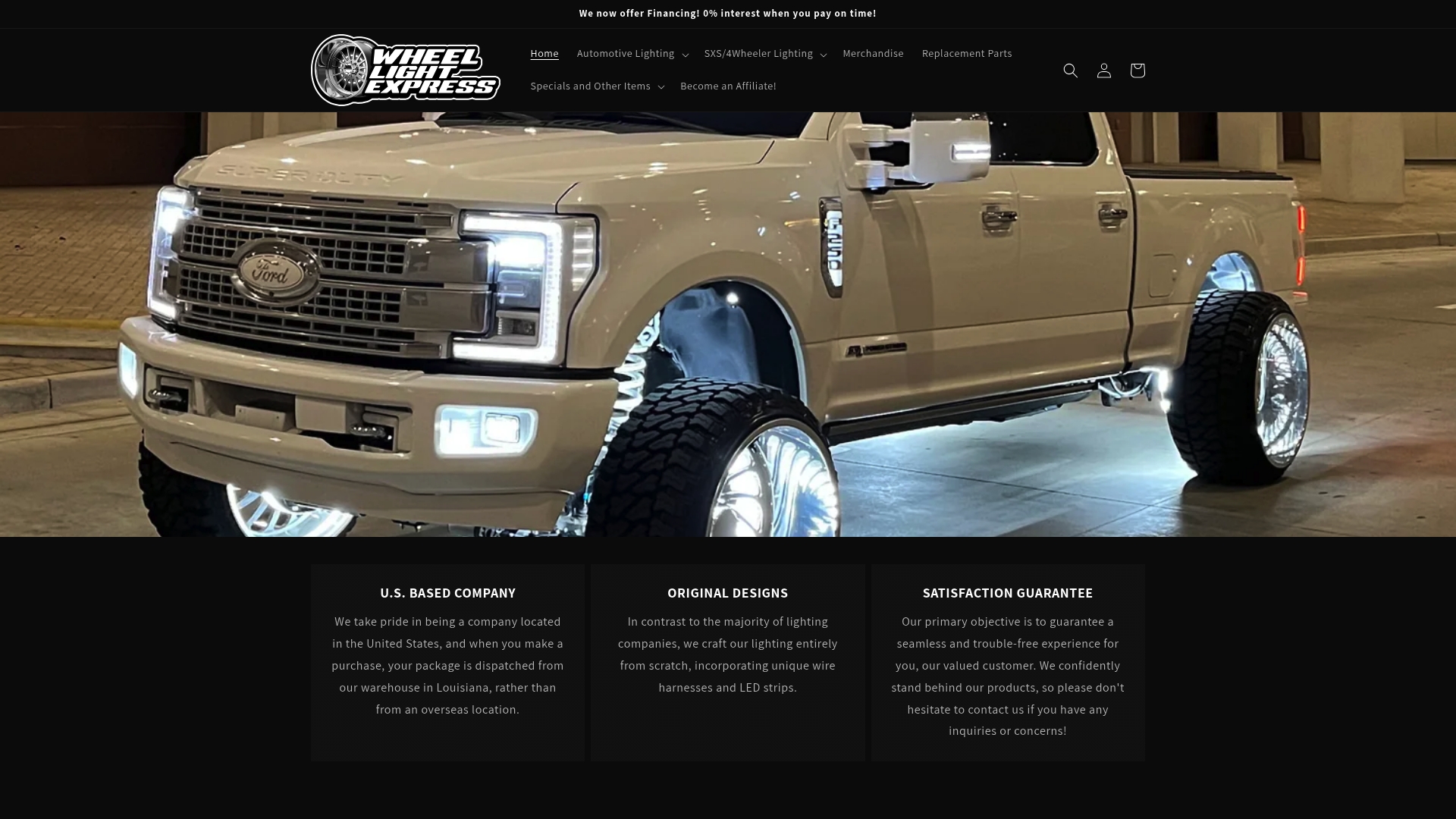
Wiring is where most DIY installs go wrong, so we sell dedicated wire harness leads and wires built specifically for these kits, along with remotes for remote harness control if you want app-based mode switching between white daily driving and RGB show modes. Every purchase carries our satisfaction guarantee, and financing options mean you don’t need the full budget upfront to get your build started. Browse the wheel ring and strip lineup today and match your kit to your wheel design before you order.
Frequently Asked Questions
Are rock lights worth it for a daily driver that rarely goes off-road? If you never leave pavement, rock lights add style more than function. They’re worth it if you drive dirt roads, gravel, or unlit rural routes at night; otherwise a wheel ring gives you more visual payoff for the same money.
Is it legal to drive with wheel rings or rock lights turned on? Steady white or amber lighting is generally accepted for street use, while red, blue, and flashing patterns are typically reserved for emergency vehicles and enforcement varies by state. Confirm your specific state’s vehicle code before driving with any colored lighting active, since this guide is general information and not a substitute for checking local law.
Do wheel rings or rock lights drain your battery? Both draw relatively little current per unit, but a full kit of six to eight rock light pods or a pair of wheel rings running RGB for hours at a show adds up. Wiring show lighting on its own fused circuit protects your starting battery from that kind of extended draw.
Can I install wheel rings and rock lights myself, or do I need a professional? Confident DIYers with basic wiring skills can handle either system, especially with a pre-built harness. If you’re not comfortable running fused relays, sealing connectors, or diagnosing voltage drop, a professional installation protects your investment and usually comes with a workmanship warranty.
Do wheel rings work on any wheel design? No. Open-spoke wheels show off the halo effect clearly, while solid-face or heavily covered wheels block most of the light and mute the visual impact significantly.