

What makes a vehicle light truly the brightest?
The brightest vehicle lighting concepts are not simply about raw lumens. They are defined by luminous intensity, beam pattern precision, and how well the system delivers light exactly where the road needs it without blinding oncoming drivers. LED technology, Matrix LED systems, and Digital Light Processing (DLP) represent the three pillars of modern automotive lighting performance in 2026.
Key technologies and what they deliver:
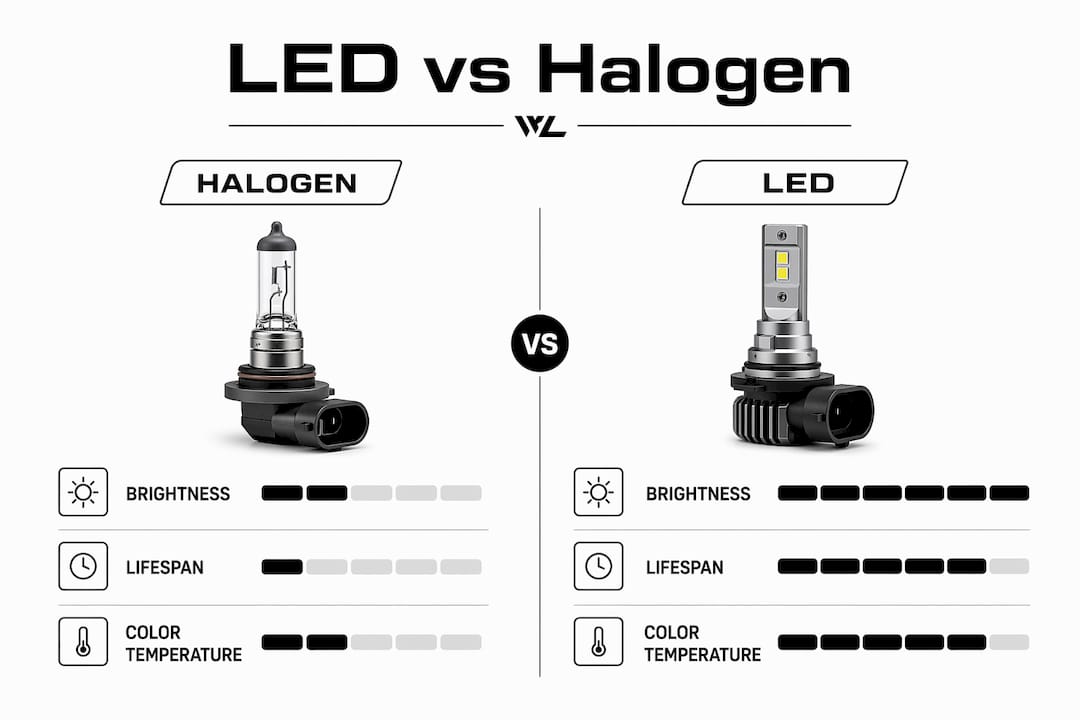
- LED headlights: high brightness per lamp, a very long lifespan, and low power draw
- Halogen headlights: lower brightness, shorter lifespan, and higher power draw
- Matrix LED systems: Individually controlled LED segments that dim or shut off around other vehicles while keeping the rest of the beam at full intensity
- Digital Light Processing (DLP): Pixel-level beam control using microscopic mirrors, enabling navigation projections and safety graphics on the road surface
- TIR optics and chromic paneling: Advanced optical materials that shape and focus light with precision, used by engineering teams at Morimoto and Tesla
Statistic callout: LED headlights are significantly brighter than halogen bulbs and last much longer. Yet raw brightness without a properly engineered beam pattern can create dangerous glare. Approximately 50% of traffic fatalities occur at night, making controlled beam design as critical as lumen output.
How do LED and halogen headlights actually compare?
LED headlights outperform halogen on every measurable metric except upfront cost and snow-clearing ability. The lumen gap alone is striking: halogen bulbs produce 1,100–1,500 lumens, while modern LED headlights deliver 3,000–6,000+ lumens. That is a significant improvement. That is a significant improvement.
Lifespan tells the same story. Halogen bulbs last considerably less time on average compared to LEDs. Over the life of a vehicle, you will replace a halogen bulb many times before a single LED wears out.
Color temperature also affects how you perceive brightness. Halogen bulbs produce a warm yellowish light in the 3,000–3,500K range. LEDs run cooler and whiter, typically 5,000–6,500K. Halogen bulbs with a blue finish can reach up to 4,000K, closer to daylight, which improves contrast perception and reduces driver fatigue. That said, maximum light output still comes from standard high-output halogen variants, not the blue-finish versions.
One real limitation of LEDs in cold climates: they generate minimal heat at the lens, so snow accumulates rather than melting off. Halogen lenses stay warm during operation, which is a genuine edge in heavy winter conditions.
| Feature | Halogen | LED |
|---|---|---|
| Brightness | lower brightness | higher brightness |
| Lifespan | shorter lifespan | much longer lifespan |
| Power draw | higher power draw | lower power draw |
| Color temperature | warmer color temperature | cooler color temperature |
| Snow on lens | melts off | can accumulate |
| Upfront cost | lower | higher |
Matrix LED and DLP: what advanced beam control actually does
Matrix LED technology is arguably the biggest leap in automotive lighting since the shift from halogen to LED. Instead of a single light source, a Matrix LED headlight contains an array of individually controlled LED segments. A camera reads the road ahead, and the system dims or shuts off specific segments around oncoming vehicles or those ahead, while keeping the rest of the beam at full high-beam intensity. You get high-beam visibility almost all the time without blinding anyone.
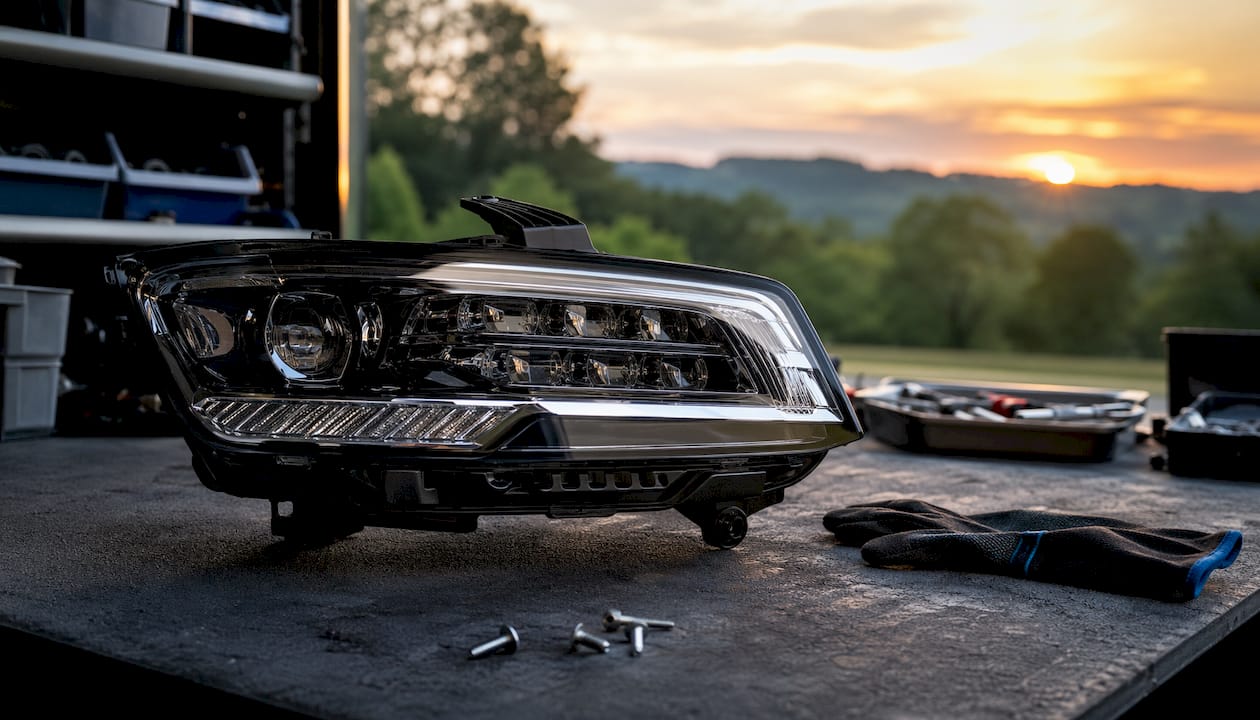
Digital Light Processing takes this further. The Huawei XPixel system, revealed at the 2026 Beijing Auto Show, uses over one million individually controlled pixels per headlamp with full RGB output. The underlying DLP chip technology uses microscopic mirrors that tilt thousands of times per second to create a precise, high-resolution image. The result is a headlight that can project navigation arrows, lane guidance, and safety warnings directly onto the road surface.
Key capabilities of these advanced systems:
- Selective dimming: Masks individual vehicles, pedestrians, and cyclists without reducing overall beam reach
- Dynamic light distribution: Widens the beam in urban areas, extends it on rural highways
- Curve anticipation: Shifts illumination toward the expected vehicle path before the steering input completes
- Road projection: Displays turn-by-turn navigation, speed limit reminders, and pedestrian crossing alerts on the road surface
- Sign suppression: Reduces intensity on reflective traffic signs to prevent visual discomfort
Callout: The Huawei XPixel DLP headlamp handles full road-legal illumination, adaptive beam shaping, and full-color projection simultaneously from a single compact module. Regulatory frameworks in the United States do not yet permit road-projection systems of this type, though adaptive driving beams were formally authorized here in 2022.
For a deeper look at how Matrix LED systems fit into the broader LED lighting picture, the technology has moved well beyond simple brightness.
Engineering challenges you need to understand before upgrading
Brightness on paper and brightness on the road are two different things. Automotive lighting depends on three core components: the light source, the reflector, and the lens, as explained in detail by Automotive Lighting Repair in Plano, TX | Headlights, Brake Lights & Electrical. Upgrading only the bulb without matching the reflector and lens design causes scattered light and unsafe glare. HELLA engineers are direct about this: luminous intensity and beam pattern control matter more than raw lumen ratings.
“The major functional aim of the reflector is to capture the greatest possible share of the luminous flux radiated by the bulb and to direct this towards the road. Upgrading bulbs alone is insufficient without matching reflector and lens design; mismatches cause scattered light and unsafe glare.” — HELLA Automotive Lighting
Thermal management is the other challenge most enthusiasts underestimate. High-performance LEDs generate concentrated heat, and if the thermal path is inadequate, the system throttles output to protect itself. Professional assemblies use fans or large aluminum heat sinks to prevent this. A headlight that looks impressive in a garage test may dim noticeably after 20 minutes on the highway if thermal design is poor.
Electrical health matters too. Voltage drops from degraded wiring or a weak alternator reduce effective brightness regardless of bulb quality. Measuring voltage at the bulb socket is the right first step before any upgrade.
Best practices for effective, safe lighting upgrades:
- Match the light source to the existing reflector and lens system, or replace all three together
- Verify voltage at the bulb socket before purchasing new bulbs
- Choose assemblies with active cooling or adequate heat sink mass for high-output LEDs
- Use TIR optics for precise focal control in custom or aftermarket applications
- Confirm DOT FMVSS 108 compliance for any street-driven vehicle
- Avoid “off-road use only” LED bulbs for daily driving; they typically exceed legal candela limits
Morimoto’s XB Evo projectors illustrate this well. They run at approximately 50% of maximum output in stock form, placing them at the upper edge of DOT compliance. The remaining capacity is reserved for off-road use only. That discipline is what separates a properly engineered headlight from one that simply looks bright on a spec sheet.
Smart adaptive lighting is where the technology is heading
Adaptive lighting systems represent the clearest direction for automotive lighting in 2026 and beyond. These systems use sensors and algorithms to adjust beam patterns in real time based on speed, steering angle, and road curvature. The goal is not simply more light. It is the right light, in the right place, at the right moment.
Adaptive driving beams continuously adjust the high-beam pattern to create a shadow around other vehicles, delivering high-beam visibility while protecting oncoming drivers from glare. Curve-adaptive headlights pivot in the direction of travel, and research found they allowed drivers to spot a hard-to-see object on a dark, curvy road about one-third of a second earlier than with conventional fixed headlights.
Advantages of smart adaptive systems:
- Maintain high-beam visibility in mixed traffic without driver input
- Reduce eye fatigue by eliminating abrupt low-to-high beam switching
- Improve detection of pedestrians, animals, and road debris on dark roads
- Automatically widen or narrow the beam based on driving environment
Limitations worth knowing:
- Performance degrades in heavy rain, fog, snow, or with dirty lenses
- Hills, braking pitch, and vehicle load can shift beam geometry outside intended parameters
- Full road-projection capabilities remain restricted by U.S. regulations
Pro Tip: If your vehicle supports high-beam assist, activate it on unlit rural roads. Drivers often underestimate how much earlier they can spot obstacles with a properly managed high beam compared to staying on low beams out of habit.
How to choose custom lighting that actually enhances your vehicle
Custom lighting for enthusiasts goes well beyond swapping bulbs. The most effective builds combine high-output LED strips, wheel light rings, and properly engineered wire harnesses into a system where every component works together. High-density LED strips deliver consistent brightness across the full length of the strip, which matters for wheel wells and undercarriage applications where uneven output looks amateurish.
Wire harnesses are the component most enthusiasts overlook. A harness designed specifically for automotive LED loads handles current draw cleanly, prevents voltage drop across long runs, and protects against shorts. Wheellightexpress designs all wire harnesses and LED strips in Louisiana, which means the products are built for the electrical realities of American vehicles rather than adapted from generic overseas components.
Popular custom lighting components for enthusiasts:
- Wheel light rings and strips: Add color and motion to wheel wells with consistent, high-density output
- Replacement wire harnesses: Protect your electrical system and maintain clean power delivery to every LED
- High-density interior strips: Bright, even cabin lighting without hot spots or dim sections
- Remote harness systems: Control multiple lighting zones from a single remote
Balancing brightness with legality is straightforward when you plan the build correctly. Interior and wheel lighting are generally not subject to the same candela restrictions as headlights, but color restrictions apply in most states. White and amber are universally safe for exterior use. Red and blue are restricted in most jurisdictions for non-emergency vehicles. Check your state’s vehicle code before committing to a color scheme for any exterior-facing application.
Statistic callout: LEDs draw 15–25W compared to 55W for halogen, which means adding multiple LED lighting zones to a vehicle places far less strain on the electrical system than a comparable halogen setup would.
For enthusiasts ready to build a complete lighting system, Wheellightexpress offers financing options that make quality components accessible without requiring full payment upfront.
Ready to upgrade your vehicle’s lighting? Wheellightexpress designs every product in Louisiana with enthusiasts in mind. Browse our wheel light rings and strips and custom wire harnesses to build a lighting system that performs as well as it looks. Every order comes with our satisfaction guarantee.
Key Takeaways
LED headlights deliver 3,000–6,000+ lumens with a 20,000–50,000 hour lifespan. Halogen bulbs produce 1,100–1,500 lumens, with both figures requiring matched optics, proper thermal management, and a healthy electrical system for maximum results.
| Point | Details |
|---|---|
| LED vs halogen brightness | LEDs produce 3,000–6,000+ lumens with 15–25W power draw versus 1,100–1,500 lumens at 55W for halogen. |
| Optics must match the source | Upgrading bulbs without matching the reflector and lens causes glare and reduces effective road illumination. |
| Thermal management is critical | LEDs throttle output when heat builds up; quality assemblies use heat sinks or active cooling to maintain luminous flux. |
| Matrix LED and DLP lead in control | Matrix LED dims individual segments around other vehicles; DLP systems like Huawei XPixel use over one million pixels per headlamp. |
| Custom builds need proper wiring | A purpose-built wire harness prevents voltage drop and protects the electrical system across multiple LED lighting zones. |