

Automotive lighting color combinations are curated blends of colors chosen to enhance vehicle appearance, improve visibility, and express personal style through exterior and interior lights. The right color scheme does more than look good. It communicates your vehicle’s identity, supports safe driving, and reflects your personal taste. Whether you are planning custom car lighting for a show build or simply upgrading your daily driver, understanding how colors interact on a vehicle is the foundation of every great result. This guide covers the most effective car light color schemes, how to choose car lights that fit your style and the law, and the exact steps to install your setup with confidence.
What are the most effective automotive lighting color combinations?
The most effective automotive lighting color combinations follow established color theory principles adapted for vehicle use. Three schemes dominate the enthusiast world: complementary, analogous, and monochromatic.
Complementary color schemes pair colors from opposite sides of the color wheel. Common complementary combos include blue and orange, yellow and purple, and red and cyan. These pairings create strong visual contrast, which is why they appear on show cars and custom builds where maximum visual impact is the goal.
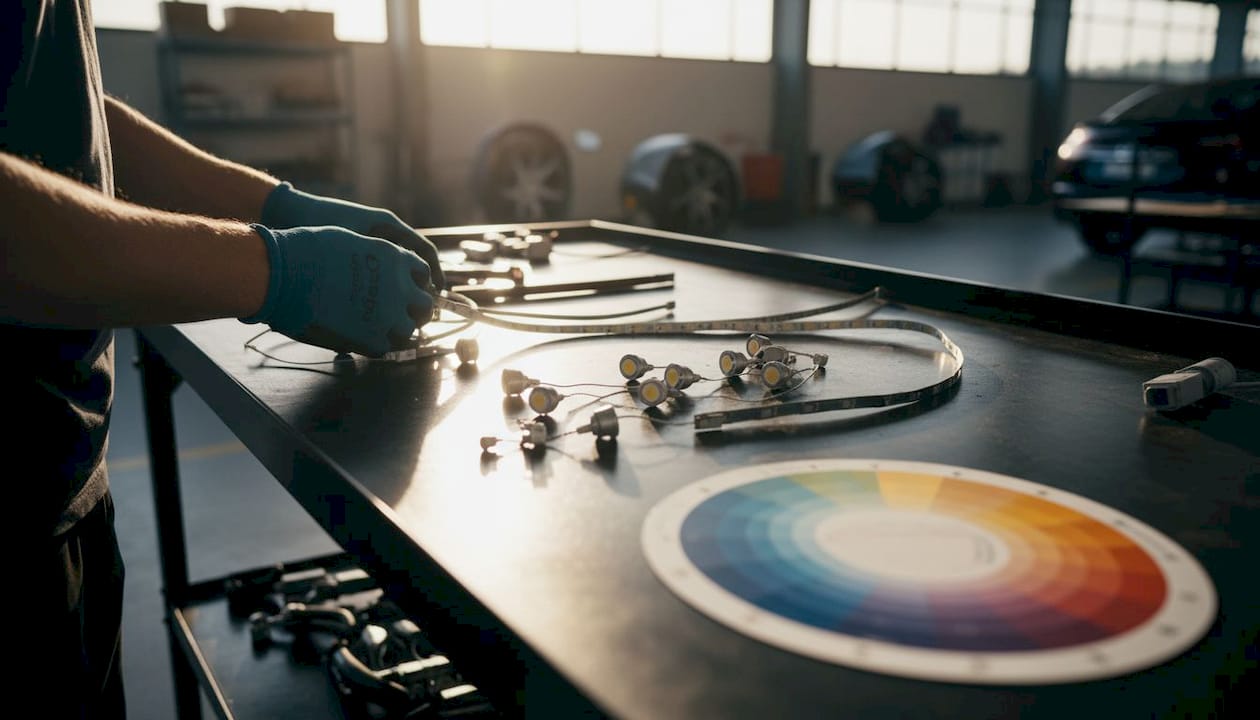
Analogous schemes use colors that sit next to each other on the color wheel, such as amber, yellow, and warm white. These combinations feel natural and cohesive. They work well for exterior lighting where you want a unified look without harsh contrast.
Monochromatic schemes use a single color in varying brightness levels or shades. An all-white exterior with a warm white interior is a classic example. This approach reads as clean and premium, especially on dark-colored vehicles.
- Complementary: high contrast, bold visual statement, best for show builds
- Analogous: cohesive and natural, ideal for daily drivers
- Monochromatic: clean and premium, works on any vehicle color
Pro Tip: Warm amber exterior accents pair exceptionally well with cool white headlights. The contrast draws the eye to your vehicle’s lines without looking chaotic.
Safety plays a direct role in color selection for exterior lights. High-contrast colors improve visibility at night and in poor weather. Selective-yellow LEDs operating at a wavelength of 585–595 nm reduce backscatter in fog and rain. That means more light reaches the road and less bounces back into your eyes.
How to choose the right lighting colors for your vehicle
Choosing the right car light color schemes requires you to think about three things: the vehicle’s purpose, the driving environment, and the applicable regulations. Interior and exterior lighting each have their own rules.
Interior lighting color selection
Interior lighting color directly affects how alert and comfortable you feel while driving. Warm amber or soft white tones in the 1800K–2700K range at low brightness (5–15%) preserve night vision and reduce eye strain. Cool blue-rich light above 4300K increases glare and reduces driver visibility at night. That is a real safety concern, not just an aesthetic preference.
High CRI lighting accurately renders interior materials like leather and wood, giving your cabin a premium, uniform appearance. CRI stands for Color Rendering Index. A score of 90 or above is the standard for premium automotive interiors. Lower CRI lighting makes materials look washed out or off-color, which undermines even the most expensive build.
Modern interior lighting also draws on emotional design principles. Lighting tied to natural environments, such as sunrise amber or twilight blue, promotes calmness and alertness inside the cabin. This is why many premium automakers now offer multi-zone ambient lighting with nature-inspired presets.
Exterior lighting color selection
- Start with your headlights. DOT-certified white or selective yellow are your legal options for forward-facing lights in the United States. Selective yellow at 3000K–3500K provides twice the lumen output of traditional halogens and cuts through fog more effectively.
- Choose your accent colors next. Amber, white, and red are the safest choices for exterior accents because they do not mimic emergency vehicle lighting. RGB underglow kits add creative expression but must comply with local laws.
- Match your accent color to your vehicle’s paint. A silver or gray vehicle looks sharp with cool white or blue-tinted accents. A black vehicle pops with warm amber or red. A white vehicle benefits from subtle warm white accents that add depth without washing out the paint.
- Consider context-aware lighting. Systems that automatically adjust color temperature and brightness based on whether you are driving or parked improve both safety and personalization. Warm, low-intensity light for driving. Dynamic RGB only when the parking brake is engaged.
Pro Tip: Check your state’s vehicle lighting laws before purchasing any colored exterior lights. Rules vary significantly between states, and some colors are outright prohibited on public roads.
You can find a detailed breakdown of LED types and their applications in this automotive LED lighting guide from Wheellightexpress.
How do you design and install custom automotive lighting color combinations?
A successful custom lighting install starts with a plan, not a parts order. Rushing to buy LED strips before you have mapped your color palette is the most common mistake enthusiasts make.
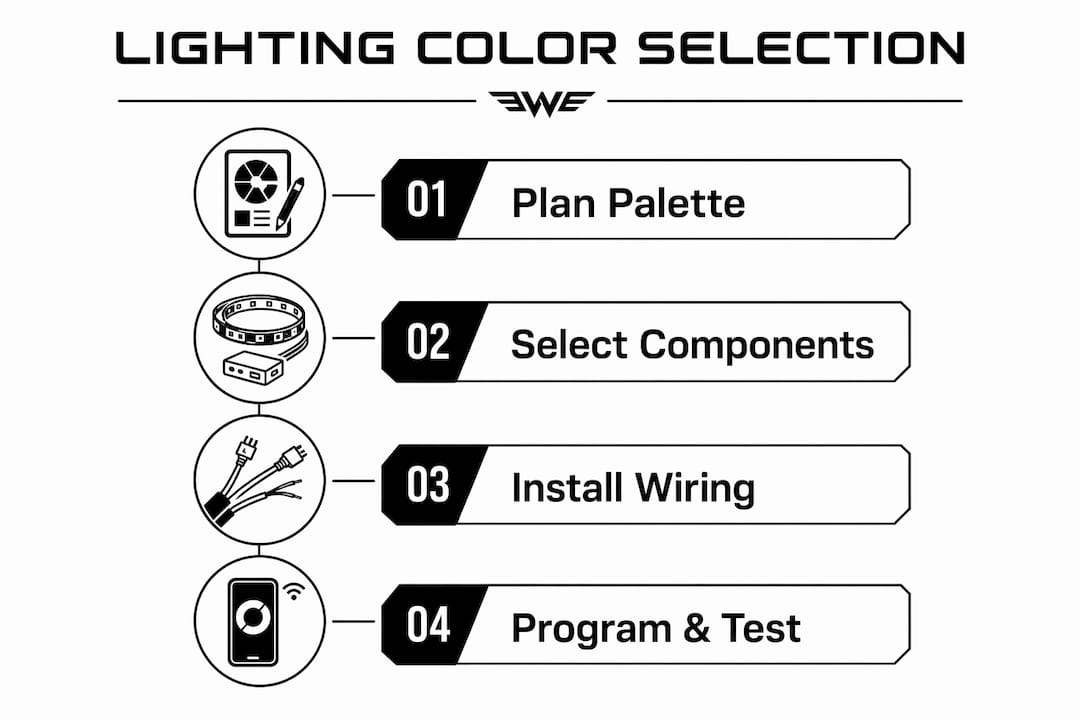
Step 1: Plan your color palette
Write down your vehicle’s paint color, interior trim color, and the look you want to achieve. Decide whether you are going for a complementary, analogous, or monochromatic scheme. Sketch the zones you want to light: wheel wells, underbody, interior footwells, door panels, and engine bay. Each zone can carry a different intensity of the same color, or you can use your accent color in one zone and your base color in another.
Step 2: Select your components
A balanced automotive LED setup typically includes DOT-certified headlights, amber fog lights, and RGB accent or underglow kits. Each component serves a different purpose. Your headlights and fog lights are safety items. Your accent lights are creative expression.
For LED quality, look for strips and bulbs that use chips from established manufacturers. High-quality automotive-grade LEDs maintain tight color temperature tolerances of ±200K to prevent color shifts and uneven lighting effects. A green shift or color separation in your beam pattern is a sign of low-quality chips. CSP bi-color LEDs offer 40% better thermal stability and meet ISO 16750-3 vibration and IP68 waterproof standards. That matters for wheel well and underbody applications where heat and moisture are constant factors.
For halogen-based assemblies, the Snake Eye 7 Inch Halogen Lens Assembly is a well-regarded option for enthusiasts building a retro or custom front-end look.
Step 3: Install and wire your system
- Mount LED strips in clean, dry locations away from direct heat sources
- Use quality wire harnesses to prevent voltage drop and color inconsistency across zones
- Connect your controller before finalizing any permanent mounting
- Run wiring through existing grommets and factory channels to keep the install clean
Pro Tip: Always test your full color scheme at night before finalizing the install. Colors look dramatically different under artificial light versus natural daylight, and you want to see exactly what other drivers will see.
Step 4: Program and test
Set your controller to your planned color scheme and test each zone individually. Check for color mismatch between strips, which usually signals a wiring issue or mismatched LED batches. Adjust brightness levels so no single zone overpowers the others. A well-balanced setup draws the eye across the whole vehicle, not just one bright spot.
You can explore the lighting layering technique for more detail on building depth and balance across multiple lighting zones.
What are the legal limits for automotive lighting color combinations?
Legal restrictions on automotive lighting colors are strict and vary by state, but several rules apply everywhere in the United States.
- Blue lights are prohibited on non-emergency vehicles in all 50 states. Blue is reserved for law enforcement. Using it on a public road is illegal and dangerous.
- Flashing or strobing lights are restricted to emergency vehicles. Dynamic RGB patterns that flash or strobe must be disabled while driving.
- Red lights visible from the front of a vehicle are prohibited in most states. Red is a rear-facing color by convention and law.
- Underglow and accent lights are legal in most states when they are non-flashing, non-blue, and not red at the front. Always verify your local code.
- Interior RGB lighting is legal when it does not distract the driver or create glare. Dynamic RGB effects are allowed only when parked or with the parking brake engaged.
“Avoid colors that mimic emergency vehicles. Keep dynamic lighting internal and subdued where laws restrict visible colored lights. The goal is personal expression, not confusion on the road.”
The role of original lighting design in vehicles covers how enthusiasts balance creative freedom with compliance in real-world builds.
Key Takeaways
The most effective automotive lighting color combinations balance color theory, technical quality, and legal compliance to deliver both visual impact and safe operation.
| Point | Details |
|---|---|
| Color scheme selection | Choose complementary, analogous, or monochromatic schemes based on your vehicle’s style and purpose. |
| Interior color temperature | Use 1800K–2700K warm tones at low brightness for night driving to protect your vision. |
| Exterior LED quality | Select LEDs with ±200K CCT tolerance and IP68 ratings to prevent color shift and weather damage. |
| Legal compliance | Never use blue, flashing, or front-facing red lights on public roads in the United States. |
| Context-aware lighting | Automate color and brightness changes based on driving state to improve safety and personalization. |
Why I stopped treating lighting color as an afterthought
Most enthusiasts pick their LED colors the same way they pick a phone case. They grab whatever looks cool in the product photo and figure out the rest later. I spent years doing exactly that, and the results were always slightly off. A purple underglow that clashed with a red paint job. A cool white interior that made night driving feel like staring into a hospital hallway.
The shift happened when I started treating lighting color the same way a designer treats a color palette. Every color on the vehicle needs a reason to be there. The exterior base, the accent, and the interior tone should all relate to each other. When they do, the vehicle looks intentional. When they do not, it looks like a parts catalog exploded.
The other thing I learned the hard way is that cheap LEDs lie to you. They look fine in the store and terrible on the car. Color consistency between strips matters more than peak brightness. A set of strips with tight chromaticity tolerances will always outperform a brighter set that shifts green at the ends.
My honest advice: plan your palette on paper first, buy quality components second, and test everything at night before you commit to permanent mounting. The car community culture rewards builds that look considered, not just expensive.
— Christopher
Wheellightexpress has the components to complete your build
Wheellightexpress designs all of its lighting products in Louisiana, which means every component is built with American enthusiasts in mind. If you are ready to put your color plan into action, the Wheel Light Ring and Strip is a strong starting point for wheel well and accent lighting with original designs you will not find sourced overseas.
For wiring your setup correctly, the wire harness leads from Wheellightexpress are built to handle the demands of custom installs without voltage drop or color inconsistency. Financing options are available, so you can build your full lighting setup without waiting. Every order comes with a satisfaction guarantee.
FAQ
What are the best automotive lighting color combinations for a daily driver?
Analogous color schemes using amber, warm white, and soft yellow are the best choice for daily drivers. They look cohesive, comply with most state laws, and do not distract other drivers.
What color temperature is best for interior car lighting at night?
Warm tones in the 1800K–2700K range at 5–15% brightness are best for night driving. They preserve your night vision and reduce eye strain compared to cool blue-rich light above 4300K.
Are colored exterior lights legal on public roads?
Most non-flashing, non-blue exterior accent lights are legal in the United States, but rules vary by state. Blue lights and flashing patterns are prohibited on non-emergency vehicles in all 50 states.
What does CRI mean for automotive interior lighting?
CRI stands for Color Rendering Index and measures how accurately a light source renders colors. A CRI of 90 or above is the standard for premium automotive interiors, ensuring leather, wood, and trim look true to their actual color.
How do I prevent color shift in LED strips?
Choose LED strips with a CCT tolerance of ±200K and chips from established manufacturers. High-quality automotive-grade LEDs maintain consistent color across all strips in a multi-zone setup.