

If your dash throws a bulb-failure warning or your turn signal hyper-flashes after an LED swap, you need a CANbus-compatible solution. If nothing on the dash complains and the flash rate looks normal, a standard non-CANbus LED works fine and costs less. Swap the old halogen back in for five minutes to confirm which category your vehicle falls into before you buy anything.
TL;DR:
- Vehicles with digital lamp monitoring or messaging systems typically require CANbus-compatible LEDs to prevent warning lights and hyper-flash symptoms.
- Load resistors are suitable for simple current-sensing circuits in older vehicles but do not solve message-based monitoring faults found in modern cars.
- Match the adapter wattage to your original halogen bulb, using 5W for interior lights and 21W for exterior signals, and verify your bulb code before purchase.
- Running a proper vehicle-specific kit built around your exact model reduces installation time and minimizes troubleshooting compared to universal parts.
- Non-CANbus LEDs will not damage your vehicle but may trigger warnings, and using the correct CANbus-compatible components helps avoid warranty issues.
Table of Contents
- CANbus vs Non-CANbus LEDs: What Each One Actually Does
- Does Your Vehicle Actually Need CANbus-Compatible Lighting?
- Load Resistors, CANbus Decoders, or Integrated Drivers: Which Fix Fits?
- Choosing the Right Adapter: 5W vs 21W and Fit Basics
- Still Getting Errors? A Troubleshooting Checklist
- How Wheel Light Express Approaches CANbus Compatibility
- Will Non-CANbus LEDs Void Your Warranty or Damage Your Electrical System?
- Is CANbus Worth the Extra Cost Over Standard LEDs?
- The Real Lesson Buried in Most CANbus Advice
- Get Model-Verified Lighting Kits That Skip the Guesswork
- Sources
- FAQ
CANbus vs Non-CANbus LEDs: What Each One Actually Does
CANbus-ready LEDs carry extra electronics onboard that either draw enough current to mimic a halogen bulb or talk directly to your vehicle’s communication network. Non-CANbus LEDs skip that circuitry entirely. They’re just a diode, a driver, and a housing, drawing a fraction of the current a halogen bulb pulls.
That current gap is the whole story. Modern vehicles built around a Body Control Module watch how much current flows through each lighting circuit, and some go further, using digital messaging over CAN or LIN networks to confirm a bulb is present and functioning. Drop in a low-draw LED where the system expects halogen-level current, and you get a false “bulb out” alert, a turn signal that blinks twice as fast, or a flicker that wasn’t there before.
Here’s how the two options actually stack up:
- CANbus-ready LEDs: eliminate false bulb-failure warnings, reduce flicker on monitored circuits, and integrate cleanly with vehicles using digital lamp monitoring.
- Non-CANbus LEDs: cost less, install faster, and work without issue on older vehicles or unmonitored circuits like most interior dome lights and cargo lamps.
- The trade-off: CANbus electronics add a few dollars and a small footprint increase; non-CANbus bulbs save money but gamble on compatibility.
Neither option is universally “better.” The right choice depends entirely on what your specific vehicle is watching for, which is why diagnosis comes before purchase.
Does Your Vehicle Actually Need CANbus-Compatible Lighting?
You don’t have to guess. A handful of quick checks will tell you which camp your vehicle falls into before you spend a dollar on bulbs.
Watch for these symptoms after installing standard LEDs:
- A dashboard warning light or message reading “bulb out,” “lamp failure,” or similar.
- Hyper-flash: your turn signal blinking roughly twice its normal rate.
- Intermittent flicker, especially noticeable at idle or low RPM.
- Any new error code, limp-home behavior, or warning chime that appeared right after the install.
If any of those show up, put the original halogen bulb back in for a few minutes. If the warning clears, you’ve confirmed the problem is current draw or signal detection, not a wiring fault. From there, check your owner’s manual or a model-specific forum for terms like “bulb monitoring” or “lamp out detection.” Vehicles from roughly the last 15 years, and nearly every premium or European brand, tend to run some form of monitoring, whether current-sensing or full digital messaging.
Pro Tip: Search your exact year, make, and model plus “hyper-flash fix” before buying anything. Fixes vary wildly between a 2015 half-ton pickup and a 2022 model with a full CAN network, and a forum thread from an owner of your exact truck saves you a return shipment.
Load Resistors, CANbus Decoders, or Integrated Drivers: Which Fix Fits?
Three main paths exist once you’ve confirmed your vehicle is flagging the LED swap, and they are not interchangeable.
Load resistors (sometimes called equalizers) wire in parallel with the LED to add artificial current draw, tricking a current-sensing circuit into thinking a halogen bulb is installed. They’re the cheapest fix and simplest to wire. The catch: they generate real heat, need ventilated mounting space, and do nothing for vehicles that monitor lamps through digital messaging rather than raw current. Wire one into the wrong system and you’ll still get warnings, plus a hot resistor tucked somewhere in your engine bay.
CANbus decoders and adapters are built to either simulate the expected electrical load more intelligently or communicate directly with the Body Control Module, depending on how your vehicle’s monitoring works. These run cooler than resistors and handle the message-based systems found in newer vehicles that a simple resistor can’t fool.
Integrated LED drivers with built-in CANbus awareness fold the compatibility electronics into the bulb or fixture itself. They tend to cost more but eliminate a separate component to wire, mount, and potentially fail down the road.
The practical rule: reserve resistors for older, simple current-sensing systems, and lean on decoders or integrated drivers for anything using CAN or LIN messaging, or for any fault that persists after a resistor install. Guessing wrong here means paying twice.

Choosing the Right Adapter: 5W vs 21W and Fit Basics
Wattage selection is where most first-time installs go wrong. Philips guidance on adapter sizing is straightforward: match the adapter to the wattage of the halogen bulb you’re replacing, not to the LED itself.
- 5W adapters typically suit interior lighting, small marker bulbs, and other low-draw applications.
- 21W adapters cover exterior circuits: turn signals, position lights, and other higher-draw applications that pulled more current as halogens.
- Bulb codes matter as much as wattage. Confirm you’re buying the correct code, such as 1156, 1157, 194, or 3157, since a physical mismatch will cause fitment problems no adapter can fix.
- Polarity matters on LEDs in a way it never did on halogens. If a bulb doesn’t light, try rotating it 180 degrees before assuming it’s defective.
- Favor a model-verified kit or harness over a generic universal resistor jammed into a cramped, unventilated spot behind a bumper or under a dash panel.
Pro Tip: Check your fuse box before blaming the bulb. A blown fuse looks identical to a compatibility issue, and it takes thirty seconds to rule out.
Route any wiring, resistor, or adapter away from heat sources and secure it so vibration doesn’t work it loose over time. If your vehicle has a published LED or accessory compatibility list from the manufacturer, check it. It can save you a return.
Still Getting Errors? A Troubleshooting Checklist
Persistent flicker or warnings after installing a CANbus fix usually trace back to one of three causes, and working through them in order saves time.
- Reinstall the original halogen bulb. If the warning clears, the issue is confirmed to be current draw or signal detection, not a wiring or BCM fault. If the warning stays, look at wiring or a connector before touching the bulb again.
- Swap in a different CANbus adapter or LED set. A faulty decoder or a bad LED unit is more common than people expect, and swapping components isolates whether the hardware itself is defective.
- Check for PWM dimming or message-based monitoring. If your headlights or taillights dim through pulse-width modulation, LEDs can flicker even on a fully functional circuit because they react faster to voltage pulses than halogens do. This usually means you need a vehicle-specific decoder or ECU coding rather than a generic adapter.
A systematic triage approach, checking wiring first, then confirming bulb behavior, then isolating the circuit, is standard practice among technicians for a reason: it stops you from replacing parts that were never the problem. If you’ve worked through all three steps and the fault persists, revert to OEM bulbs and consult a dealer. Some vehicles genuinely require dealer-level ECU coding that no aftermarket adapter can replicate.
How Wheel Light Express Approaches CANbus Compatibility
Christopher covers CANbus troubleshooting and plug-and-play decoder selection on a blog, focusing on the diagnostic side of LED retrofits rather than generic sales copy. That model-check-first approach shapes how Wheel Light Express designs its own hardware.
Products are designed with the fit and wiring quirks of specific truck and off-road platforms in mind, not a generic one-size-fits-most template. A harness engineered around your actual wiring layout removes a huge chunk of the guesswork that turns a thirty-minute install into a weekend project. Choosing a kit or harness from a designer who understands where these compatibility issues actually originate cuts troubleshooting time compared to piecing together mismatched parts from different sellers.
Will Non-CANbus LEDs Void Your Warranty or Damage Your Electrical System?
Installing non-CANbus LEDs will not physically damage a modern vehicle’s electrical system. The low current draw that triggers warning lights doesn’t create a dangerous condition. It just confuses a monitoring circuit designed around halogen-level current.
Warranty concerns are a separate, more nuanced issue. Aftermarket lighting generally doesn’t void a full vehicle warranty on its own, but a dealer could reasonably decline coverage for a specific electrical fault if a non-CANbus LED installation is the demonstrable cause, such as a blown fuse from an improperly wired resistor or a BCM fault traced to incorrect polarity. The distinction that matters is causation. Adding a resistor incorrectly, routing wiring against a hot exhaust manifold, or leaving a connection loose creates real risk. A properly matched CANbus-ready bulb or a correctly wired decoder carries essentially none.
The safest path if warranty coverage matters to you: keep your original halogen bulbs stored somewhere accessible so you can reinstall them before any dealer visit, and choose components rated for your specific make and model rather than generic universal parts. That single habit resolves most warranty friction before it becomes a conversation.
Is CANbus Worth the Extra Cost Over Standard LEDs?
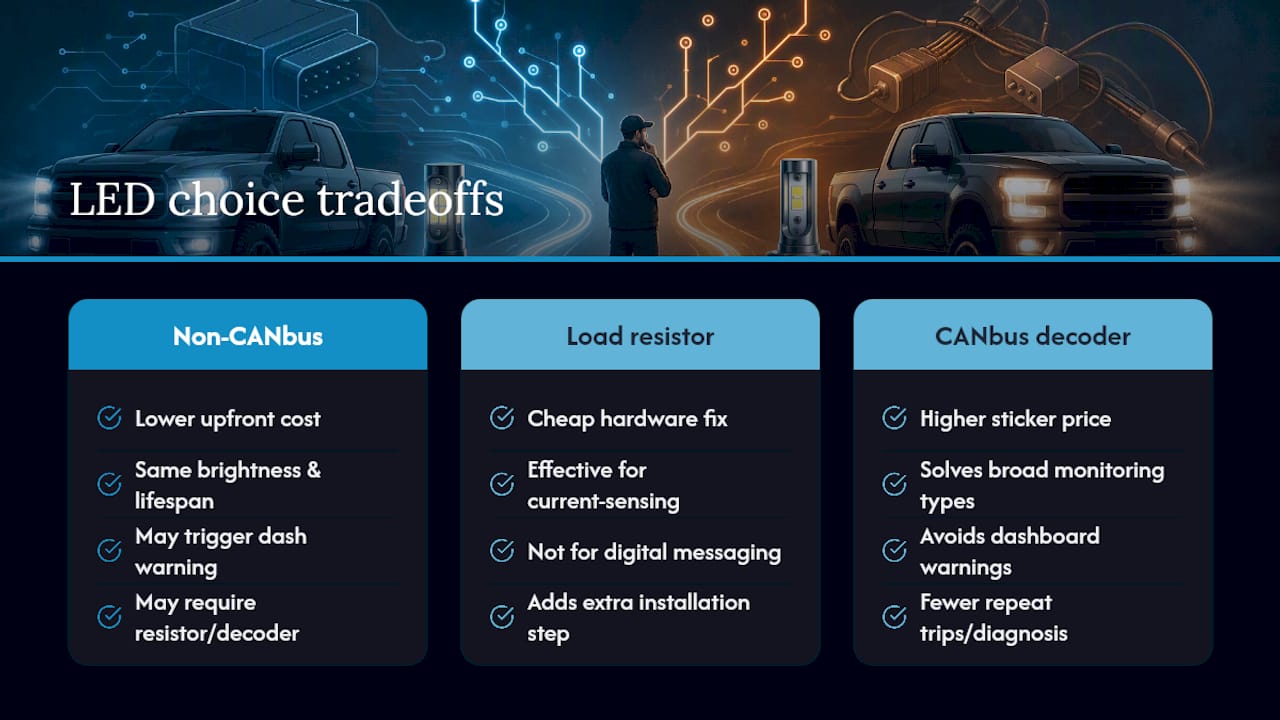
Non-CANbus LEDs typically run cheaper upfront since they skip the extra circuitry entirely. For a vehicle with no lamp monitoring, that’s a straightforward win: you get equivalent brightness and life span without paying for electronics you don’t need.
The math changes fast once monitoring enters the picture. A non-CANbus bulb that triggers a dashboard warning isn’t actually cheaper. You’re stuck driving with a nagging alert, or you’re buying a second product (a resistor or decoder) after the fact, which erases the initial savings and adds a second installation session. Factor in the time spent diagnosing an unexpected warning, and the “budget” option often costs more in hours than the CANbus-ready part would have cost in dollars.
Load resistors sit in the middle: cheap and effective for simple current-sensing systems, but not a fix for anything running digital messaging. CANbus decoders and integrated drivers cost more than resistors but solve a broader range of monitoring types and tend to run cooler, which matters if you’re mounting components in a tight engine bay.
The realistic value calculation isn’t “which bulb costs less.” It’s “how many trips to the parts store will this decision cost me.” A model-verified kit that works the first time, even at a higher sticker price, usually beats a cheap bulb plus a return trip plus a resistor plus another round of troubleshooting.
The Real Lesson Buried in Most CANbus Advice
Most CANbus content online treats load resistors as the default fix, but that’s backwards for how modern vehicles actually behave. Resistors solve one specific problem: simple current-sensing circuits. They do nothing for the digital messaging systems that have become standard on a growing share of vehicles on the road, and jamming one into a cramped engine bay to fix a message-based fault wastes money and adds a heat source you didn’t need.
The advice that actually holds up is checking your specific vehicle’s monitoring type before buying anything. That one step, confirmed by swapping the original bulb back in and searching your model’s known behavior, eliminates most of the trial-and-error that makes CANbus troubleshooting feel harder than it is.
What gets underrated is fit. A decoder that solves the electrical problem but dangles loose behind a bumper, or a resistor mounted somewhere it can’t shed heat, creates a new problem to replace the old one. Prioritize a harness or kit built around your actual vehicle over a universal part that technically works but fights you on installation.
— Christopher
Get Model-Verified Lighting Kits That Skip the Guesswork
Kits are designed so that harnesses and adapters are built around real fitment, not a generic template that leaves you improvising in a parking lot.

If you’re upgrading beyond a single bulb swap, the Wheel Lights collection covers standard, High Density, and Ultra High Density options built for consistent brightness without the compatibility headaches a mismatched universal part invites. Off-roaders adding ground-level visibility can browse the Rock Lights lineup, while anyone dealing with wiring uncertainty from a previous install should look at the replacement wire harness built specifically to reduce fit and compatibility problems. Every purchase comes backed by a satisfaction guarantee, and financing options mean you don’t need to pay the full cost upfront to get a properly designed setup on your truck. Head to the product pages, check your model against the fitment details, and order the kit built for your rig instead of hoping a universal part cooperates.
Sources
Technical claims here draw on Philips CANbus adapter documentation, the CANbus adapter guide from Carneon Lighting, the CANbus vs non-CANbus comparison from CarLightVision, and fleet lighting triage steps from Premier Fleet Repair.
- Philips LED CANbus Adapters
- Do LED Headlight Bulbs Require CANbus Adapters? Expert Guide
- Fix Trailer Lights Fast: 5 Minute Triage for Drivers and Fleets - Premier Fleet Repair
FAQ
What Does CANbus Mean for LED Bulbs?
CANbus refers to your vehicle’s internal communication network, and a CANbus-ready LED bulb includes electronics designed to work correctly with vehicles that monitor bulb current or status through that network. Without it, low-draw LEDs can trigger false bulb-failure alerts on monitored circuits.
Can I Just Use a Load Resistor Instead of a CANbus Decoder?
Resistors work on simple current-sensing systems but won’t resolve faults on vehicles using digital message-based monitoring. Check whether your vehicle uses current sensing or digital messaging before choosing between the two.
Should I Buy 5W or 21W CANbus Adapters?
Match the adapter wattage to your original halogen bulb rather than the new LED. Philips guidance points to 5W for interior and small marker applications and 21W for exterior turn signals, position lights, and similar higher-draw circuits.
How Much Do Wheel Light Express Products Cost?
Pricing varies by product line, and current prices are listed directly on the Wheel Lights and Rock Lights collection pages. The Solar Powered Cab Lights are listed at $399.
Will Non-CANbus LEDs Damage My Truck’s Electrical System?
Non-CANbus LEDs won’t physically damage a modern electrical system on their own. They can trigger a false warning light on monitored circuits, but the fix is a compatible adapter or decoder, not a wiring repair.