

LED strips are the superior choice for automotive lighting because they deliver more brightness per watt, last up to six times longer, and operate at voltages safe enough for DIY installation. The core reasons why LED strips outperform neon come down to five measurable factors: energy efficiency, lifespan, safety, durability, and customization. Traditional neon glass tubes require 3,000–15,000 volts, shatter on impact, and lock you into a single fixed color. LED flex strips, the industry term for flexible silicone-encased LED neon alternatives, run on 12–24V DC, bend to a 25mm radius, and support full RGB color control. For automotive enthusiasts, that gap is not a minor detail. It defines what you can build and how long it will last.
How do LED strips and neon compare on energy efficiency?
LED strips consume roughly 75% less electricity than traditional neon for equivalent brightness. That number matters in a vehicle because every watt you pull from the electrical system competes with your alternator, battery, and other accessories.
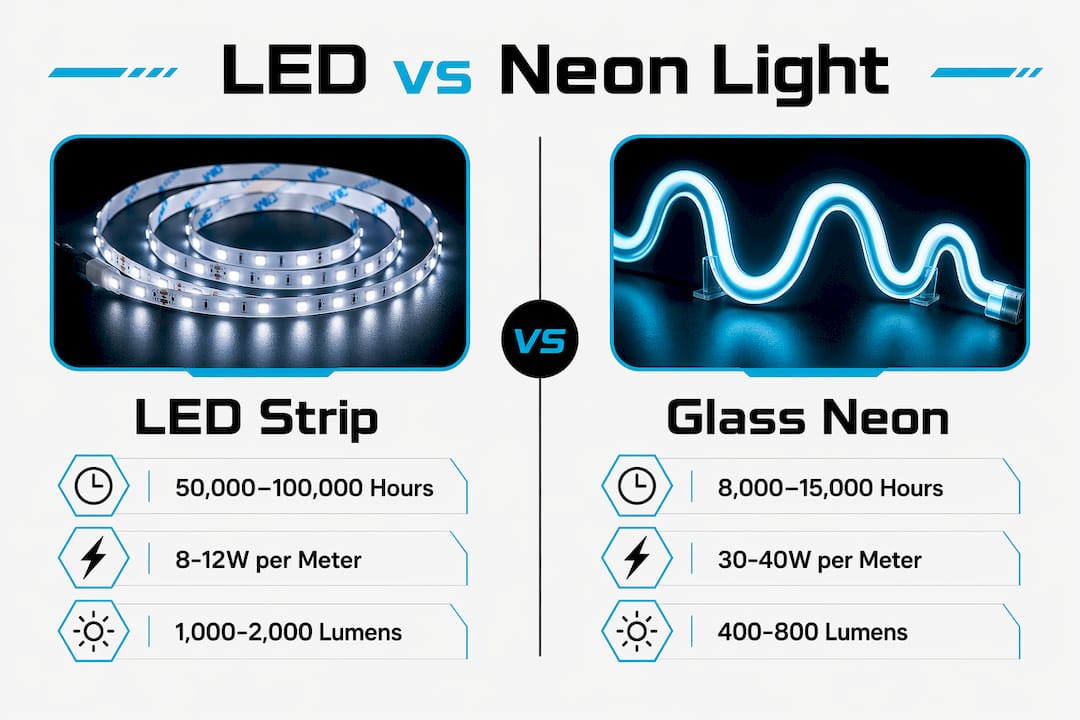
The watt-per-meter comparison is stark. LED strips draw 8–12W per meter while producing brightness equivalent to a glass neon tube running at roughly 40W per meter. That is a four-to-one efficiency advantage on a per-meter basis. On a full underbody kit covering 10 meters, the difference between 100 watts and 400 watts is the difference between a clean install and a stressed electrical system.
LED systems also produce 1,000–2,000+ lumens per meter compared to neon’s 400–800 lumens per meter. Higher lumen output at lower wattage means you get a brighter, more visible result without taxing your vehicle’s power supply. For builds running multiple lighting zones, wheel lights, and interior accents simultaneously, that efficiency compounds fast.
Pro Tip: When planning a multi-zone LED install, add up the total wattage across all strips and confirm your wire harness and fuse ratings can handle the load before powering up.
Why do LED strips last longer than neon in automotive builds?
LED flex strips carry a typical lifespan of 50,000–100,000 hours compared to 8,000–15,000 hours for glass neon tubes. At average use rates, that translates to years of reliable performance versus a product that may need replacement within two to three years.
Neon tubes degrade through gas loss. As the noble gas inside the tube slowly escapes, the tube dims unevenly and eventually goes dark entirely. The transformer that drives the high voltage also ages, requiring service as it loses efficiency. Neon transformers and tubes dim progressively and demand maintenance that LED systems simply do not.
The modular design of LED strips adds another practical advantage. LED segments can be selectively replaced when a section fails, while a glass neon failure causes the entire tube to go dark. On a vehicle, that means you can cut out a damaged section and splice in a replacement strip without pulling the entire install. Neon offers no such option.
| Factor | LED Flex Strip | Glass Neon Tube |
|---|---|---|
| Lifespan | 50,000–100,000 hours | 8,000–15,000 hours |
| Failure mode | Sectional, repairable | Full tube blackout |
| Maintenance | Minimal | Transformer and tube service |
| Vibration resistance | High (silicone body) | Low (glass, fragile) |
| Replacement cost | Low (modular sections) | High (full tube replacement) |
Glass neon is also physically fragile in ways that matter on a vehicle. Road vibration, speed bumps, and minor impacts that a silicone LED strip absorbs without issue can crack a neon tube. That fragility creates what YIZEE Lighting describes as a “breakage tax,” the hidden cost of contingency parts and installation delays that neon builds routinely carry.
What safety advantages do LED strips offer over neon?
LED strips operate at 12–24V DC, which is the same voltage range as your vehicle’s standard electrical system. Traditional neon requires a transformer to step voltage up to 3,000–15,000 volts. That transformer sits somewhere in your vehicle, generating heat and representing a genuine shock and fire risk near fuel lines, wiring, and flammable materials.
High-voltage neon transformers produce noticeable heat. That heat represents a fire and burn risk near the flammable materials common in automotive interiors and undercarriages. LED strips run cool by comparison, which is not just a comfort feature. It is a safety compliance factor for any build that needs to pass inspection or insurance review.
The installation difference is equally significant:
- LED strips connect directly to your vehicle’s 12V system using standard connectors and wire harnesses, no licensed electrician required.
- Neon installations require a professional to handle high-voltage transformer wiring safely.
- LED neon flex is lightweight and DIY-friendly, while glass neon requires careful handling to avoid breakage during installation.
- Silicone-encased LED strips contain no mercury gas, eliminating the environmental and health hazard present in glass neon tubes.
- LED strips are shatterproof, so a rock strike or parking lot impact will not send glass fragments into your wheel well or undercarriage.
Pro Tip: Always use a fused wire harness rated for your total LED wattage. A properly fused circuit protects both your strips and your vehicle’s electrical system from shorts.
How do LED strips offer better customization than neon?
LED flex strips bend to a minimum radius of 25mm, which means they follow tight curves around wheel arches, door sills, and bumper edges without kinking. Glass neon requires a much larger bend radius and must be custom-formed by a glassblower for each unique shape. That process takes time, costs money, and cannot be changed once the tube is made.
Color customization is where LED technology creates the largest gap. Here is what LED strips support that neon cannot:
- RGB color mixing. Red, green, and blue LEDs combine to produce millions of colors from a single strip. Neon is locked to the color of its gas fill, typically red, blue, or white.
- RGBW output. Adding a dedicated white LED channel produces cleaner whites and pastels that pure RGB mixing cannot achieve accurately.
- Tunable white. Dual-white LED strips let you shift between warm and cool white tones, useful for interior accent lighting.
- Dynamic color changes. LED controllers from brands like Govee and similar systems allow color cycling, strobing, music sync, and app-based control. Neon has no equivalent.
- Zone control. Addressable LED strips let you program individual segments to display different colors simultaneously, creating gradient effects across a full underbody run.
For a deeper look at how LED strip density affects brightness and visual impact on custom builds, the high-density LED strip guide at Wheellightexpress covers the technical specs that matter most for vehicle applications.
Neon does produce a distinctive warm glow with a soft diffusion that some enthusiasts still prefer for a retro aesthetic. That is a legitimate preference. But it is the only area where neon holds any advantage, and it comes at the cost of every practical performance metric.
What should you consider when choosing LED strips for your vehicle?
The total cost of ownership favors LED strips decisively. LED lighting systems reduce total cost through lower energy draw, longer service life, easier repairs, and no high-voltage components to maintain or replace. Neon looks cheaper upfront in some cases, but the transformer, professional installation, and eventual tube replacement close that gap quickly.
Before you buy, work through these practical checkpoints:
- Wattage per meter. Match your strip’s wattage to your wire harness capacity. Wheellightexpress designs wire harnesses specifically for automotive LED loads, which removes the guesswork from this step.
- IP rating. For underbody and wheel well applications, choose strips rated IP65 or higher for water and dust resistance.
- Controller compatibility. Confirm your RGB or RGBW controller supports the strip type you select. Mismatched controllers produce incorrect colors or no output at all.
- Mounting surface. Silicone-bodied LED strips adhere well to clean metal surfaces. Prep the surface with isopropyl alcohol before applying adhesive-backed strips.
For a full breakdown of how LED strips perform across different vehicle zones, the LED strip applications guide at Wheellightexpress covers underbody, wheel, interior, and exterior setups with specific product recommendations.
Weather and vibration resistance also deserve attention. LED neon flex is waterproof and resilient in environments prone to vibration and impact. Glass neon is fragile during transport and installation, and road vibration accelerates tube failure over time. For any vehicle that sees regular road use, that durability difference is not theoretical. It shows up in how long your install actually holds up.
Key takeaways
LED strips outperform neon in automotive lighting because they combine lower energy draw, longer lifespan, safer voltage, and full color control in a single durable package.
| Point | Details |
|---|---|
| Energy efficiency | LED strips use 75% less electricity than neon, reducing strain on your vehicle’s electrical system. |
| Lifespan advantage | LED flex strips last 50,000–100,000 hours versus 8,000–15,000 hours for glass neon tubes. |
| Safety at low voltage | LED strips run at 12–24V DC, eliminating the fire and shock risks of neon’s 3,000–15,000V transformers. |
| Modular repairability | Failed LED sections can be replaced individually; neon tube failure takes out the entire run. |
| Customization range | LED strips support RGB, RGBW, and dynamic color control that neon’s fixed gas color cannot match. |
Why i think neon’s reputation outlasts its usefulness
I have watched a lot of enthusiasts choose neon for the aesthetic and then spend the next two years managing the consequences. The glow is real. The nostalgia is real. But the practical trade-offs stack up faster than most people expect.
The safety issue is the one I take most seriously. Routing a high-voltage transformer into a vehicle that sees road vibration, moisture, and temperature swings is a risk that does not get enough attention in build forums. LED technology has closed the visual gap with neon significantly. Modern silicone-diffused LED strips produce a soft, even glow that reads nearly identical to neon from a few feet away. The retro look is achievable without the fragile glass and high voltage.
My honest recommendation is this: if you want the neon aesthetic, build it with LED flex strips. You get the look, the color flexibility, the longevity, and the ability to fix a section yourself on a Saturday afternoon instead of waiting for a specialty shop. The lumen output comparison data backs this up. LED simply delivers more light per watt at every brightness level neon can reach. Choose based on performance, and the choice is clear.
— Christopher
Upgrade your vehicle’s lighting with Wheellightexpress

Wheellightexpress designs every LED strip and wire harness in Louisiana, built specifically for automotive applications. If you are ready to move past neon and install a lighting system that holds up to real road conditions, the aftermarket lighting catalog covers wheel light rings, LED strips, wire harnesses, and replacement components. Every product ships with a satisfaction guarantee, and financing options mean you do not have to wait to build the setup you want. We stand behind our designs because we build them for enthusiasts who expect their lighting to perform every time they drive.
FAQ
How much less energy do LED strips use than neon?
LED strips use approximately 75% less electricity than traditional neon for comparable brightness. At the watt-per-meter level, LED strips draw 8–12W/m versus neon’s roughly 40W/m.
Can LED strips replicate the neon glow on a vehicle?
Yes. Silicone-diffused LED flex strips produce a soft, even glow that closely matches the visual effect of glass neon. They also support RGB color mixing, giving you far more color options than neon’s fixed gas fill.
Are LED strips safe to install without a professional?
LED strips operate at 12–24V DC, the same voltage as your vehicle’s standard electrical system, making them safe for DIY installation. Neon requires a high-voltage transformer and professional wiring to operate safely.
What happens when an LED strip fails on a vehicle?
Only the affected section goes dark, and it can be cut out and replaced independently. Glass neon tube failure causes the entire tube to go dark with no modular repair option.
How long do automotive LED strips last compared to neon?
LED flex strips typically last 50,000–100,000 hours. Glass neon tubes last 8,000–15,000 hours before gas loss causes dimming and eventual failure.