
Rock lights are legal to own and install in every state, but running them on public roads is a different question entirely, and the answer depends on where you’re driving. The biggest risk factor isn’t the lights themselves, it’s color, flashing, and visibility. Keep them off on public roads unless your state clearly permits a steady white or amber setup, and you’ll avoid nearly every citation risk. Federal rules under FMVSS 108 set the baseline, but state law does the real work, and that’s exactly what compliant lighting designs should consider.
TL;DR:
- Running rock lights on public roads is generally prohibited if they display flashing patterns, red or blue colors, or are visible as bare LEDs from certain angles.
- State laws vary from broad restrictions to specific allowances for steady white or amber lights, with some states enforcing strict color and pattern limits.
- Proper installation involves recessed mounting, diffusion covers, and a kill switch to help maintain legal compliance and avoid citations.
- Most citations focus on equipment violations and can often be resolved by quickly turning off the lights and correcting any non-compliant setup.
- Checking local statutes and using compliant hardware like diffusion housings and preset controls significantly reduces the risk of legal issues.
Table of Contents
- Are Rock Lights Street Legal Under Federal Law?
- What Rules Actually Show Up in State Vehicle Codes?
- How Do Rock Light Laws Differ by State?
- How Can You Keep Rock Lights Street Legal?
- What Happens if You Get Cited for Rock Lights?
- Does Rock Lighting Affect Your Insurance or Liability?
- When Do Officers Actually Pull People Over for Rock Lights?
- A compliant rock light kit should consider the reality of state law, including recessed mounting points, diffusion housings, dedicated wiring harnesses, and kill-switch-ready controls to reduce the odds of roadside issues. Steady-only presets in control options can help with compliance.
- Get Rock Lights Built for Compliance, Not Just Looks
- Where to Check Your State’s Exact Rock Light Rules
- Sources
- FAQ
Are Rock Lights Street Legal Under Federal Law?
There’s no federal statute banning rock lights outright. FMVSS 108 governs vehicle lighting equipment nationwide, but it focuses on color placement and making sure aftermarket lights don’t interfere with required lamps like headlights, taillights, and turn signals. It doesn’t specifically regulate rock lighting as a category, which is exactly why states have filled the gap with their own rules.
That gap creates the patchwork enthusiasts run into constantly. A setup that’s fine in one state can draw a citation two states over. Before a road trip, it pays to check the actual statute or your state’s DMV site rather than trust a forum post from someone in a different jurisdiction.
- FMVSS 108 sets the federal floor for lighting color and placement.
- State vehicle codes add restrictions on top of that floor.
- Municipal ordinances can tighten things further, especially in cities.
- DMV websites and state legislature pages carry the current, binding language.
What Rules Actually Show Up in State Vehicle Codes?
Most state codes converge on four things: color, pattern, visibility, and mounting. Get these right and you’ve covered most of the compliance risk.
Color is the biggest one. Red and blue are reserved for emergency vehicles almost everywhere, and using them while driving invites more than a simple equipment ticket. White or amber is generally the safer lane, though even that carries front/rear restrictions in some states, similar to how amber belongs up front and red belongs at the rear on standard vehicle lighting.
Patterns matter just as much. Flashing, strobing, and chase-sequence modes read as emergency-vehicle mimicry or driver distraction, and most state codes prohibit them on public roads regardless of color.
Visibility and mounting trip people up the most, because even a plain white LED pod can trigger a citation if the bare light source is directly visible from certain angles. Recessed mounting, diffusion lenses, and downward aim solve this.
- Never run red or blue while driving, in any state.
- Disable flashing, strobe, or chase modes before hitting the road.
- Conceal the bare LED point source; diffuse and aim down.
- Keep brightness and beam spread modest to avoid glare complaints.
Pro Tip: If you can see the individual LED dots when standing next to the vehicle at night, an officer can see them too. Diffusion covers fix this cheaply and fast.
How Do Rock Light Laws Differ by State?
The patchwork is real, and it breaks down into roughly three camps.
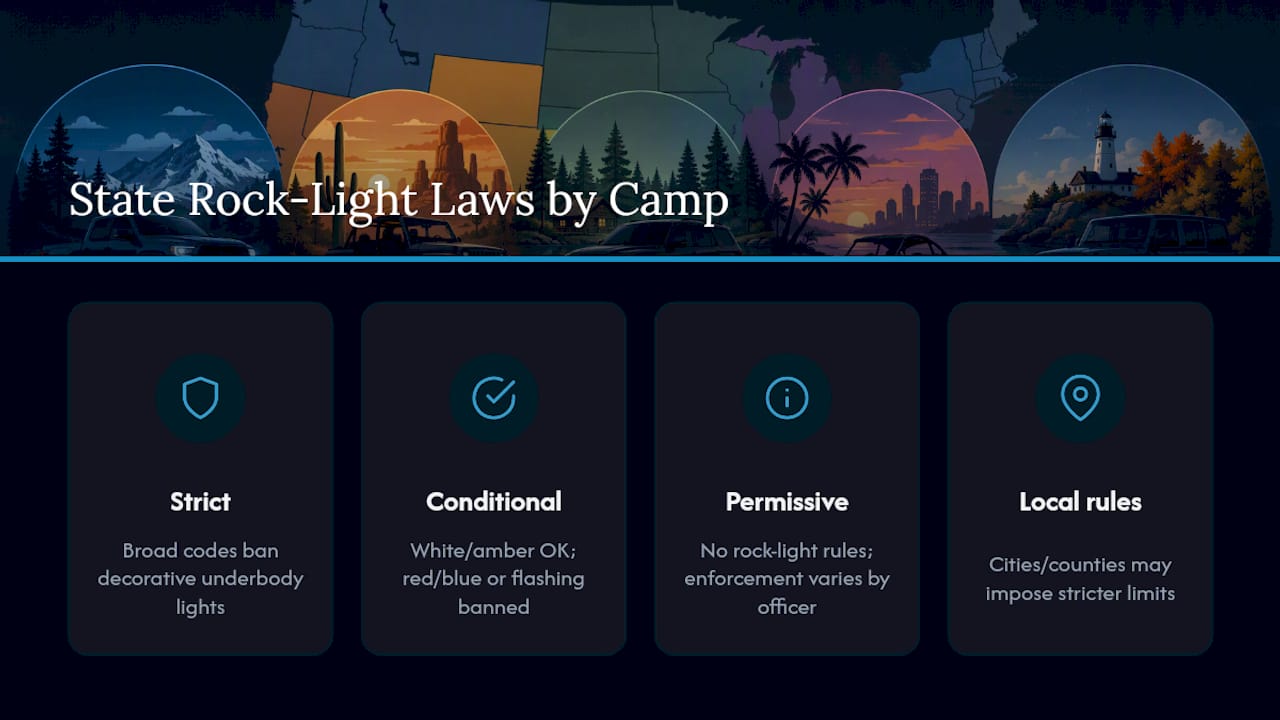
Strict states write vehicle codes broadly enough to cover decorative underbody lighting entirely. New York’s statute language on prohibited lighting equipment is a good example: it’s broad enough that decorative underglow and rock lighting while driving fall under general restrictions, not a narrow carve-out.
Conditional states spell out exactly what’s allowed. Texas statutes permit white or amber lighting under specific conditions but explicitly prohibit flashing, red, and blue, which gives builders a clear steady-on lane to work within.
Permissive-by-omission states don’t name rock lights specifically but still enforce general distraction and visibility statutes, so the outcome depends heavily on the officer and the specific setup. Arizona tends to fall here in practice, and enthusiasts often assume that means anything goes, which isn’t quite right.
Illinois and Michigan both sit closer to the conditional camp, restricting color and flash patterns while tolerating steady white or amber in defined circumstances.
The one constant across all three camps: a city or county ordinance can be stricter than the state code covering it, particularly in dense urban areas where local zoning and equipment rules add another layer. Check both before you assume you’re clear.
How Can You Keep Rock Lights Street Legal?
A compliant rock light setup comes down to five habits, and none of them require sacrificing how the truck looks at a show or on the trail.
- Mount them recessed. Use a housing and diffusion lens that hides the bare LED source from direct sightlines, which addresses the “visible point source” language several states rely on.
- Install a labeled kill-switch. A dedicated master off, clearly marked near the driver, or an app-based controller with a public-road preset removes the guesswork.
- Default to steady white or amber. Disable RGB, chase, and strobe modes before you’re anywhere near a public road, and save the color shows for the driveway.
- Check the state DMV before crossing lines. A quick look at the destination state’s statute beats finding out the hard way at a checkpoint.
- Comply immediately if stopped. Power the system off, stay polite, and if you know the local code supports your setup, mention it calmly rather than arguing the point on the roadside.
Good wiring is what makes steps two and three actually usable instead of theoretical. A proper wire harness with an accessible switch means “turn it off” takes two seconds, not a trip to the fuse box.
Pro Tip: Set your remote’s “off” button as the first preset in the sequence, not the last. Muscle memory matters more than menu logic when a patrol car’s lights show up in your mirror.
What Happens if You Get Cited for Rock Lights?
Most rock light stops end as ordinary equipment violations, not criminal matters. Officers typically issue an equipment citation, sometimes called a fix-it ticket, requiring you to correct the issue and show proof within a set window.
- Fines for illegal decorative lighting commonly run from $50 to $300 or more, depending on the state and whether it’s a repeat violation.
- Inspection failures are possible in states with annual vehicle inspections if the lighting setup doesn’t meet code.
- Criminal exposure is rare but real: red or blue lighting, or flashing patterns that mimic emergency vehicles, can escalate into impersonation-related charges in some jurisdictions, which is a far bigger problem than a fine.
The practical move is simple: comply fast. Powering the system off and correcting the setup before your court date almost always keeps things at the equipment-citation level.
Does Rock Lighting Affect Your Insurance or Liability?
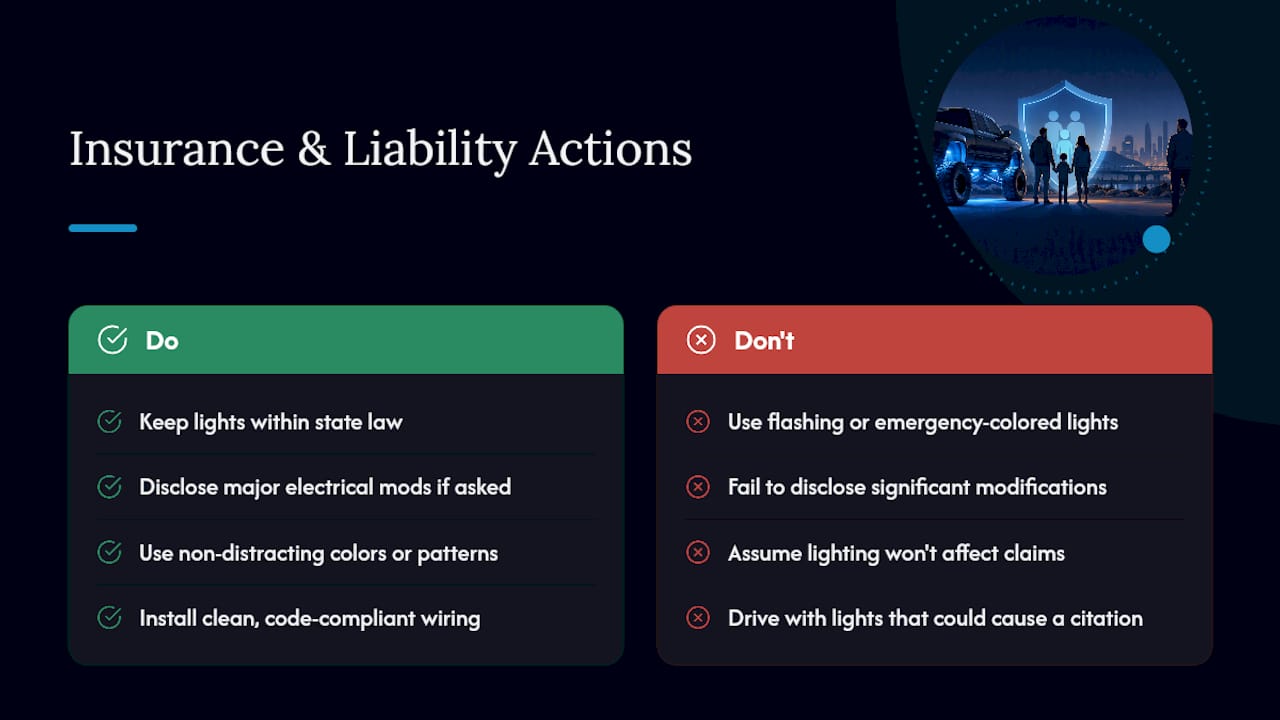
Rock lights themselves rarely show up as a line item on an insurance policy, but they can matter a lot after an accident. If an insurer determines that non-compliant lighting, particularly flashing or emergency-colored lights, contributed to a collision by distracting another driver or creating confusion, that finding can affect a liability claim.
Aftermarket modifications in general sit in a gray zone with many standard auto policies. Some insurers treat significant aftermarket electrical work as a modification that should be disclosed, and undisclosed modifications occasionally give carriers grounds to dispute part of a claim. This isn’t unique to rock lights, it applies to any wiring change that goes beyond factory equipment, but lighting draws extra scrutiny because it’s visible and because color/pattern violations are documented on a police report if you’re cited at the scene of a crash.
The safer position is straightforward: keep the setup within your state’s legal boundaries, disclose major electrical modifications to your insurer if asked, and avoid any color or pattern that could be read as a factor in driver distraction. A citation on record at the time of an accident gives an adjuster an easy reason to argue partial fault, even when the lighting had nothing to do with what actually caused the crash. Clean, code-compliant installations remove that argument entirely.
When Do Officers Actually Pull People Over for Rock Lights?
Enforcement isn’t random. A handful of scenarios account for most rock light stops.
The most common trigger is color at night: red or blue glow underneath a vehicle catches attention instantly, because it visually echoes emergency lighting even when the driver has no intent to impersonate anything. The second most common trigger is flashing or chase patterns, which read as distraction hazards regardless of color and are explicitly banned in most state codes.
Traffic stops for other reasons, a broken taillight, expired tags, speeding, often turn into equipment citations for rock lights as a secondary finding once the officer approaches the vehicle at night and notices the underglow. Because enforcement leans on broad “distraction” or “visible light source” language in many statutes, officers have real discretion in how they apply it, which means identical setups can get treated differently in two counties of the same state.
Parking lots and car meets rarely trigger anything, since most codes target operation on public roads specifically. The risk concentrates almost entirely on driving with the lights active after dark, which is also the easiest risk to eliminate: the kill-switch habit covered above handles it.
A compliant rock light kit should consider the reality of state law, including recessed mounting points, diffusion housings, dedicated wiring harnesses, and kill-switch-ready controls to reduce the odds of roadside issues. Steady-only presets in control options can help with compliance.
None of that replaces checking your own state’s statute before you drive with lights active. What it does is give you hardware that makes compliance the easy default rather than an afterthought.
— Christopher
Get Rock Lights Built for Compliance, Not Just Looks
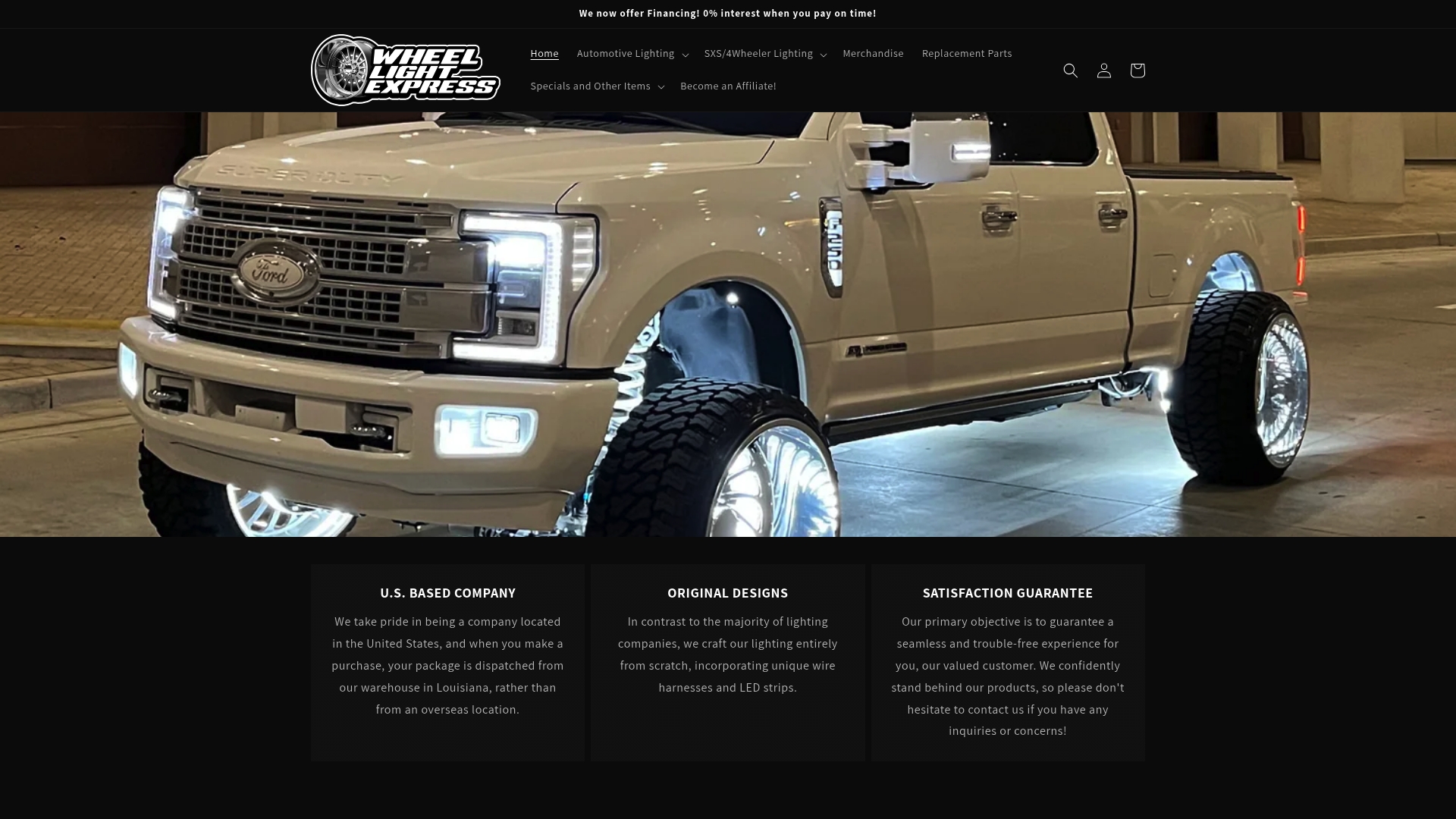
Wheellightexpress is the direct route to lighting hardware built with the compliance habits this guide covers already baked in, not bolted on after the fact. Our wheel light ring and strip kits use diffusion and mounting that keep bare LED points out of direct sightlines, and our wire harness leads make a labeled kill-switch simple to wire in rather than an afterthought project.
If you’re planning an install this season, pair your order with the remotes for remote harness so a public-road preset is one tap away. For a full walkthrough of wiring and color choices before you buy, read our guide on keeping underglow street legal in the U.S., then browse the full lighting collection to build a kit around your state’s specific rules.
Where to Check Your State’s Exact Rock Light Rules
Nothing in this guide replaces the actual statute covering your vehicle. Start with the federal standard, then confirm state and local specifics before you ever flip the switch on a public road.
- Texas Transportation Code, Section 547.332
- New York Vehicle and Traffic Law, Section 375
- Florida Highway Safety and Motor Vehicles
Municipal codes can still be stricter than any of these, so a quick call to local city hall beats guessing.
Sources
- New York vehicle and traffic statutes
- Texas statutes (example link supplied)
- Can You Legally Drive With Rock Lights? Laws & Colors - LegalClarity
FAQ
In What States Are Rock Lights Illegal?
No state bans owning rock lights, but running them while driving is effectively restricted in states with broad decorative-lighting statutes, such as New York, and tightly conditioned in states like Texas that permit only steady white or amber. Check your specific state code before assuming either extreme applies to you.
Can I Get Pulled Over for Rock Lights?
Yes. Red or blue color, flashing or chase patterns, and visible bare LED pods are the top three triggers officers cite most often, and any of them alone is usually enough for a stop.
Can You Use Rock Lights on the Road?
It depends on your state. Some states permit steady white or amber rock lights under specific conditions, while others effectively prohibit any decorative underbody lighting while driving, so the safest default is powering them off on public roads unless you’ve confirmed your state allows it.
Can You Run Rock Lights in Tennessee?
Tennessee doesn’t spell out rock lights by name, so enforcement typically falls under general equipment and distraction statutes similar to other conditional states, meaning steady white or amber carries far less risk than flashing or red/blue setups. Confirm current language with the Tennessee DMV before relying on that pattern for a specific trip.