
Underbody lighting systems are LED or neon fixtures mounted beneath a truck’s chassis to illuminate the ground and accentuate the vehicle’s profile, serving both aesthetic and functional roles on lifted builds. The role of underbody lights on lifted trucks goes beyond visual flair. These systems improve ground-level visibility in low-light conditions, help other drivers gauge your truck’s width and position, and give your build a signature look that stands out at shows and on trails. Brands like OPT7 and AURA PRO have made underglow kits widely accessible, but choosing the right setup requires understanding legal limits, installation best practices, and product differences before you buy.
What is the role of underbody lights on lifted trucks?
Underbody lighting on a lifted truck serves two distinct purposes: visual customization and functional ground illumination. On a standard-height truck, the undercarriage sits close enough to the ground that lighting has minimal visual impact. Lift a truck 4 to 8 inches and suddenly the entire chassis is on display, making underglow a natural extension of the build’s personality.
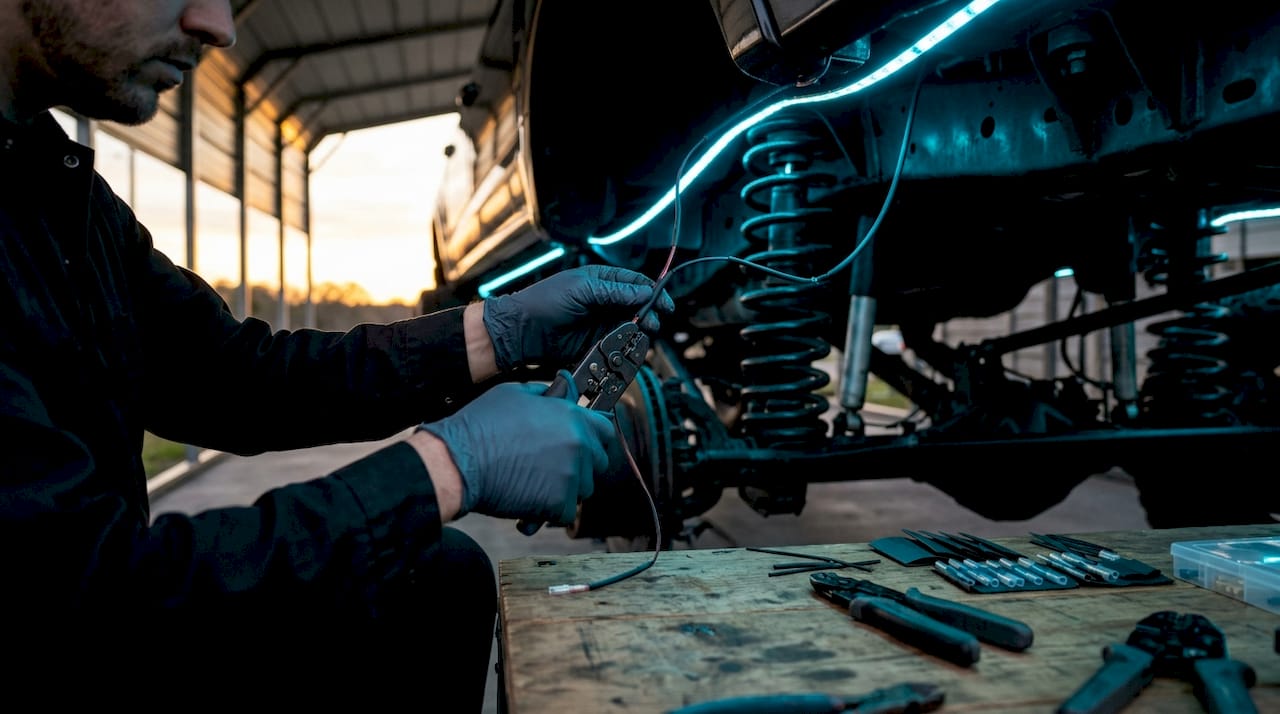
The aesthetic benefits are straightforward. Color options span the full RGB spectrum, and modern LED strips allow you to match your truck’s paint, coordinate with wheel lighting, or program dynamic effects for shows and events. Functional benefits are less obvious but equally real. Underglow lights cast light downward and outward, helping you spot rocks, curbs, and obstacles when parking or crawling off-road at night.
Here is how underbody lighting compares to other auxiliary lighting types commonly used on lifted trucks:
- Rock lights: Pod-style lights mounted in wheel wells or frame rails, aimed directly at the ground for off-road obstacle visibility. Narrower beam, higher intensity, purpose-built for trail use.
- Running board lights: Strip lights mounted along the rocker panels, primarily for step illumination and side visibility. Less dramatic visually, more practical for daily use.
- Underbody/underglow lights: Full-perimeter LED strips running front to rear beneath the chassis. Widest visual coverage, best for aesthetics, and useful for general ground illumination.
Why lighting changes on lifted trucks matters: the added height shifts the light source further from the ground, which widens the illuminated area but also increases the risk of projecting light horizontally into other drivers’ eyes. Careful aiming and brightness selection become more critical the higher your lift.
Pro Tip: Avoid red and blue in your color scheme. In most states, those colors are reserved for emergency vehicles, and using them on a public road can result in a traffic stop or fine regardless of your intent.
How do legal regulations impact underbody lighting on lifted trucks?
Underglow legality varies by state, with nine states prohibiting it entirely on public roads as of 2026. That number matters because many truck owners assume underglow is universally legal as long as it is not flashing. It is not. Each state sets its own rules on color, brightness, and behavior.
The table below summarizes common restriction categories across U.S. states:
| Restriction type | Common rule |
|---|---|
| Prohibited colors | Red and blue banned in nearly all states; green restricted in many |
| Flashing or strobing | Prohibited on public roads in most states |
| Brightness limits | Some states cap candlepower output (Ohio is a notable example) |
| Distance from factory lights | California requires auxiliary lights to be a set distance from OEM lighting |
| Full prohibition | Nine states ban underglow on public roads entirely |
The practical takeaway: white, amber, and purple are the safest color choices for street-legal underglow in most states. Even then, you need to verify your specific state’s code before installation. SAE research on glare control confirms that increased mounting height amplifies glare risk, which is exactly why regulators pay closer attention to lighting on lifted vehicles than on standard-height trucks.
Compliance is not just about avoiding fines. Improperly aimed or illegally colored lights can distract other drivers and create genuine road hazards. The dangers of driving around lifted trucks are already elevated due to height and blind spot differences. Adding non-compliant lighting compounds that risk.
Pro Tip: Before purchasing any underglow kit, look up your state’s vehicle code section on auxiliary lighting. Most state DMV websites publish this directly. A five-minute search saves you from a costly mistake.
What are the best installation practices for underbody lights?
Installing underbody lights on a lifted truck correctly requires more than zip ties and a power tap. A clean, reliable install follows a logical sequence and uses the right components from the start.
- Plan your layout first. Measure the perimeter of your frame and decide whether you want full coverage or zone-specific lighting. Lifted trucks with long wheelbases may need multiple LED strips spliced in series.
- Mount strips to clean, flat frame surfaces. Use self-tapping screws or metal mounting clips rather than adhesive alone. Adhesive backing fails under heat and vibration. Clean the mounting surface with isopropyl alcohol before attaching anything.
- Run a dedicated fused circuit from the battery. Do not tap into an existing circuit. Modular wiring with weatherproof fuse/relay hubs and dedicated grounds is the professional standard. This isolates your lighting system so a fault does not affect other vehicle electronics.
- Use separate fused relays for different lighting functions. If you want white trail illumination and amber flash effects on separate switches, wire them as independent circuits. This is how professional modders approach undercarriage lighting lifted build examples to keep functions clean and fault-tolerant.
- Ground each circuit to bare metal on the frame. Painted surfaces create resistance. A poor ground is the leading cause of flickering and inconsistent brightness.
- Aim strips downward, not outward. Angle LED strips toward the ground to minimize horizontal light projection. On lifted trucks, higher mounting height increases glare risk into oncoming drivers’ eyes, so aim is not optional.
- Test before closing up wiring. Run the system before securing all harness runs. Check for flickering, which usually signals a ground or PWM compatibility issue. PWM signal compatibility prevents hyper-flashing and error codes when integrating with modern truck lighting circuits.
You will need wire strippers, a crimping tool, heat shrink connectors, self-tapping screws, and a multimeter. If you are not comfortable working near the battery or routing wires through the firewall, a professional install is worth the cost.
How do underbody lighting options compare for lifted trucks?
Not all underglow products perform equally. The three main product types each have distinct trade-offs in brightness, durability, and customization depth.
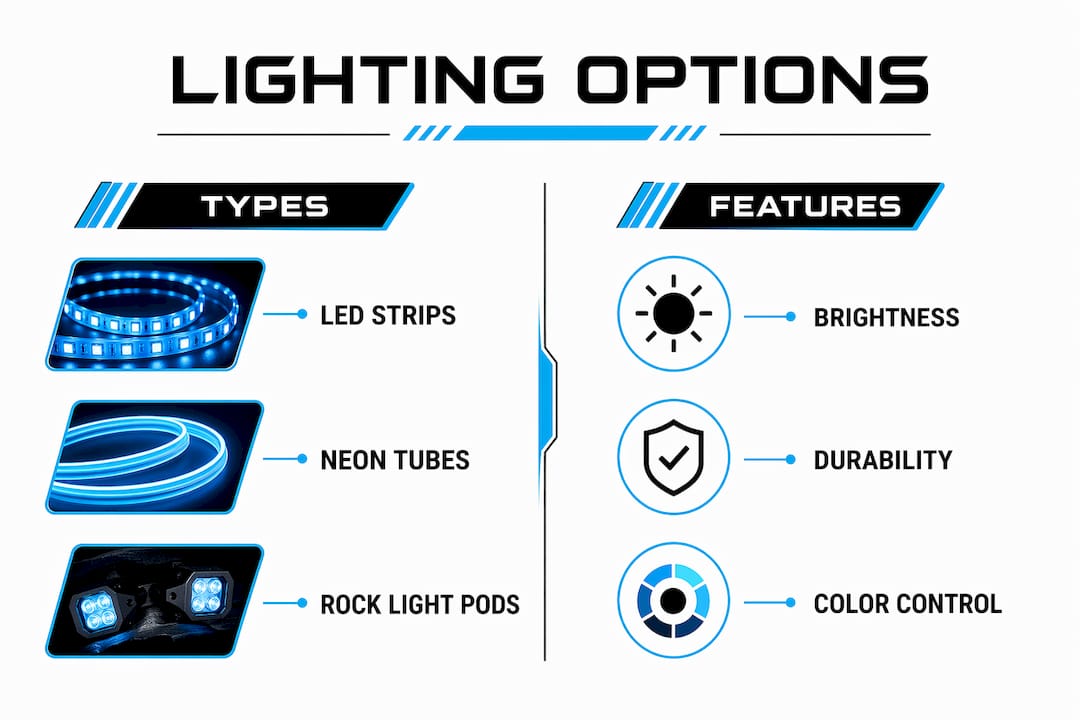
LED strips are the preferred choice for longevity and performance. They produce higher lumen output than neon, resist vibration and moisture better, and support full RGB color control with remote or app-based switching. A quality LED strip kit rated IP67 or IP68 handles mud, water, and trail debris without degrading. Lifespan typically exceeds 50,000 hours under normal use.
Neon tubes offer a softer, more diffused glow that some enthusiasts prefer for a classic look. The trade-off is fragility. Neon is glass-based and cracks under off-road impacts. It also draws more power and offers no dynamic color-change capability. For a show truck that stays on pavement, neon has visual appeal. For any truck that sees dirt, it is a poor fit.
Pod-style rock lights are the third category. These are not traditional underglow but serve a related function. High-intensity pods mounted at frame corners or in wheel wells deliver focused beams for trail use. They are not designed for perimeter aesthetics but excel at functional ground illumination.
Here is a direct comparison of the three types:
| Feature | LED strips | Neon tubes | Rock light pods |
|---|---|---|---|
| Brightness | High | Moderate | Very high (focused) |
| Durability | Excellent (IP67+) | Poor (glass) | Excellent |
| Color options | Full RGB, dynamic | Limited, static | White or single color |
| Off-road suitability | Good | Poor | Excellent |
| Cost | Moderate | Moderate | Higher per unit |
| Lifespan | 50,000+ hours | Shorter | Long |
For most lifted truck owners who want both street presence and trail capability, LED strips are the practical answer. You can compare lumen output options to match brightness to your specific use case before committing to a kit.
What safety practices should truck owners follow with underbody lights?
Underbody lighting enhances visibility but does not eliminate the safety challenges that come with a lifted build. Most accidents involving lifted trucks occur at bumper height due to mismatched impact levels with standard vehicles. Lighting helps other drivers see you, but it does not change your truck’s physical footprint or crash dynamics.
SAE findings on glare show that angular intensity distribution matters more than raw brightness. A light aimed at a 10-degree upward angle from a lifted frame can project directly into the eyes of drivers in standard-height vehicles. Aim strips parallel to the ground or slightly downward to keep light where it belongs.
Amber running lights are the safest choice for side illumination on public roads. Amber is universally recognized as a caution color, does not mimic emergency vehicles, and is less likely to cause glare discomfort than white or blue-tinted LEDs. If you run white underglow for trail use, switch it off before returning to public roads.
Inspect your underbody lighting every three to six months. Vibration loosens connections, and moisture infiltrates imperfect seals over time. A strip that starts flickering is drawing inconsistent current, which stresses your vehicle’s electrical system. Replace or reseal any compromised sections promptly.
Pro Tip: Use a dedicated on/off switch for your underglow system rather than wiring it to run with your headlights. This gives you full control over when the lights are active, which is critical for staying compliant when crossing state lines.
Key takeaways
The role of underbody lights on lifted trucks combines aesthetic customization with functional ground visibility, but legal compliance and proper installation determine whether that role is a benefit or a liability.
| Point | Details |
|---|---|
| Dual purpose confirmed | Underbody lights serve both visual customization and ground illumination on lifted builds. |
| Legal compliance is non-negotiable | Nine states ban underglow entirely; most others restrict color, brightness, and flashing effects. |
| Aiming determines safety | Angular intensity, not raw brightness, drives glare risk on lifted trucks with higher mounting heights. |
| LED strips outperform neon | LED kits offer better durability, brightness, and color control for both street and trail use. |
| Modular wiring prevents failures | Separate fused circuits with weatherproof relay hubs are the professional standard for reliable installs. |
Why I think most truck owners underestimate the installation side
I have seen a lot of lifted builds come through with underglow kits that look great in photos and fail within a season. The lights themselves are rarely the problem. The wiring is. Owners tap into an existing circuit, skip the dedicated ground, and wonder why their strips flicker every time the A/C kicks on.
The aesthetic side of underbody lighting gets all the attention in lifted truck communities and on social media. The functional and legal side gets ignored until someone gets pulled over or a strip shorts out on a trail. That imbalance is worth correcting.
My honest advice: treat the wiring as seriously as the light selection. A quality LED kit paired with a properly fused, weatherproof harness will outlast three cheap kits wired poorly. And before you finalize your color scheme, spend ten minutes on your state DMV’s website. The underglow laws in 2026 are more specific than most people realize, and the fines are not worth the shortcut.
For newcomers to lifted truck customization, start with a single-color white or amber kit on a clean dedicated circuit. Get comfortable with the install, verify compliance, and then expand to RGB and dynamic effects once you know the system is solid. Quality and compliance first. The visual wow factor follows naturally.
— Christopher
Light up your lifted truck the right way with Wheellightexpress
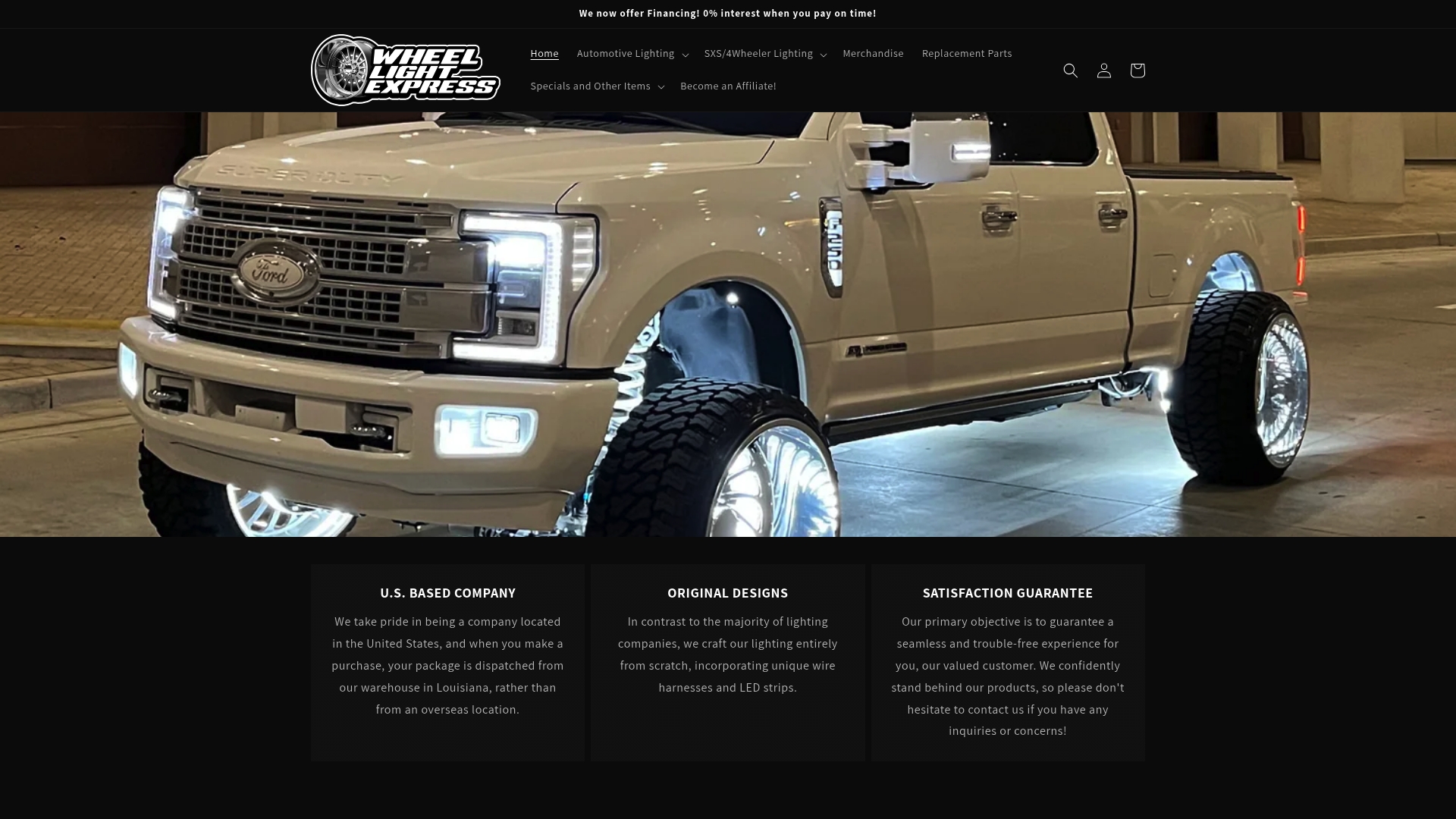
Wheellightexpress designs all of its lighting solutions in Louisiana, which means every LED strip, wire harness, and remote control is built with the specific demands of truck owners in mind. We do not source generic overseas kits. We build products that fit your vehicle and hold up to real-world use.
Our aftermarket lighting collection covers everything from full underglow kits to replacement strips and wiring harnesses. If you need a replacement wire harness to support a modular install, we have that too. Financing options are available so you can get the full setup without waiting. Every purchase comes with our satisfaction guarantee.
FAQ
What do underbody lights actually do on a lifted truck?
Underbody lights illuminate the ground beneath the chassis and accentuate the truck’s profile visually. On lifted builds, the added height makes the undercarriage more visible, giving underglow a stronger aesthetic impact than on standard-height vehicles.
Are underbody lights legal on public roads?
Legality depends on your state. Nine states prohibit underglow on public roads entirely, and most others ban red, blue, and flashing effects. White and amber are the safest color choices for street use in most jurisdictions.
What is the best type of underbody lighting for a lifted truck?
LED strips rated IP67 or higher are the best choice for most lifted truck owners. They offer full RGB color control, high durability against moisture and vibration, and lifespans exceeding 50,000 hours, outperforming neon tubes on every practical metric.
How do I prevent glare from underbody lights on a lifted truck?
Aim LED strips parallel to the ground or slightly downward. SAE research confirms that angular intensity distribution drives glare discomfort more than raw brightness, so proper aiming on a lifted truck is critical given the higher mounting position.
Can I install underbody lights myself?
Yes, with the right tools and a dedicated fused circuit. Use weatherproof connectors, a separate ground to bare metal on the frame, and avoid tapping into existing circuits. If you are not confident with automotive wiring, a professional install protects both your truck and your electrical system.