

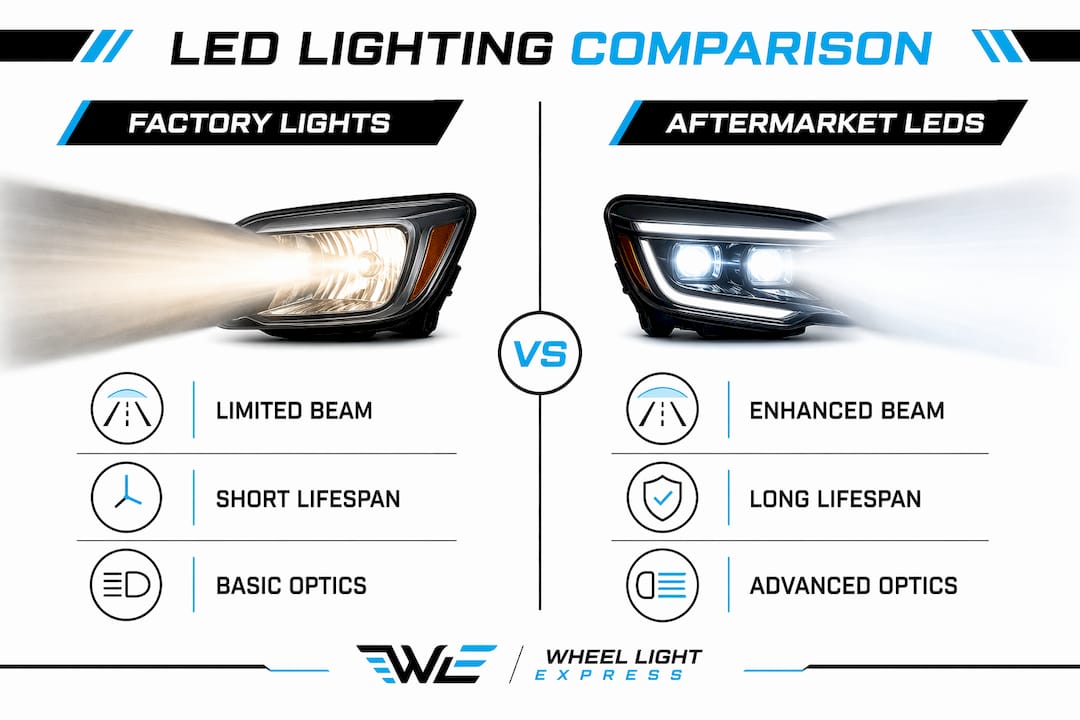
Aftermarket LED systems typically deliver better usable illumination, longer service life, and far more customization than most factory units. Three reasons drive that advantage: superior optics and beam control that put light where the road actually is, engineered thermal management that keeps emitters running at full output for years, and wiring options that integrate cleanly with modern vehicle electronics.
- Optics and beam control determine where light lands, not how many lumens a box claims
- Thermal design separates premium upgrades from budget failures that dim within months
- Harness and CAN-bus compatibility prevent error codes, flicker, and ADAS disruptions
- U.S. compliance (FMVSS 108, SAE J2592) is achievable with certified aftermarket products
- Budget units using foam-tape seals carry a 73% higher condensation risk than butyl rubber alternatives.
Table of Contents
- 1. Why usable light matters more than raw lumens
- 2. U.S. safety and legal standards you need to know
- 3. What to check when buying an aftermarket LED kit
- 4. Installation realities: wiring, CAN-bus, and aiming
- 5. Costs, lifespan, and what to expect over time
- 6. Styling ideas that keep your build street-legal
- Key Takeaways
- The part most guides get wrong about LED upgrades
- Wheellightexpress products that match what this article recommends
- Authoritative sources and further reading
1. Why usable light matters more than raw lumens
The most common mistake buyers make is chasing lumen counts. Lumens measure total light output, but lux on the road surface is what actually improves visibility. A 10,000-lumen bulb crammed into the wrong housing can produce more foreground glare and less down-road reach than a well-engineered 4,000-lumen assembly.
Optics do the real work. Projector housings use a focused lens and a sharp cutoff shield to throw a controlled beam pattern. Reflector housings rely on a shaped bowl to redirect light, and they were designed around the 360-degree glow of a halogen filament. Drop an LED chip into that bowl and the emitter sits in the wrong position, scattering light in every direction instead of down the road.
- Projector housings: tight cutoff, controlled throw, LED-friendly by design
- Reflector housings: require LED-specific emitter geometry or a full projector retrofit
- Lux (illumination at a surface) is the practical metric; lumens alone mislead
Pro Tip: When retrofitting a reflector-housing vehicle, skip plug-and-play bulbs. A full LED projector retrofit re-engineers the beam from scratch and eliminates the scatter problem entirely.
2. U.S. safety and legal standards you need to know
Street-legal status in the United States depends on photometric performance and proper certification, not on price or brand recognition. SAE J2592 and FMVSS 108 are the two primary references. FMVSS 108 sets minimum photometric and glare limits for motor vehicle lighting. SAE J2592 provides the engineering guidance installers and manufacturers use to meet those limits in practice.
A common misconception is that all aftermarket lighting is automatically non-compliant. Certified products exist across every price tier, and legality tracks with documentation, not origin. The risk comes from uncertified retrofits, particularly non-DOT HID conversions into halogen housings, which routinely fail beam-pattern requirements and blind oncoming drivers.
Pro Tip: After any headlight install, aim your headlights against a flat wall at 25 feet. The cutoff line should be level and slightly below horizontal. A shop aiming tool takes five minutes and prevents a fix-it ticket.
3. What to check when buying an aftermarket LED kit
Match the LED solution to your housing type and your vehicle’s electrical architecture first. Everything else follows from that. Premium aftermarket assemblies match OEM specs when they use UV-coated polycarbonate lenses, butyl rubber seals, and active thermal management. Budget kits skip all three.
Buyer checklist:
- UV-coated polycarbonate lens (resists yellowing and hazing)
- Butyl rubber perimeter seal (not foam tape)
- Aircraft-grade aluminum heatsink or active fan cooling
- Verified photometric data available on request
- CAN-bus compatibility or included decoder/load resistor
- Stated warranty of at least one year
Questions to ask any seller: Do you provide photometric test data? Are lenses UV-protected? What cooling method is used? Is there a plug-and-play harness for my make and model?
Watch for vague claims like “10,000 lumens” with no test documentation. Real manufacturers publish IES LM-79 style photometric reports or reference SAE test methods. No data means no accountability. Also check the lumen output comparison for strip applications before committing to a kit.
| Tier | Typical price range | Beam control | Thermal design | Warranty |
|---|---|---|---|---|
| Plug-and-play bulb | $30/pair | Variable, housing-dependent | Passive fins only | 6–12 months |
| Full projector retrofit | $150/pair | Excellent | Active cooling | 1–2 years |
| Complete LED housing | $300/pair | OEM-grade | Active or passive | 1–3 years |
4. Installation realities: wiring, CAN-bus, and aiming
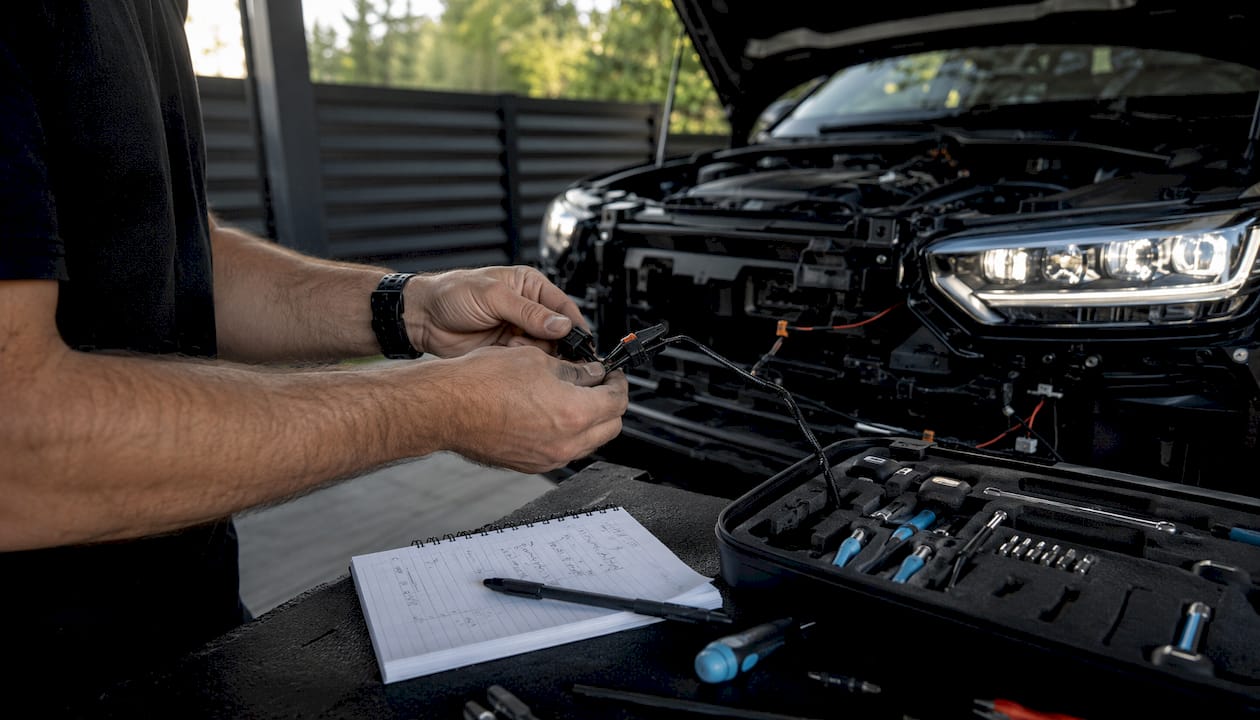
Correct wiring and aiming matter as much as the lights themselves. A premium assembly aimed two degrees too high blinds oncoming drivers. A quality bulb without a decoder throws a dashboard error on any modern CAN-bus vehicle.
Installation checklist (in order):
- Verify fitment against your year/make/model before opening the box
- Install the harness or CAN-bus decoder before connecting the light
- Check and replace butyl rubber seals; never use foam tape as a substitute
- Bench-test the assembly on a 12V source before mounting
- Mount, then aim against a flat wall at 25 feet
- Road-test at night and confirm no oncoming driver flashes you
CAN-bus and DRL notes:
- Modern vehicles detect low-power LED draw as an open circuit, triggering error codes or flicker
- Load resistors or dedicated decoders resolve this without modifying factory wiring
- DRL circuits often run at reduced voltage; confirm your LED kit operates correctly at that voltage
Sealing deserves its own attention. Butyl rubber gaskets compress evenly and maintain a waterproof barrier through temperature cycles. Foam tape compresses unevenly and allows moisture in, which is why budget units carry a 73% higher condensation risk. Vent membranes (breather valves) equalize pressure without letting water enter.
DIY vs. professional install: DIY works well for plug-and-play bulbs and strip lights. Full projector retrofits and adaptive LED assemblies benefit from a shop with a headlight aiming rack, especially on vehicles where the housing sits behind a complex bumper assembly.
For a detailed walkthrough on strip light installs, the high-lumen strip light install guide covers the steps cleanly.
5. Costs, lifespan, and what to expect over time
Premium aftermarket LED assemblies cost more upfront than halogen replacements, but the math shifts quickly. A typical halogen bulb lasts 450–1,000 hours. A quality LED assembly can exceed 30,000 hours of service life, which translates to close to a decade of daily driving for most owners.
Maintenance checklist:
- Clean UV-coated lenses with a pH-neutral soap; avoid abrasive compounds
- Inspect butyl seals annually for compression loss or cracking
- Check fan/heatsink for debris every six months on active-cooled units
- Verify headlight aim after any suspension work or front-end impact
| Feature | OEM | Premium aftermarket | Budget aftermarket |
|---|---|---|---|
| Usable beam | Factory-calibrated | Matches or exceeds OEM | Inconsistent |
| Thermal design | Active or passive | Aircraft-grade aluminum | Minimal heatsink |
| Typical warranty | 1–3 years | 1–3 years | 6–12 months |
| Expected lifespan | Vehicle lifespan | 5–10+ years | 1–3 years |
| Installation complexity | Plug-and-play | Moderate | Low to moderate |
Wheellightexpress backs its products with a satisfaction guarantee and offers financing, so the upfront cost of a quality kit doesn’t have to be a barrier.
6. Styling ideas that keep your build street-legal
Aftermarket LEDs let you separate functional lighting from aesthetic accents, and do both properly. The key is knowing which fixtures face traffic and which ones are purely decorative.
- Wheel light rings and strips: highly visible at shows and cruise nights; keep them amber or white for road use in most states
- White or amber DRL accents: legal in all 50 states when forward-facing and DOT-compliant
- Sequential turn signals: legal when amber and meeting FMVSS 108 flash-rate requirements
- Under-hood and wheel-well lighting: decorative use; check local ordinances for color restrictions
- Color temperature matching: 5,000K–6,000K produces a crisp white that reads as daylight and pairs well across all lighting zones
For forward-facing fixtures, stay DOT-compliant and avoid colored light (red or blue) that mimics emergency vehicles. Decorative strips on wheel wells and undercarriage are generally unrestricted when the vehicle is parked or at low speed, but laws vary by state. The custom lighting integration guide covers color and placement rules in more detail.
The real power of customization in automotive builds comes from layering functional and aesthetic upgrades thoughtfully, not from stacking the brightest parts available.
Key Takeaways
Premium aftermarket LEDs outperform factory lights when optics, thermal design, and proper wiring work together — not because of lumen counts alone.
| Point | Details |
|---|---|
| Optics beat lumens | Beam control and emitter placement determine usable road illumination, not advertised lumen totals. |
| Thermal design is critical | Aircraft-grade aluminum heatsinks and active cooling prevent early emitter degradation in quality kits. |
| Sealing protects longevity | Butyl rubber seals reduce condensation risk significantly versus foam-tape alternatives used in budget units. |
| Compliance is achievable | SAE J2592 and FMVSS 108 certified aftermarket products exist; verify photometric data before buying. |
| Wheellightexpress | Louisiana-designed wire harnesses, wheel light rings, and strips with a satisfaction guarantee and financing options. |
The part most guides get wrong about LED upgrades
The conventional wisdom says “buy LEDs and get better light.” That’s only half the story, and the half that gets skipped is the one that actually matters.
Every week, enthusiasts install high-lumen kits into reflector housings and wonder why oncoming drivers flash them. The answer is always the same: the emitter is in the wrong position for that housing, and the light scatters instead of projecting. The fix isn’t a brighter bulb. It’s either a projector-specific kit or a full housing swap.
The other thing guides consistently understate is thermal management. An LED that runs hot doesn’t just dim — it degrades the phosphor coating on the emitter, shifting the color temperature toward yellow and reducing output permanently. That’s not a warranty claim most buyers ever make because it happens gradually. By the time the light looks noticeably worse, the warranty has expired.
Buy for optics and cooling first. Lumens are a marketing number. Lux on the road surface at 100 feet is what keeps you safe at night. And always verify your beam cutoff on a wall before you drive. That five-minute check is the difference between a legal, safe upgrade and a fix-it ticket.
Wheellightexpress products that match what this article recommends
If you’ve read this far, you know what separates a quality LED upgrade from a frustrating one: the right harness, verified sealing, and a product designed for your vehicle’s electrical system.
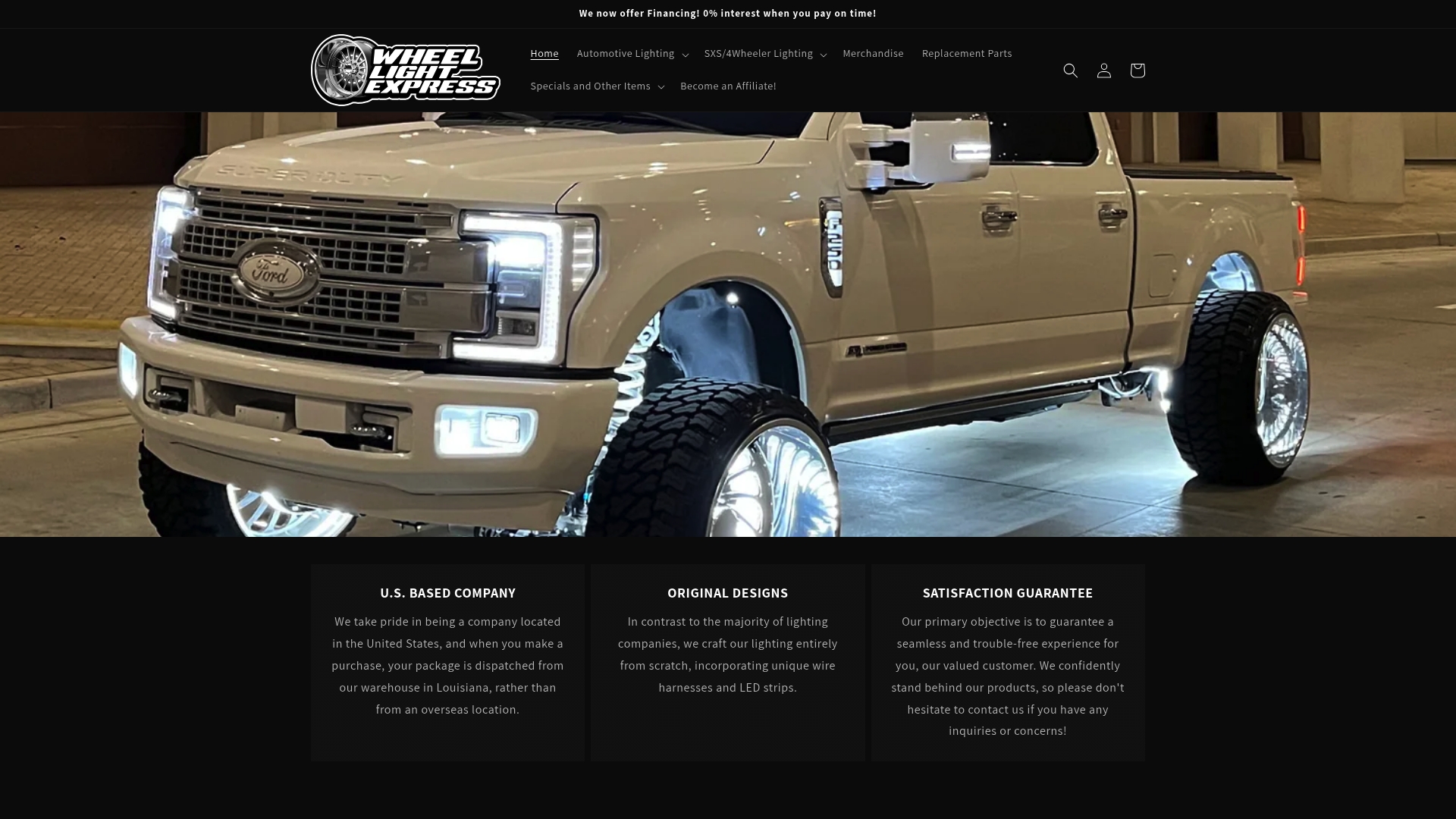
Wheellightexpress designs every product in Louisiana, with enthusiasts in mind and quality control built in from the start. The Wheel Light Ring and Strip delivers the wheel-well and accent lighting covered in the styling section, with the fitment and finish that show builds demand. The Replacement Wire Harness for all lighting solves the CAN-bus and clean-wiring problems discussed in the installation section, plug-and-play for most makes and models. The Remotes for Remote Harness give you full control over your strip and ring lighting without splicing into factory wiring. Every purchase is backed by a satisfaction guarantee, and financing is available so you can build the way you want without waiting.
Authoritative sources and further reading
- FMVSS 108 — The federal standard governing photometric output, glare limits, and type-approval for all motor vehicle lighting sold in the United States.
- SAE J2592 — SAE International’s engineering guidance for LED headlamp performance; the practical reference for manufacturers and installers verifying U.S. street-legal beam patterns.
- Consumer Reports headlight testing — Independent photometric testing showing why optical design determines real-world performance regardless of light source type.
- S3 Magazine: brightness vs. control — Practical breakdown of why high lumens without matched optics increases glare and reduces down-road visibility.
- Wheellightexpress lighting best practices — Install guidance for custom automotive LED builds, covering wiring, aiming, and compliance considerations.
Recommended
- Benefits of Custom Car Lighting for Enthusiasts – Wheel Light Express
- High Visibility Custom LED Options for Car Enthusiasts – Wheel Light Express
- Why LED Wheel Lights Outperform Bulbs Every Time – Wheel Light Express
- American Made Auto Lighting Brands: Top Picks for Enthusiasts – Wheel Light Express