

For white task lighting, the 2835 is the stronger choice. It delivers 160–190 lm/W efficiency in practical product configurations and runs cooler per lumen, making it ideal for under-cabinet work, office cove lighting, and continuous-on vehicle accent runs. The 5050 wins when you need RGB color, addressable pixels, or high per-package flux from a compact LED count.
Quick job-specific picks:
- Under-cabinet or office task lighting: 2835 at 120–240 LEDs/m for smooth, efficient white light
- Under-vehicle or wheel accent (white): high-density 2835 for uniform output and lower heat
- RGB accent, color-changing, or addressable: 5050, which houses multiple dies and supports WS2812-type control ICs
- Compact high-flux spot (fewer LEDs, high output): 5050 for its higher per-package lumen count
Wheellightexpress designs vehicle-ready strip kits and wire harnesses in Louisiana for exactly these applications, so the chip comparison below maps directly to real product choices.
Key Takeaways
The 2835 is the right chip for efficient, continuous white lighting; the 5050 is the right chip for RGB, addressable, and compact high-flux applications.
| Point | Details |
|---|---|
| 2835 for white efficiency | 2835 strips reach 160–190 lm/W and run cooler per lumen, making them the best choice for task and white accent lighting. |
| 5050 for color and addressable | 5050’s multi-die package enables RGB, RGBW, and addressable pixel control — no other standard package matches it for color effects. |
| Density determines lm/m | The high-density 2835 strip produces more than twice the lumens per meter of a standard 5050 strip. |
| Request system-level data | Package lm/W figures do not equal fixture lm/W — always ask suppliers for luminaire-level test data at rated drive current. |
| Wheellightexpress for vehicle builds | Wheellightexpress offers vehicle-specific strip and harness kits designed for trucks and off-road rigs, assembled in Louisiana. |
Table of Contents
- How do 5050 vs 2835 strips compare at a glance?
- What do the numbers in “5050” and “2835” actually mean?
- Physical and electrical specs: what the numbers mean for your wiring
- Brightness explained: lumens per LED, per meter, and per watt
- Color options, CCT, and CRI: which chip handles each job
- Heat, lifespan, and why thermal design determines long-term reliability
- Power supplies, dimming, and wiring for reliable installs
- How LED density, diffusers, and mounting affect what you actually see
- Pricing, IP ratings, and what to expect when you shop
- How to choose between 5050 and 2835 for your specific job
- How we measure and what we recommend for automotive and wheel lighting
- What I actually reach for when building vehicle lighting
- Vehicle-ready LED strips and harnesses from Wheellightexpress
- Key datasheets and resources to verify specs
- Sources
How do 5050 vs 2835 strips compare at a glance?
The table below covers the specs that actually drive purchasing decisions. Ranges reflect typical catalog values across quality tiers; exact figures vary by manufacturer, drive current, and binning.
Key tradeoffs at a glance:
- 2835 wins on efficiency (lm/W) and thermal management for white light
- 5050 wins on per-chip lumen output and multi-die color capability
- Density is the great equalizer: a high-density 2835 strip can outperform a low-density 5050 strip in total lumens per meter
- Neither chip family guarantees system efficiency on its own — driver, optics, and thermal path all matter
What do the numbers in “5050” and “2835” actually mean?
The four-digit SMD code is a direct description of the chip’s physical footprint. The first two digits give the width in tenths of a millimeter; the last two give the length. So 2835 = 2.8 × 3.5 mm and 5050 = 5.0 × 5.0 mm. That is the entire naming convention — no performance rating, no generation number, just dimensions.
Footprint matters more than it sounds. A larger package can accommodate more or larger semiconductor dies, which is why the 5050 commonly houses three dies in RGB configurations. The 2835’s smaller body limits it to one or two dies, but that constraint also means manufacturers can pack far more chips per meter of PCB. At 240 LEDs/m, a 2835 strip places chips roughly 4 mm apart center-to-center, producing a nearly continuous line of light. A 5050 strip at 60 LEDs/m spaces chips about 16 mm apart, creating visible individual points unless a diffuser covers them.
On the strip itself, you can identify the package by the dome shape and pad size. A 2835 chip sits low and flat with a rectangular profile; a 5050 chip is noticeably larger and often shows a slight dome. The thermal pad on a 2835 is visible on the underside of the chip, which is a key reason it dissipates heat more effectively into the PCB.
Physical and electrical specs: what the numbers mean for your wiring
Understanding per-LED electrical behavior lets you size drivers correctly and avoid voltage drop problems on longer runs.
-
Per-LED current draw. A typical 2835 chip runs at roughly 20–60 mA depending on drive current and binning. A 5050 chip, with its larger die area and often three dies, typically draws 60–150 mA per package at rated output. Always confirm the manufacturer’s test current — catalog lumen claims are often measured at a lower drive current than the strip actually runs.
-
Forward voltage. Both families operate in the 2.8–3.4 V range per die on a 12 V or 24 V constant-voltage strip. The controller circuit on the PCB handles the series/parallel arrangement, so you connect to 12 V or 24 V directly. A 24 V supply generally allows longer runs before voltage drop becomes a problem.
-
Watts per meter calculation. Multiply per-LED wattage by LED density. A 2835 strip at typical power per LED and common LED density draws significantly less power per meter than a 5050 strip at typical power and lower density. That difference compounds fast on a 5-meter run: 48 W vs 72 W from the same supply.
-
PCB and thermal pad differences. The 2835 package exposes a thermal pad directly to the PCB copper, giving heat a short path to the substrate. The 5050’s larger package concentrates more heat in one spot, which demands a thicker copper PCB or an aluminum-core board to avoid thermal buildup at each LED location.
-
Automotive wiring note. Vehicle electrical systems run at 12–14.4 V under load. Confirm the strip’s rated input voltage matches your vehicle’s actual operating voltage, not just nominal 12 V. A strip rated for exactly 12 V may run slightly brighter and hotter at 14.4 V charging voltage — a detail that matters for long-term reliability in wheel and underbody applications.
Brightness explained: lumens per LED, per meter, and per watt
Lumen-per-LED figures alone can mislead you. A 5050 chip at 22–24 lm/LED sounds brighter than a 2835 at 8–15 lm/LED — and it is, per chip. But once you account for density, the picture flips.
Consider a concrete example using catalog-level figures:
The high-density 2835 strip produces more than twice the lumens per meter of a standard 5050 strip. For vehicle underbody lighting or comparing lumen output across strip types, that gap is significant.
Efficiency (lm/W) is the other critical metric. The 2835 reaches 160–190 lm/W at the package level, while most 5050 strips land in the 50–80 lm/W range. On a long continuous run, that efficiency gap translates directly to lower power draw, smaller required PSU, and less heat generated per lumen produced.
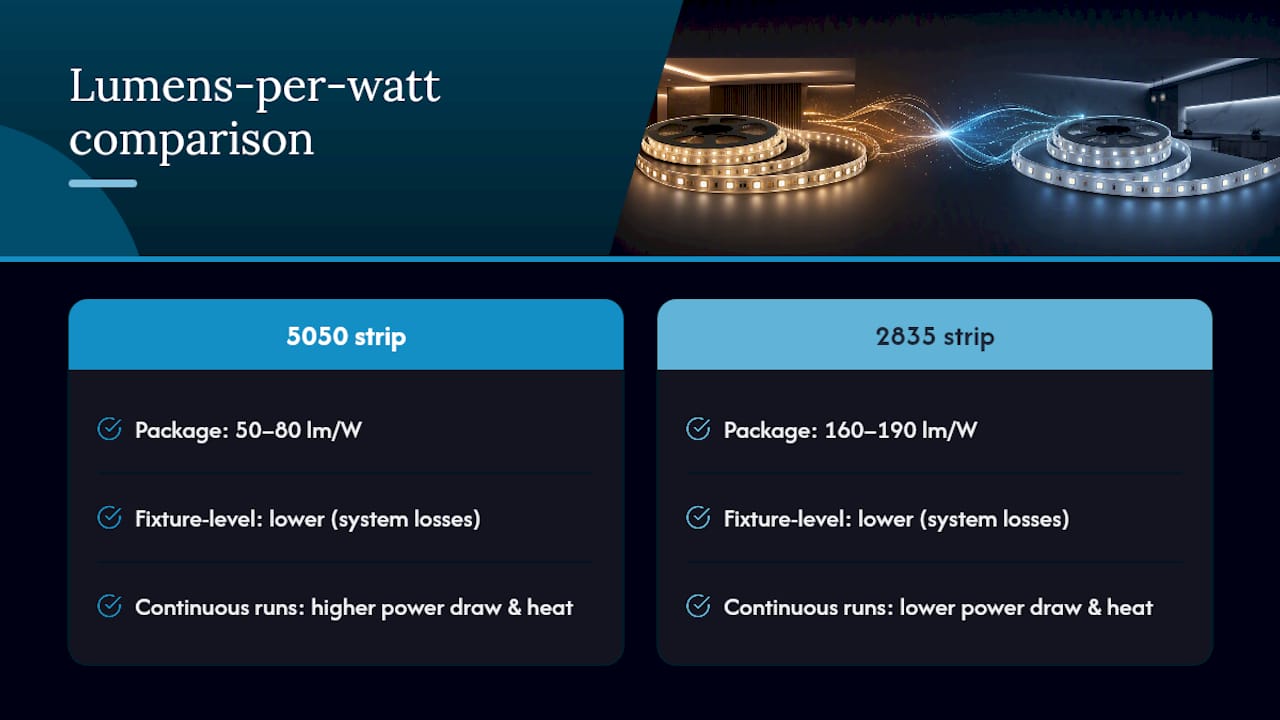
One important caveat is that package-level lm/W figures do not equal system lm/W. Driver losses, diffuser transmission, and thermal derating at operating temperature all reduce real-world output. Always ask suppliers for fixture-level or luminaire-level test data at the actual drive current the strip will run.
For short decorative runs where total lumens matter less than color, the 5050’s per-chip output advantage is fine. For task lighting or long vehicle accent runs where efficiency and heat accumulation matter, the 2835’s lm/W advantage is the deciding factor.
Color options, CCT, and CRI: which chip handles each job
The 5050’s multi-die architecture is what makes RGB and RGBW possible. Fitting three dies into one package lets manufacturers assign red, green, and blue to each die, controlled independently. Addressable variants like WS2812B integrate a control IC directly into the 5050 package, enabling per-pixel color programming. If your project involves color-changing effects, dynamic animations, or individually addressed pixels, the 5050 is the only practical choice.
The 2835 is optimized for single-die white production. That focus pays off in two ways:
- CRI: Single-die phosphor-converted white LEDs can reach CRI 90–95+ in quality 2835 strips, making them suitable for retail display, photography lighting, and any application where accurate color rendering matters.
- CCT range: 2835 white strips are available in warm white (2700–3000K), neutral white (3500–4000K), and cool white (5000–6500K). Tunable white strips using two 2835 channels (warm + cool) let you shift CCT without sacrificing CRI.
When to choose each:
- High-CRI task or retail lighting: 2835 white, CRI 90+
- Photography or video fill: 2835 at CRI 95+, neutral or daylight CCT
- Accent color or party lighting: 5050 RGB
- Addressable pixel effects (wheel lights, underglow animations): 5050 addressable
- White vehicle accent with smooth uniformity: high-density 2835
RGB mixing in a 5050 strip produces white light by blending red, green, and blue, which typically yields a lower CRI than a phosphor-converted white LED. If white light quality matters, a dedicated white 2835 strip outperforms an RGB 5050 in white mode.
Heat, lifespan, and why thermal design determines long-term reliability
Heat is the primary cause of LED lumen depreciation. The faster a chip’s junction temperature rises, the faster its output drops and the shorter its useful life. This is where the 2835 holds a structural advantage for white-light applications.
The 2835’s exposed thermal pad creates a direct conduction path from the die to the PCB copper and, ideally, to an aluminum mounting channel. Running cooler per lumen means the junction temperature stays lower at a given output level, which directly extends lumen maintenance. In LM-80 and L70 terms, a cooler-running strip reaches its 70% lumen maintenance point later in its operating life.
The 5050 concentrates more power in a larger package. At high drive currents, that heat concentration demands a more capable thermal path — thicker copper PCB, aluminum-core substrate, or active cooling. In sealed or enclosed installations without a thermal path to a heatsink, 5050 strips are more likely to show early lumen depreciation.
Practical steps to reduce heat in any installation:
- Mount strips in aluminum extrusion channels with a thermally conductive pad between the strip and channel
- Avoid sealing strips in enclosed housings without a direct thermal path to the exterior
- Run strips at 80% of rated wattage rather than full load to reduce junction temperature
- In automotive installs, keep strips away from exhaust components and brake heat sources
Pro Tip: In tight automotive wheel-well or portal installations where aluminum channels are not practical, apply a thin layer of thermal interface material between the strip’s PCB and any metal mounting surface — even a bare steel bracket conducts heat far better than an air gap.
Power supplies, dimming, and wiring for reliable installs
Sizing your power supply correctly prevents both underperformance and premature failure. The standard recommendation is to add 20–25% headroom above your calculated load.
-
Calculate total wattage. Multiply W/m by total strip length. A 5-meter 2835 strip at 9.6 W/m draws 48 W. Add 20% headroom: you need a 60 W supply minimum. A 5-meter 5050 RGB strip at 14.4 W/m draws 72 W, requiring at least a 90 W supply.
-
Choose constant-voltage (CV) drivers for standard strips. Most 12 V and 24 V LED strips are constant-voltage designs. Use a CV driver rated for the strip’s input voltage. Constant-current (CC) drivers are for specific LED modules, not standard strip lights.
-
Dimming compatibility. PWM dimming works well with both chip types and is the standard method for RGB 5050 strips using an RGB controller. For white 2835 strips, a PWM-compatible CV driver or a 0–10 V dimmable driver both work. Avoid leading-edge (TRIAC) dimmers designed for incandescent loads — they cause flicker and can damage LED drivers.
-
Voltage drop on long runs. At 12 V, voltage drop across a long strip run reduces brightness at the far end. For runs over 5 meters, use 24 V strips, feed power from both ends, or use a heavier-gauge wire. A 24 V supply cuts current by half for the same wattage, reducing resistive losses in the wire.
-
Automotive fusing. In vehicle installs, fuse the strip circuit at the supply end, sized to 125–150% of the strip’s rated current draw. A 5-meter 5050 RGB strip drawing 6 A should be fused at 7.5–8 A. Use an automotive blade fuse holder and marine-grade wire for vibration and moisture resistance. For a complete wiring solution, a purpose-built wire harness for vehicle lighting handles connector integrity and fusing in one assembly.
How LED density, diffusers, and mounting affect what you actually see
Raw lumens per meter tell you how much light a strip produces. What you see depends on how that light is distributed, which is where density, diffusers, and mounting choices take over.
At 30 LEDs/m, individual LED points are clearly visible even from a few feet away. At 60 LEDs/m, the points are closer but still distinguishable without a diffuser. At 120 LEDs/m, the strip begins to look like a continuous line of light. At 240 LEDs/m, even a clear-lens strip reads as a solid glowing bar. For high-density vehicle strip applications, 120 LEDs/m or higher is the practical minimum for a professional appearance.
Diffusers change the equation significantly. An opal polycarbonate cover on an aluminum extrusion blends individual LED points into a uniform glow, allowing a 60 LEDs/m strip to look nearly as smooth as a 120 LEDs/m strip without one. The tradeoff is a 10–30% reduction in transmitted lumens depending on diffuser opacity.
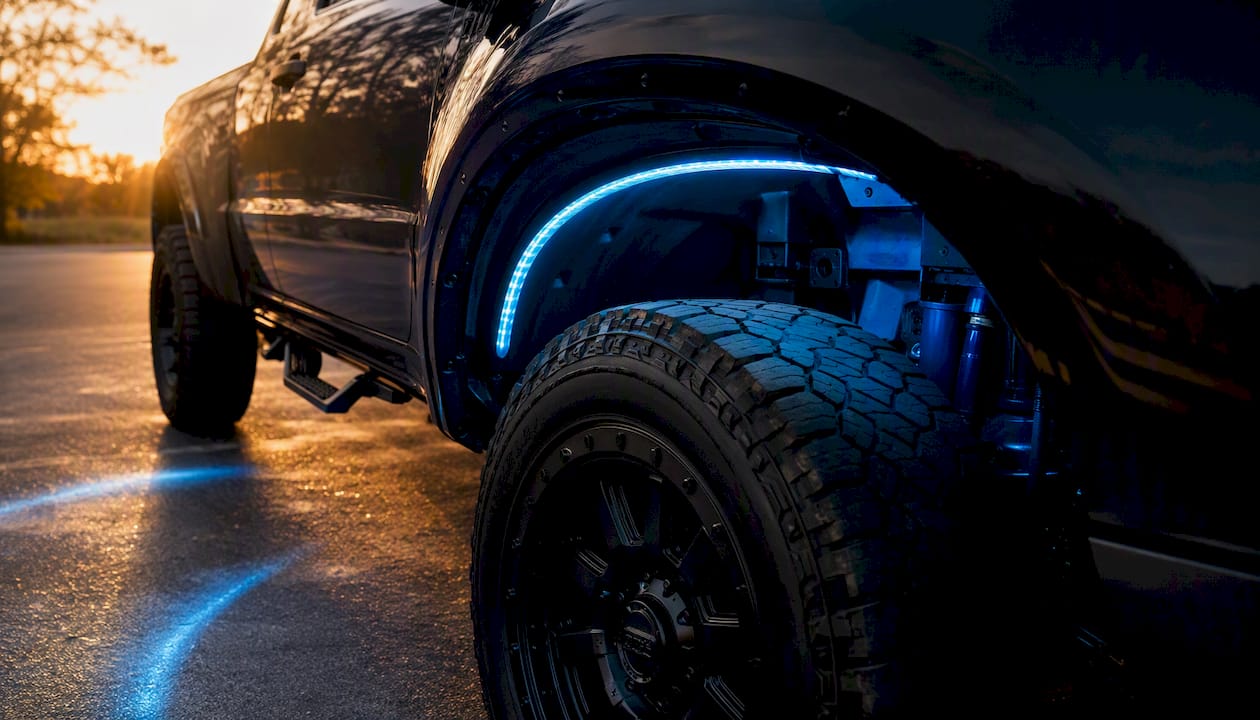
For automotive wheel-well and underbody work, exposed strips without diffusers are common because the installation depth and viewing angle naturally blend the light. In those cases, density matters more: 120 LEDs/m 2835 strips produce a noticeably smoother arc of light around a wheel than a 60 LEDs/m 5050 strip at the same total wattage.
Pricing, IP ratings, and what to expect when you shop
Cost per meter varies widely based on density, binning quality, and IP rating. As a general pattern, a basic 2835 strip at 60 LEDs/m costs less per meter than a 5050 RGB strip at the same density, because the 5050 package and its RGB control circuitry add material cost. High-density 2835 strips at 240 LEDs/m can cost more per meter than standard 5050 strips simply because of the chip count.
IP ratings tell you how well the strip is protected:
- IP20: No protection. Bare PCB, indoor use only.
- IP65: Silicone coating over the LEDs. Splash-resistant; suitable for wheel wells and underbody areas with indirect water exposure.
- IP68: Fully encapsulated in silicone or epoxy. Submersion-rated; used for applications with direct water contact.
Waterproofing adds cost and reduces thermal performance because the encapsulant traps heat. An IP68 strip runs warmer than the same strip at IP20, which can shorten lifespan if the installation does not account for that. For vehicle underbody and wheel-well use, IP65 is usually sufficient and preserves better thermal behavior than full IP68 encapsulation. For guidance on dust-proof and weather-resistant strip selection in vehicle contexts, IP65 covers most real-world conditions.
Common retail variants to know: white-only 2835 strips (single channel, dimmable), RGB 5050 strips (three-channel, requires RGB controller), RGBW 5050 strips (four-channel, adds a dedicated white die), and addressable 5050 strips (WS2812B or SK6812, individually controlled pixels).
How to choose between 5050 and 2835 for your specific job
Work through this checklist before ordering. It takes two minutes and prevents a costly mismatch.
-
Define your primary goal. White task or accent light? Choose 2835. Color-changing or addressable effects? Choose 5050. Both? Consider separate strips on separate channels.
-
Set a lumen target. Estimate the lumens per meter you need for the space or vehicle section. Use the density math: lm/LED × LEDs/m. If you need more than 2,000 lm/m, a high-density 2835 strip is almost always the more efficient path.
-
Assess your thermal environment. Enclosed housing, high ambient temperature, or continuous-on use? Favor 2835 and plan for aluminum channel mounting. Intermittent decorative use with good airflow? Either chip works.
-
Measure your run length. Runs over 5 meters on 12 V need voltage drop mitigation. Switch to 24 V strips or plan dual-end power feeds.
-
Confirm your budget includes the full system. A cheaper 5050 strip can cost more overall once you add the heavier PCB, stronger driver, and thermal management a high-flux 5050 design requires.
-
Ask suppliers the right questions. Request fixture-level lm/W at the rated drive current, not just package-level claims. Ask for LM-80 or lumen-maintenance data. Confirm LED density (LEDs/m), not just total LED count.
-
Watch for these red flags. Missing lm/m data (only per-chip lumens listed), no driver specs, unclear IP rating, adhesive described only as “3M-style” without a grade, and no mention of PCB copper weight. In automotive installs specifically, look for high-temp adhesive ratings and secure connector systems — adhesive failure and segment failure are the most common field complaints across both chip types.
How we measure and what we recommend for automotive and wheel lighting
When evaluating strip performance for vehicle applications, the measurement approach matters. We test lumens per meter using a calibrated lux meter at a fixed distance under controlled ambient conditions, then back-calculate lm/m. We also measure operating temperature at the PCB surface after 30 minutes of continuous operation, which reveals thermal behavior that spec sheets often obscure. Driver efficiency is measured separately so system lm/W reflects the full installation, not just the chip.
For wheel lights and underbody accent strips, our practical recommendations are consistent:
- White accent (wheel wells, rock lights, portal lights): 2835 at 120 LEDs/m minimum, IP65 rated, mounted with thermal interface material against the vehicle’s metal structure. The smaller chip and higher density produce a smoother arc of light around wheel openings and generate less heat in confined spaces.
- RGB or addressable wheel effects: 5050 addressable (WS2812B or SK6812), IP65 minimum, with a dedicated RGB controller or remote. The per-pixel control enables color animations that a single-channel 2835 strip cannot replicate.
- Adhesive and wiring: High-temp automotive-grade adhesive is non-negotiable. Standard 3M VHB tape fails at sustained underbody temperatures. Pair any strip with a purpose-built wire harness to maintain connector integrity through vibration and thermal cycling. Before installation, clean mounting surfaces thoroughly — a clean, grease-free surface is the single biggest factor in adhesive longevity, and a streak-free surface prep on painted or glass areas makes a measurable difference.
Wheellightexpress maps directly to these recommendations. The replacement wheel light strip and the full wheel light ring and strip catalog cover both white and color configurations, designed and assembled in Louisiana for vehicle-specific fit. For custom vehicle LED applications, the product lineup pairs strips with matched harnesses so the full system is engineered together.
What I actually reach for when building vehicle lighting
When I’m speccing a vehicle lighting build, the chip choice comes down to one question: is this a white accent run or a color effect? For white wheel-well and underbody work, I reach for high-density 2835 every time. The thermal behavior in tight, enclosed spaces is simply more forgiving, and the smooth, continuous line of light looks more finished than a lower-density 5050 strip at the same wattage. For addressable RGB effects on wheels or cab lighting, the 5050 is the only chip that delivers per-pixel control, so there is no real debate there.
The one thing I see builders underestimate consistently is the wiring side. A great strip paired with a marginal harness will fail at the connector before the LED ever dims. That is why I always spec the harness alongside the strip, not as an afterthought.
Vehicle-ready LED strips and harnesses from Wheellightexpress
Wheellightexpress builds strip kits and wire harnesses specifically for trucks, off-road rigs, and custom vehicles — designed in Louisiana, not sourced from generic overseas catalogs. If the comparison above pointed you toward a high-density white strip for wheel wells or an RGB addressable setup for color effects, Wheellightexpress has both configurations ready to install.

Product categories worth knowing:
- Wheel light rings and strips: white and color options sized for common wheel diameters, with vehicle-specific fit guidance
- Wire harness leads and wiring: purpose-built harnesses that handle connector integrity, fusing, and routing for clean installs
- Replacement wire harnesses: direct-fit replacements when a harness fails before the strip does
- Remotes and controllers: matched remotes for RGB and dimmable setups
Browse the full catalog at Wheellightexpress and use the product fit guidance to match your truck or off-road build to the right strip and harness combination.
Key datasheets and resources to verify specs
When you are ready to confirm manufacturer numbers before ordering, these sources provide the technical depth to cross-check catalog claims:
- SMD 2835 vs 5050 LED Chip Comparison (Alibaba Seller Blog): catalog-level efficiency figures, per-LED power, and lumen-per-meter examples for both chip families
- SMD LED Package Sizes: 2835 vs 5050 vs 3528 (HIL Electronic): package dimension standards, die count implications, and PCB selection guidance
- Difference Between 2835, 5050, and 3528 LED Strips (LED Lighting Info): thermal pad design, lumen maintenance, and lifespan comparisons
- 2835 vs 5050 LED: How to Choose the Right Chip (Ledestar): BOM and thermal tradeoff analysis for high-flux designs
- SMD 2835 vs 5050: Efficiency and Performance Guide (Fanxstar): system-level lm/W discussion and why fixture-level data is the only reliable comparison point
When reading any datasheet, check the test drive current (mA), ambient temperature during measurement, and whether the lumen figure is at the package or luminaire level. A chip rated at 190 lm/W at 20 mA may deliver significantly less at the 60 mA the strip actually runs in use.
Sources
- SMD 2835 vs 5050 LED Chip Comparison - Alibaba.com Seller Blog
- SMD LED Package Sizes: 2835 vs 5050 vs 3528 and PCB Selection
- What Is The Difference Between 2835, 5050 And 3528 LED Strips? | LED Lighting Info
- SMD 2835 vs. 5050: The Ultimate LED Efficiency & Performance Guide