

LED wheel lights are aftermarket lighting accessories that mount to vehicle wheels to deliver enhanced aesthetics, improved lateral nighttime visibility, and energy-efficient illumination. The benefits of LED wheel lights go well beyond looks. From RGB customization with over 200 dynamic lighting modes to Bluetooth app control, these accessories have become a serious upgrade for both car enthusiasts and daily drivers. Kits range from $5–$15 for simple valve cap lights to over $200 for premium multi-row ring kits, with LED density spanning 288–4,608 LEDs per kit. Whether you want to turn heads at a car show or add real visibility on the road, the right wheel lighting setup delivers both.
1. What makes LED wheel lights outperform traditional bulbs?
LED wheel lights outperform conventional bulb-based lighting on every measurable factor: lifespan, brightness, power draw, and durability. Traditional incandescent bulbs burn out quickly under the vibration and heat of a wheel well. LEDs handle those conditions without flinching.
Here is what gives LEDs a clear technical edge:
- Lifespan: LEDs last tens of thousands of hours compared to a few hundred for standard bulbs.
- Brightness and color control: LEDs produce consistent, vivid output across the full color spectrum without fading.
- Power consumption: LEDs draw significantly less current, reducing strain on your vehicle’s electrical system.
- Waterproof ratings: Quality kits carry IP67 or IP68 ratings, meaning they resist full water immersion and debris.
- Vibration resistance: Solid-state LED construction has no filament to break, making it far more durable in harsh wheel environments.
Common installation types include full wheel ring kits, LED strip kits, and valve cap lights. Ring kits offer the most dramatic visual impact and the widest feature set. Strip kits work well for custom builds where space is limited.
Pro Tip: When comparing kits, check the housing material first. Die-cast aluminum housings dissipate heat better than plastic and hold up longer in the wheel well.
2. How do LED wheel lights enhance vehicle aesthetics and customization?
RGB LED wheel lights give you thousands of color combinations and the ability to match your vehicle’s color theme precisely. This level of customization is the primary reason car enthusiasts choose wheel lighting over other aftermarket accessories. The role of lighting aesthetics in car design has grown significantly as LED technology has become more accessible.
Dynamic lighting modes available in most mid-range and premium kits include:
- Solid color: Clean, consistent glow that complements paint and body kits.
- Chasing: Sequential LED activation that creates a spinning effect as the wheel rotates.
- Strobe: Rapid flashing for show environments (not for public road use).
- Music sync: Lights pulse in time with audio output through a Bluetooth connection.
App-controlled customization lets you switch modes, adjust brightness, and set color schedules directly from your phone. That convenience removes the need to reach under the vehicle every time you want a different look.
| Feature | Valve cap lights | Full ring kits |
|---|---|---|
| Visual impact | Low to moderate | High |
| Color options | Limited | Full RGB |
| Dynamic modes | Few or none | 200+ patterns |
| Installation difficulty | Very easy | Moderate |
| Cost range | $5–$15 | $80–$200+ |
Pro Tip: For the cleanest look at car shows, choose a ring kit color that matches your brake caliper color. The visual continuity makes the entire wheel assembly look intentional and designed.
Wheel design and color customization work together to define a vehicle’s overall profile. Wheel lighting amplifies that effect after dark, making your build visible and recognizable from a distance.
3. What safety and visibility advantages do LED wheel lights provide?
LED wheel lights improve lateral visibility at night, making your vehicle more noticeable to other drivers approaching from the side. This is one of the most practical and underappreciated advantages of LED wheel lights. Side visibility is a known gap in standard vehicle lighting, and wheel lights directly address it.
Some advanced kits include brake light and turn signal synchronization features. These connect to your vehicle’s existing lighting circuits and flash the wheel lights in sync with your brake pedal or turn signals. That added signal point increases the chance that nearby drivers notice your intentions.
Legal note: Activation on public roads triggers legal violations in many states, not the presence of the hardware itself. You can keep lights installed and simply turn them off while driving on public streets to stay compliant.
As of 2026, 15–20 states have restrictions on wheel light colors and flashing patterns. That number matters because it means most drivers are operating in a regulated environment without knowing it. Fines start around $10 in many areas, but repeated violations can escalate.
The safest approach for public road use:
- Use static amber or white lighting modes only.
- Avoid chasing, strobe, or flashing patterns that mimic emergency vehicles.
- Check your specific state laws before activating any colored lighting on public roads.
- Reserve dynamic RGB modes for private property, car shows, and off-road use.
Static amber or white steady modes are generally permissible across most jurisdictions and still provide meaningful side visibility without triggering legal issues.
4. What should you consider for installation and durability?
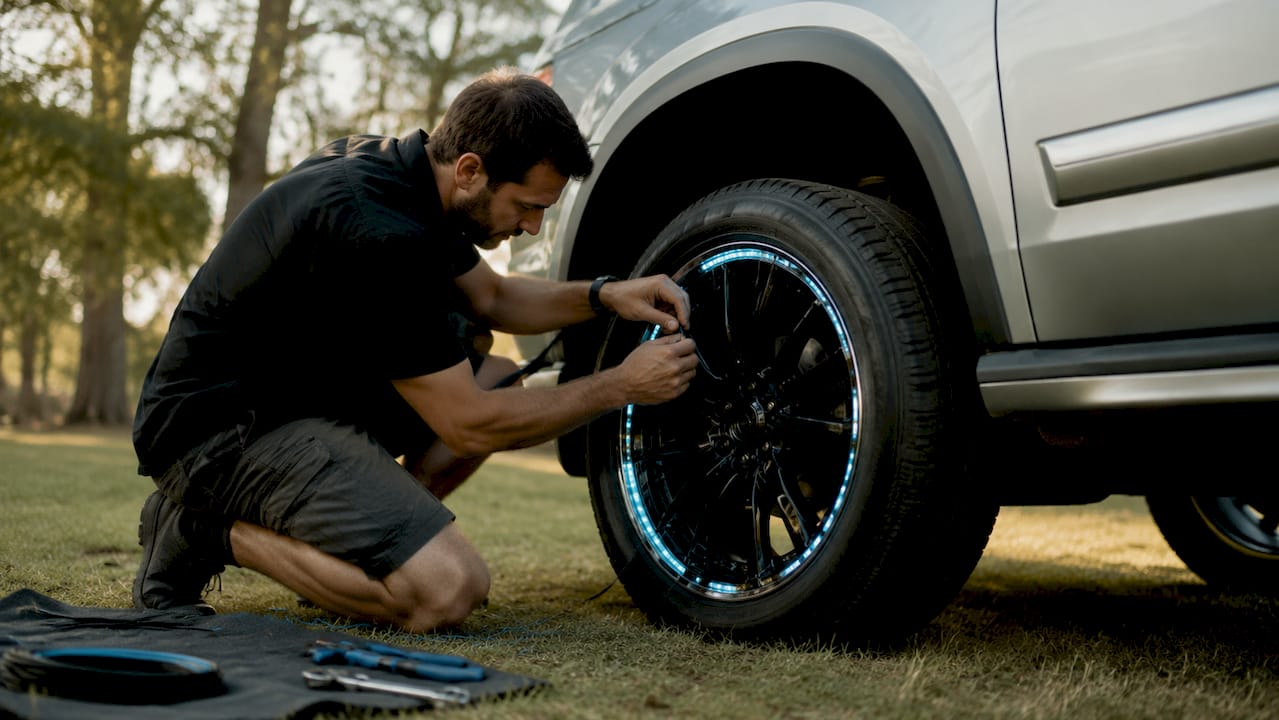
Installation quality determines how long your wheel lights actually last. The wheel well is one of the harshest environments on any vehicle, combining constant vibration, heat from braking, road debris, and water exposure. Choosing the right kit and installing it correctly makes the difference between lights that last years and lights that fail in weeks.
- Verify IP ratings. Only buy kits rated IP67 or IP68. Anything lower will not survive regular road conditions.
- Check housing material. Die-cast aluminum is the standard for quality kits. Avoid thin plastic housings that crack under heat.
- Measure clearance before buying. Proper ring sizing requires measuring the gap between your brake rotor edge and the inner barrel of your rim. Skipping this step is the most common installation error.
- Protect your wiring. Wiring harness failure is the leading cause of premature kit failure. Wrap connections with heat-shrink tubing and run wires through protective wire loom. Electrical tape alone is not sufficient.
- Plan for brake and turn signal sync carefully. Improper wiring into your vehicle’s electrical system can cause hyper-flashing and dashboard warning errors. If you are not confident in automotive wiring, have a professional handle this step.
- Understand the difference between wheel ring lights and rock lights. Rock lights mount to the undercarriage and illuminate the ground for off-road trail use. A standard 4-pod rock light kit costs $80–$200 and installs in under one hour. Wheel ring lights are aesthetic first, while rock lights are functional first.
| Installation factor | What to check |
|---|---|
| Waterproof rating | IP67 minimum, IP68 preferred |
| Housing material | Die-cast aluminum over plastic |
| Rim clearance | Measure rotor-to-barrel gap before ordering |
| Wiring protection | Heat-shrink tubing plus wire loom |
| Electrical integration | Professional install for brake/signal sync |
Pro Tip: Before routing any wires, do a dry-fit of the ring or strip against your rim. Confirm clearance with the wheel turned to full lock in both directions. Brake components shift position as the wheel turns, and a kit that clears at center may contact the caliper at full steering angle.
5. How to choose the right LED wheel lights for your needs
The right LED wheel light kit depends on three things: your budget, your primary use case, and your local laws. Buyers who skip the legal research step often end up with an expensive kit they can only use at shows.
Entry-level buyers ($5–$30): Valve cap lights are the lowest-commitment option. They require no wiring, install in seconds, and produce a subtle glow. They work well for drivers who want a small visual upgrade without any installation complexity.
Mid-range buyers ($50–$120): Single-row LED ring kits offer solid RGB performance, app or remote control, and IP67 ratings. These are the best starting point for most enthusiasts. They deliver visible impact without the fitment complexity of multi-row systems.
Premium buyers ($150–$200+): Multi-row ring kits with high LED density produce the most dramatic output. These kits often include 200+ lighting modes, full Bluetooth control, and brake or turn signal sync capability. They are the right choice for show cars and serious builds.
Key factors to evaluate before buying:
- LED density: More LEDs per strip means smoother, more uniform light output. Look for kits in the 288–4,608 LED range depending on ring size.
- Control method: Bluetooth app control offers the most flexibility. Remote controls are simpler but less precise.
- Color accuracy: True RGB kits produce accurate colors. Some budget kits label themselves RGB but deliver washed-out or inconsistent hues.
- Legal compliance: If you drive on public roads, prioritize kits with a static white or amber mode. Confirm the kit can hold that mode without defaulting to a flashing pattern on startup.
Use the wheel light sizing guide to confirm compatibility before ordering. Buying the wrong ring diameter is the most expensive mistake you can make in this category.
Key takeaways
LED wheel lights deliver the most value when build quality, legal compliance, and proper installation are prioritized over LED count alone.
| Point | Details |
|---|---|
| LED advantages over bulbs | LEDs last longer, draw less power, and resist vibration better than traditional bulbs. |
| Customization depth | Full RGB kits offer 200+ modes and app control for precise color and animation management. |
| Legal compliance | Static amber or white modes are safest; 15–20 states restrict flashing patterns on public roads. |
| Installation durability | IP67/IP68 ratings and die-cast aluminum housing are the two most important quality markers. |
| Choosing the right kit | Match your kit to your use case: valve caps for simplicity, multi-row rings for show-level impact. |
Why I always tell enthusiasts to buy quality before buying features
I have seen a lot of wheel light setups over the years, and the pattern is consistent. The builds that hold up are the ones where the buyer spent money on housing quality and wiring protection first, and worried about lighting modes second. The builds that fail are the ones where someone bought a kit with 4,000 LEDs and 300 modes but skimped on the housing material and left the wiring unprotected.
The legal side is where I see the most avoidable problems. Drivers activate dynamic RGB modes on public roads without checking their state laws, and then act surprised when they get cited. The hardware is not the issue. Activation is. Keeping lights off on public roads and reserving dynamic modes for shows and private property is the responsible approach, and it keeps your setup legal.
My honest recommendation: buy a kit with a solid IP68 rating, die-cast aluminum housing, and a reliable wire harness. Use the quality wheel lights guide to understand what separates durable builds from disposable ones. Then enjoy the customization. The technology is genuinely impressive when you install it right and use it responsibly.
— Christopher
Upgrade your ride with Wheellightexpress
Wheellightexpress designs all of its LED wheel lighting products in Louisiana, which means you get original designs built for real automotive use, not generic imports. The product lineup covers everything you need for a complete wheel lighting build: LED ring and strip kits, wire harnesses, remotes, and replacement components.
Browse the full aftermarket lighting collection to find the right kit for your vehicle. If you are unsure about sizing, the wheel light sizing guide walks you through the measurement process step by step. Wheellightexpress also offers financing options, so you can get the setup you actually want without waiting. Every purchase comes backed by a satisfaction guarantee.
FAQ
What are the main benefits of LED wheel lights?
LED wheel lights improve lateral nighttime visibility, add RGB aesthetic customization with 200+ lighting modes, and consume less power than traditional bulbs. They also carry IP67/IP68 waterproof ratings for durability in harsh wheel well conditions.
Are LED wheel lights legal to use on public roads?
Legality depends on your state. As of 2026, 15–20 states restrict certain colors and flashing patterns. Static amber or white steady modes are the safest choice for public road use, and activation rather than installation is what triggers violations.
How difficult is it to install LED wheel ring lights?
Basic valve cap lights require no tools and install in seconds. Full ring kits require measuring rim clearance, routing wiring, and optionally splicing into the vehicle’s electrical system for brake or turn signal sync, which is best handled by someone with automotive wiring experience.
What is the difference between wheel ring lights and rock lights?
Wheel ring lights mount inside the rim for aesthetic illumination. Rock lights mount to the undercarriage and project light downward for off-road trail visibility. A standard 4-pod rock light kit costs $80–$200 and serves a functional purpose rather than a primarily visual one.
How do I choose the right size LED wheel ring?
Measure the gap between your brake rotor edge and the inner barrel of your rim before ordering. Use a sizing guide to match ring diameter to your specific wheel dimensions. Skipping this measurement is the most common and costly installation mistake.