

Speed-sensitive wheel lighting is the practice of connecting LED wheel lights to your vehicle’s speed signal so the lights change brightness, color, or pattern as you drive faster or slower. To sync wheel lights with vehicle speed, you need either a wired controller tapped into your OBD-II port or speedometer wire, or a self-powered LED hub cap that generates its own electricity from wheel rotation. Wheellightexpress designs both LED strips and wire harnesses in Louisiana specifically for this kind of speed-linked customization. The result is a dynamic lighting effect that responds to real driving conditions, not just a static glow sitting on your wheels.
What equipment do you need to sync wheel lights with vehicle speed?
Getting the right hardware before you start saves hours of troubleshooting. Speed-synchronized wheel lighting requires three core components: a light source, a speed signal input, and a controller to connect the two.
Light sources fall into three main categories:
- Wired RGB LED rings: These mount inside the wheel and connect to your vehicle’s 12V electrical system. They offer the most color options and the tightest speed response.
- Self-powered LED hub caps: These generate their own electricity through wheel rotation. Wireless self-powered LED wheel lights do not drain your vehicle battery and require no wiring harness.
- Bluetooth-controlled LED strips: These mount along the wheel rim and pair with a smartphone app for color and pattern control.
Speed signal sources include:
- OBD-II port readers that pull live speed data from your vehicle’s ECU
- Speedometer wire taps that read the analog or digital signal from your instrument cluster
- Wheel rotation sensors already built into ABS systems on most vehicles made after 1990
Controllers sit between the speed signal and the lights. They interpret the incoming signal and tell the LEDs what to do. Bluetooth app control supports millions of colors and multiple lighting modes for fully customized effects. You also need proper wiring harness leads and fuses for safety and reliable function when connecting lights to a live speed signal.
Pro Tip: Always verify your vehicle runs a standard 12V electrical system before purchasing a wired controller. Most passenger cars and trucks do, but some hybrid systems use different voltage rails that require a voltage regulator between the controller and the lights.
How to connect wheel lights to your vehicle speed sensor
Connecting LED wheel lights to a speed signal is a straightforward process when you work through it step by step. Rushing any stage, especially the wiring, creates problems that are hard to diagnose later.
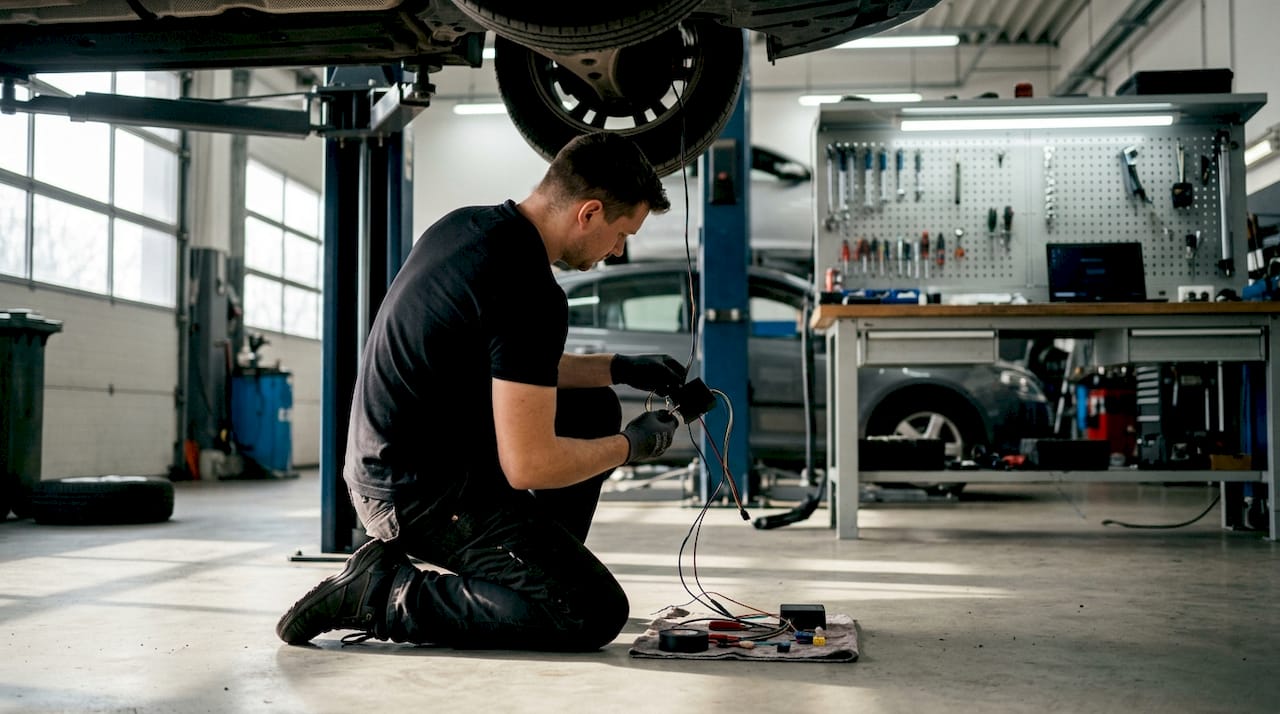
Step 1: Identify your speed signal source. Locate your OBD-II port (found under the dashboard on the driver’s side on all U.S. vehicles made after 1996) or trace the speedometer wire from the instrument cluster. Your vehicle’s service manual lists the exact wire color and pin location. An OBD-II reader is the easier option for most enthusiasts because it requires no wire splicing.
Step 2: Wire the speed signal to the controller input. Connect the speed signal wire to the designated input terminal on your LED controller. Match polarity carefully. A reversed connection will not damage most modern controllers, but it will prevent the speed sync from functioning. Use a multimeter to confirm you are reading a clean signal before securing any connections.
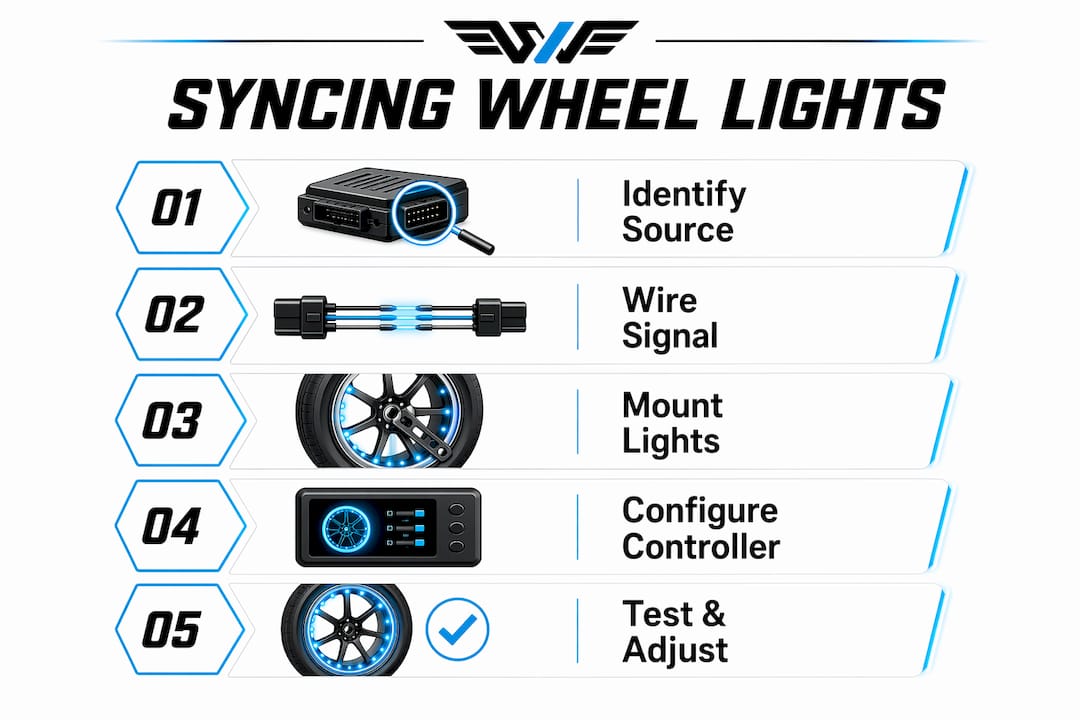
Step 3: Mount the wheel lights. Position your wheel light rings and strips inside the wheel well or along the rim, following the manufacturer’s mounting instructions. Lights that are not secured properly will shift during rotation and create uneven visual effects. Use the supplied adhesive or mounting brackets, and add a zip tie for extra security on high-speed applications.
Step 4: Configure the controller. Power up the controller and open the paired app or use the physical controls to set your speed response profile. XKmax LED wheel ring lights offer Bluetooth app control for syncing lights to vehicle speed and acceleration with customizable startup modes. Set a low-speed color, a high-speed color, and the transition point between them.
Step 5: Test at multiple speeds. Drive in a safe, open area and observe the light behavior at 15 mph, 35 mph, and 55 mph. Confirm the transition points match your settings. Adjust the controller sensitivity if the lights respond too abruptly or too slowly.
Troubleshooting common issues:
- Lights flicker at idle: signal noise from the alternator. Add a small inline capacitor to the signal wire.
- No response to speed changes: check that the controller input is wired to the speed signal, not a constant 12V line.
- Lights stay on one color: the controller may be in static mode. Cycle through the app settings to activate speed-sync mode.
Pro Tip: Many Bluetooth controllers also support music sync. If you use your vehicle for shows or events, you can switch between speed-sync mode on the road and music-sync mode while parked, all from the same app.
What are self-powered LED wheel caps and how do they sync with speed?
Self-powered LED wheel caps are the simplest form of speed-sensitive wheel lighting. They require no wiring, no controller, and no app. The cap contains a small internal generator that spins with the wheel and produces enough electricity to power the LEDs above a certain rotation speed.
Self-powered LED wheel hub caps automatically illuminate when the vehicle exceeds a speed threshold of roughly 18.6 mph without external wiring. Below that speed, the generator does not produce enough current to activate the LEDs, so the lights stay off. That passive behavior is actually a useful feature: the lights only activate when the vehicle is moving at a meaningful speed, which is exactly when they are most visible.
Here is a comparison of self-powered caps versus wired LED rings across key criteria:
| Feature | Self-powered caps | Wired LED rings |
|---|---|---|
| Installation complexity | Low (no wiring) | Moderate (wiring required) |
| Speed response | Passive (on/off threshold) | Active (full color/pattern control) |
| Battery impact | None | Minimal draw from 12V system |
| Color customization | Limited | Full RGB spectrum |
| Activation speed | Approx. 18.6 mph | Configurable |
The main limitation of self-powered caps is that they offer binary behavior: on or off. They do not change color or pattern based on speed. For enthusiasts who want a floating light effect with zero installation complexity, they are the right choice. For those who want full color control and speed-linked patterns, a wired RGB ring is the better option.
Benefits of self-powered caps:
- No battery drain on your vehicle
- No wiring harness required
- Easy to swap between vehicles
- Ideal for daily drivers where simplicity matters
You can learn more about LED wheel light benefits and which format suits your vehicle best before committing to a setup.
Common challenges when syncing wheel lights to vehicle speed
Most installation problems fall into three categories: signal issues, power issues, and controller configuration errors. Knowing which category your problem belongs to cuts diagnostic time significantly.
Signal issues are the most common. If your lights do not respond to speed changes, the controller is not reading a clean speed signal. Verify the signal wire connection with a multimeter. Confirm you are tapping a speed signal wire, not a ground or constant power wire. On vehicles with digital speedometer signals, some older analog controllers will not interpret the signal correctly. In that case, use an OBD-II adapter instead of a direct wire tap.
Power issues show up as flickering, dimming, or lights that cut out at high speeds. Proper wiring harness leads and fuses are critical for safety and reliable function. Always fuse the power wire close to the battery. Use wire gauge appropriate for the LED draw: most wheel light kits draw under 5 amps, so 18-gauge wire is sufficient for runs under 10 feet.
Controller configuration errors cause the most frustration because the hardware is fine but the behavior is wrong. Read the controller manual before assuming a fault. Many controllers ship in static color mode and require a specific button sequence to activate speed-sync mode.
Speed feedback technology in professional traffic environments differs from decorative wheel lights. Speed-synced wheel lights are visual enhancement devices, not enforcement tools. Under MUTCD standards, speed feedback signs must display static numeric readouts and cannot flash or animate. Your wheel lights operate under a completely different regulatory category and are governed by your state’s vehicle lighting laws, not federal traffic sign standards.
Safety notes:
- Never splice into airbag system wires. They run near the steering column and instrument cluster.
- Secure all wiring away from moving parts, heat sources, and sharp edges.
- Use proper self-tappers and fuses rated for automotive use, not household electrical components.
- Check your state’s laws on colored wheel lighting before driving on public roads. Some states restrict certain colors to emergency vehicles.
Key Takeaways
The most reliable way to sync wheel lights with vehicle speed is to match your light type to your installation skill level: self-powered caps for simplicity, wired RGB rings for full control.
| Point | Details |
|---|---|
| Two sync methods exist | Self-powered caps use rotation to activate lights; wired controllers connect to OBD-II or speedometer signals. |
| Activation threshold matters | Self-powered caps illuminate only above approximately 18.6 mph due to generator physics. |
| Controller choice drives customization | Bluetooth controllers support full RGB color, speed patterns, and music sync from a single app. |
| Wiring quality determines reliability | Proper wire harnesses and correctly rated fuses prevent flickering, shorts, and battery issues. |
| Legal compliance is required | State laws govern colored wheel lighting on public roads; check local regulations before installing. |
Why the right sync method matters more than the flashiest kit
I have seen enthusiasts spend serious money on high-end RGB ring kits and then wire them incorrectly, ending up with lights that glow one static color forever. The technology is not the hard part. The wiring and configuration are where most people go wrong, and where the quality of your components shows up immediately.
My honest recommendation: start with self-powered caps if you have never done automotive electrical work. They teach you how wheel-based lighting behaves without putting any stress on your vehicle’s electrical system. Once you understand the basics, moving to a wired RGB ring with Bluetooth control is a natural next step, and the results are genuinely impressive.
The sequential lighting techniques used in speed-linked setups are the same ones professional builders use for show cars. There is nothing stopping a weekend enthusiast from achieving the same effect with the right components and a careful installation. What separates a clean build from a messy one is not budget. It is patience during the wiring stage and using components that are actually designed for automotive use.
Quality wire harnesses, properly rated fuses, and LED strips built for rotation and vibration make the difference between a setup that lasts years and one that fails on the highway. I have watched people save $30 on cheap wiring and spend $200 fixing the damage. Buy the right parts once.
— Christopher
Wheellightexpress has the parts to get your lights speed-synced
Wheellightexpress designs and builds its lighting solutions in Louisiana, specifically for automotive enthusiasts who want original, quality-built products. Every component is made to work together, from the LED strips to the wire harnesses, so you are not guessing about compatibility.
The wheel light rings and strips from Wheellightexpress are built for speed-sync applications, with the durability to handle rotation, vibration, and weather. Pair them with a replacement wire harness designed for all lighting setups to get a clean, reliable installation from day one. Wheellightexpress also offers financing options, so you can get the full kit without paying everything upfront. Visit Wheellightexpress for product guidance and a satisfaction guarantee on every order.
FAQ
How do wheel lights sync with vehicle speed?
Wheel lights sync with vehicle speed by connecting an LED controller to your OBD-II port or speedometer wire, which sends real-time speed data to the controller and triggers color or pattern changes. Self-powered hub caps use a simpler method: internal generators activate LEDs automatically above approximately 18.6 mph.
Do self-powered LED wheel caps drain the car battery?
Self-powered LED wheel caps do not drain the vehicle battery because they generate their own electricity from wheel rotation. They require no external wiring and have no connection to the vehicle’s electrical system.
What is the easiest way to sync LED wheel lights with speed?
The easiest method is a self-powered LED hub cap, which activates automatically through wheel rotation with no wiring required. For full color control and customizable speed patterns, a Bluetooth controller paired with wired RGB rings is the most flexible option.
Are speed-synced wheel lights legal to use on public roads?
Speed-synced wheel lights are visual enhancement devices, not enforcement tools, and they fall under state vehicle lighting laws rather than federal traffic sign standards. Check your specific state’s regulations on colored lighting before driving on public roads, as some colors are restricted to emergency vehicles.
What tools do I need to install wired wheel lights?
A basic wired installation requires a multimeter, wire strippers, a wiring harness, inline fuses, mounting hardware, and access to your vehicle’s OBD-II port or speedometer wire. Most kits also include a Bluetooth controller and a paired smartphone app for configuration.