

For most truck owners, LED cab lights beat halogen on every measure that matters: brightness perception, lifespan, and total cost. LEDs run cooler, resist vibration better, and last more than 20 times longer than a halogen bulb. The one catch is legal: check your state’s amber-lens rules and confirm socket and voltage fit before you buy, and a U.S.-designed kit like Wheel Light Express reduces the odds of a wiring headache later.
TL;DR:
- LED cab lights produce a brighter, whiter light at around 6,000K, enhancing roadside visibility and sign recognition compared to warmer halogen bulbs.
- The focused beam and higher color temperature of LEDs result in better edge detail and less glare, making them more effective for night driving.
- LEDs last over twenty thousand hours and are more durable, suffering less from vibration and rough terrain than halogen units that typically last 500-1,000 hours.
- Proper installation requires checking voltage compatibility, harness fit, and avoiding CAN-bus conflicts, with purpose-built kits reducing wiring issues.
- Temperature extremes impact each technology differently, with LEDs performing better in cold but needing good heat sinking for hot climates.
Table of Contents
- LED vs Halogen Cab Lights: Brightness and Beam Quality Compared
- Lifespan, Energy Use, and What Cab Lights Actually Cost You Over Time
- What to Check Before You Buy or Install Cab Lights
- Cab Lights Aren’t Just Style. They’re a Safety Signal.
- Why a U.S.-Designed Harness Changes the Upgrade Math
- How Heat and Cold Affect LED and Halogen Cab Lights
- Swapping a Bulb vs Replacing a Unit: Maintenance Realities
- Skip the Hype, Follow the Evidence
- Wheel Light Express Cab Light Options Worth Considering
- Sources
- FAQ
LED vs Halogen Cab Lights: Brightness and Beam Quality Compared
The brightness gap between LED and halogen cab lights isn’t really about raw lumens. It’s about color and control.
LED cab lights typically run near 6,000K, producing a white, daylight-like beam. Halogen bulbs sit closer to 4000 kelvin, casting a warmer, yellow-tinted glow. That difference sounds cosmetic until you’re driving a dark two-lane road at night. The higher color temperature of LED light makes edges, road signs, and hazards easier for your eyes to pick out, even when the two bulbs are putting out similar total light output.
Beam behavior separates them further. LEDs are directional by nature, so a well-built housing can throw a tight, focused pattern exactly where you aim it. Halogen filaments glow in every direction, which means more of that light gets wasted inside the housing or scattered as glare instead of landing on the road. This is why housing quality and lens design matter as much as the bulb itself. A poorly aimed LED can actually underperform a properly aimed halogen, so beam pattern deserves as much attention as brightness specs.
A test-drive comparison from Truck News backed this up with side-by-side photos: LED-equipped trucks revealed roadside detail that simply didn’t show up under halogen lighting. The testers credited color temperature and beam quality, not just brute lumen count, for the difference.
What this means for your buying decision:
- Choose LED if you drive at night often and want maximum roadside visibility and crisp, white light.
- Choose LED if you’re layering cab lights with other exterior lighting and want consistent color matching.
- Choose halogen only if you need to match an exact OEM color temperature or you’re prioritizing the lowest possible upfront cost over everything else.
Pro Tip: Don’t judge brightness from a spec sheet alone. A high-lumen LED aimed badly will look worse on the road than a well-aimed, lower-output bulb. Beam angle and housing quality decide the outcome as much as the light source does.
Lifespan, Energy Use, and What Cab Lights Actually Cost You Over Time
Here’s where the LED vs halogen comparison stops being close. Halogen bulbs typically last 500 to 1,000 hours before the filament burns out. Quality LED cab lights are rated for many thousands of hours, often over twenty thousand. That’s roughly 25 to 50 times the service life from a single install.
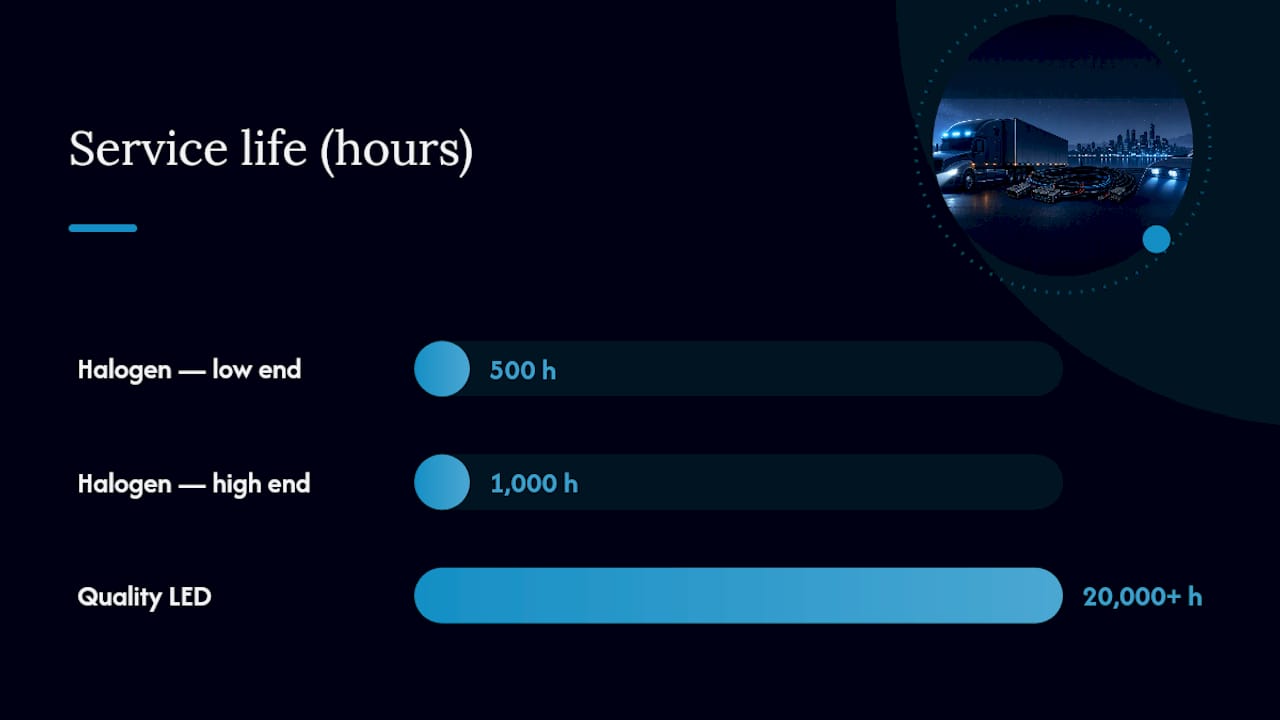
Durability compounds the gap. A halogen bulb relies on a thin filament suspended in glass. Every pothole, gravel road, and highway vibration puts stress on that filament until it eventually snaps. LED cab lights are solid-state, with no filament to shake loose, which is a big part of why they hold up so much better on trucks that see rough terrain.
Energy draw is the other quiet cost. LEDs consume a fraction of the power a halogen bulb needs to produce comparable perceived brightness, which matters more than most owners realize once you start stacking cab lights, rock lights, and marker lights on the same electrical system. Less current draw means less strain on your battery and alternator, especially if you’re running a full lighting package rather than a single row of cab lights.
Run the numbers over a typical ownership period and the picture gets clearer:
- A typical halogen bulb with moderate lifespan needs replacing roughly once a year for a truck driven regularly at night.
- Each replacement means buying a new bulb and either paying for labor or spending your own time under the cab.
- A single LED kit, installed once, can outlast several halogen replacement cycles combined, based on lifespan ratings from current LED buyer guides.
The upfront price tag on LED cab lights is higher. Stretch that cost across the number of halogen bulbs you’d otherwise replace, and LED usually comes out ahead in total cost of ownership.
What to Check Before You Buy or Install Cab Lights
A cab light upgrade goes sideways more often from a wiring mismatch than a bad bulb choice. Run through these checks before you commit to a kit.
- Confirm your system voltage. Most pickups run 12V, but heavy-duty trucks and some commercial rigs run 24V. Buying the wrong voltage kit is the single fastest way to end up with a light that never turns on.
- Check socket and connector fit. Physically confirm the plug type matches your cab light housings before ordering, especially if you’re replacing factory units.
- Watch for CAN-bus conflicts. Some newer trucks read the lower current draw of LED bulbs as a fault and throw a warning light or cause rapid flashing. A load resistor or inline adapter usually resolves this.
- Inspect harness and seal quality. A purpose-built wiring harness with proper gaskets keeps moisture out and reduces the failure rate you’d otherwise get from a generic, one-size adapter.
- Test beam aim before you finish the install. Power the lights up before final mounting, check for glare into oncoming traffic, and adjust while you still have access.
Pro Tip: If your cab lights flicker or throw a dashboard warning right after install, don’t assume the bulbs are defective. Nine times out of ten, it’s a CAN-bus mismatch that a simple resistor fixes in minutes.
Cab Lights Aren’t Just Style. They’re a Safety Signal.
Cab and marker lights exist for a reason beyond looks. On a truck taller or wider than a standard passenger vehicle, they tell other drivers, at a distance and in the dark, exactly how big the vehicle in front of them actually is. That signal matters most on rural highways and in low visibility, where headlight glare alone doesn’t give oncoming traffic enough information.
This is also where a styling decision can turn into a legal problem. Many states require exterior cab and marker lights to show amber, not white, smoked, or blue. A forum thread of installers weighing smoked housings makes the workaround clear: keep the bulb color amber even if you want a smoked lens, since the lens tint is often fine as long as the light output still reads amber at night.
- Check your state DOT or DMV requirements before installing anything other than amber cab lights.
- Do a simple night test after install: stand behind the truck and confirm the lights clearly read as amber, not white or blue.
- If you’re combining a smoked housing with a colored bulb, verify the combination stays compliant rather than assuming the lens tint alone is the issue.
Why a U.S.-Designed Harness Changes the Upgrade Math
Most compatibility problems with cab lights don’t come from the bulb. They come from the harness. A connector that’s slightly off-spec, a gasket that wasn’t sized for the housing, or a wiring diagram written for a different market all create the CAN-bus errors and water ingress issues that give LED upgrades a bad reputation they don’t deserve.
Wheel Light Express designs its lighting products in Louisiana rather than sourcing generic overseas kits, which means the harnesses, LED strips, and cab light housings are built to fit as a system instead of being pieced together from mismatched parts. That matters because a purpose-built harness is far less likely to trigger the flicker or fault codes that plague poorly matched imports. The company backs its kits with a satisfaction guarantee and offers financing, so getting the fit right the first time doesn’t come with the same financial risk as a trial-and-error import purchase.
How Heat and Cold Affect LED and Halogen Cab Lights
Temperature extremes expose real differences between the two technologies, and they don’t favor the same one in every condition.
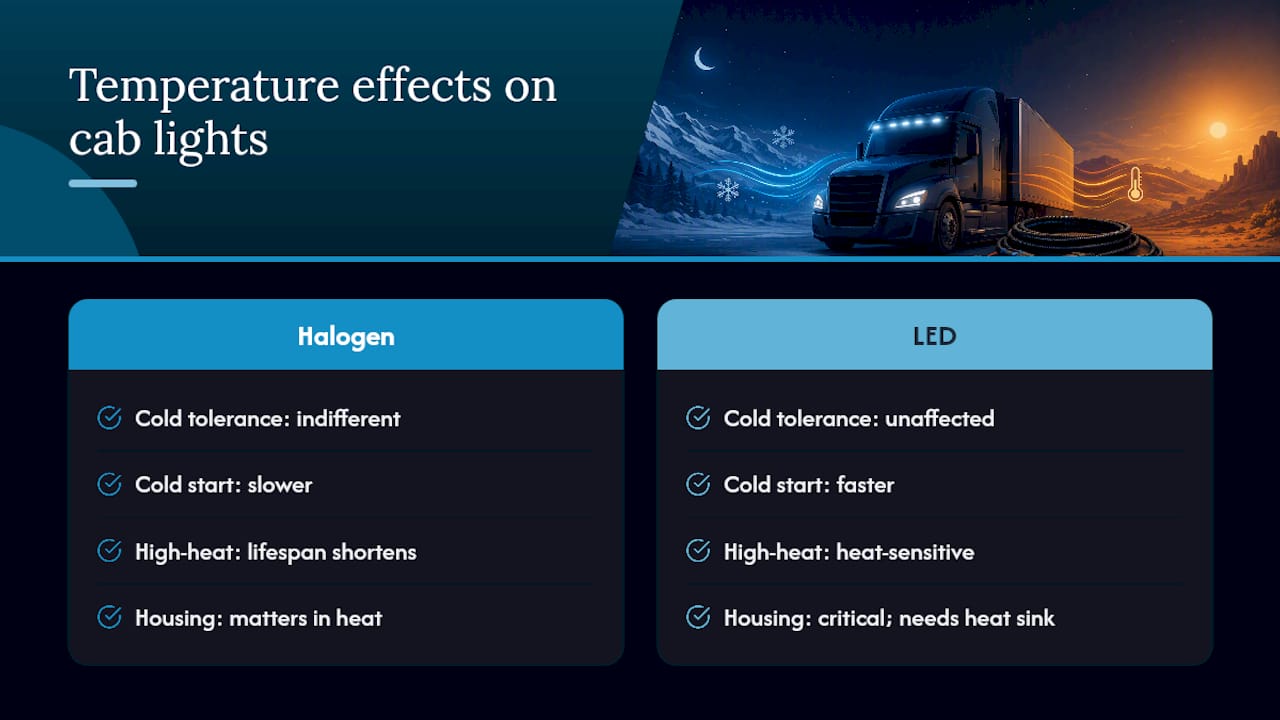
Halogen bulbs generate heat as a byproduct of lighting the filament, which means they’re largely indifferent to cold starts. That heat, however, is also their weakness in hot climates. A halogen bulb running for hours in a sun-baked engine bay or tight cab housing already runs near its thermal limit, and stacking outside heat on top shortens its already short lifespan further.
LEDs behave almost the opposite way. Cold weather doesn’t bother them. In fact, LEDs often reach full brightness faster than halogen in freezing temperatures since they don’t need to heat a filament first. The tradeoff is heat management on the other end: LEDs are more sensitive to sustained high heat, and a cheaply built housing without adequate heat sinking can shorten LED lifespan in desert climates or engine-adjacent mounting spots.
This is why housing design matters as much as the light source when you’re shopping for cab lights built for trucks that see real temperature swings, whether that’s a Louisiana summer or a Montana winter. A well-engineered LED housing with proper heat dissipation holds its rated lifespan in most climates. A poorly built one won’t, regardless of what the packaging claims.
Swapping a Bulb vs Replacing a Unit: Maintenance Realities
Maintenance is where the two technologies diverge most in day-to-day ownership, and it’s not just about how often you’re doing the work.
Halogen bulbs are simple to replace. Pop the housing, swap the bulb, and you’re done in a few minutes. That simplicity is also the problem: because halogens burn out roughly every 500 to 1,000 hours of use, you’re repeating that quick job far more often over the life of your truck, and matching the exact color temperature of a replacement bulb years later isn’t always guaranteed.
LED cab lights flip that equation. The units themselves rarely need attention for years, but when something does go wrong, it’s usually a full module or strip replacement rather than a five-minute bulb swap, since most LED cab lights are sealed units rather than a socket-and-bulb design. The practical upside is that you’re doing this far less often. Quality control also plays a bigger role with LEDs: units with proper sealing and gaskets resist the moisture intrusion that causes premature failure, while cheaper sealed units without adequate weatherproofing can fail well before their rated lifespan.
For most owners, fewer total maintenance events wins out over each individual event being marginally more involved.
Skip the Hype, Follow the Evidence
The LED vs halogen debate gets muddied by marketing claims about lumen counts that don’t reflect how your eyes actually perceive light at night. The evidence points somewhere more specific: color temperature and beam control drive real-world visibility gains, not raw brightness numbers alone. That’s a more useful way to shop than chasing the highest lumen figure on a box.
Where conventional advice falls short is treating installation as an afterthought. Plenty of guides sell you on LED benefits and then leave you to figure out CAN-bus errors, resistor requirements, and harness mismatches on your own. That gap is exactly where good upgrades turn into frustrating ones.
If you’re prioritizing one thing first, prioritize fit. A dazzling color temperature spec means nothing if the housing doesn’t seal properly or the harness fights your truck’s electrical system. Buy the bulb technology that suits your driving needs, but buy it from a kit engineered to work with your vehicle from the start, not one you’ll be troubleshooting six months in.
— Christopher
Wheel Light Express Cab Light Options Worth Considering
If you’ve decided LEDs are the right call, the next question is which kit actually fits your truck without a fight. Wheel Light Express builds that fit in from the start, designing every product in Louisiana rather than adapting a generic overseas part to your cab.
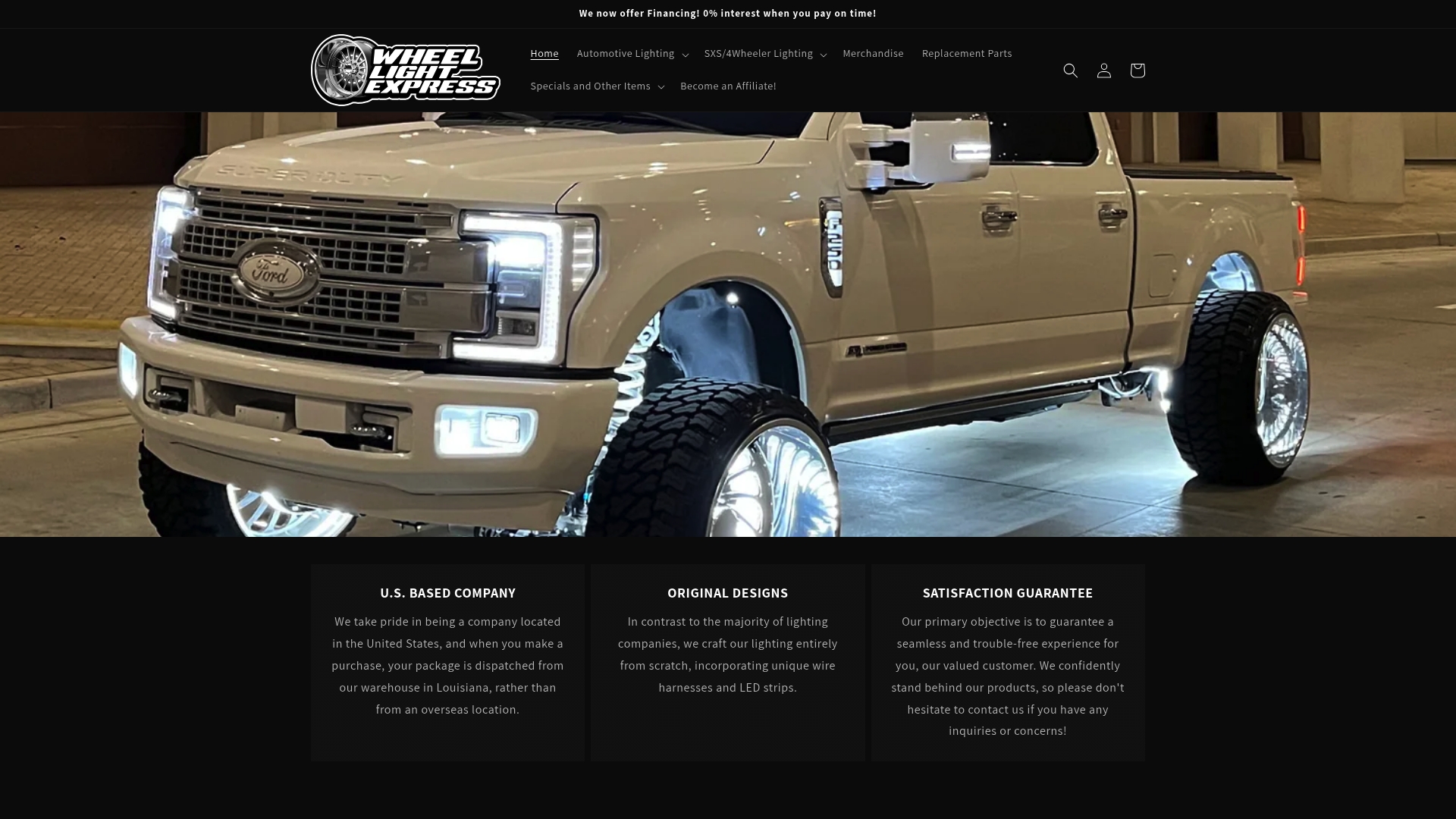
The Solar Powered Cab Lights collection is the direct match for readers upgrading exterior cab and marker lighting, priced at $399 for the kit with no wiring into your electrical system required. If you’re also addressing the harness compatibility issues covered above, the replacement wire harness is built to reduce the CAN-bus and connector mismatches that cause the flicker and fault codes generic kits are known for. Orders may include a satisfaction guarantee, and financing options might be available to help spread costs. Browse the cab light collection, check your fitment against your cab housing, and place your order when you’re ready to upgrade.
Sources
- Halogen or LED lights — which should you buy?
- A night and day difference in truck lighting - Truck News
- Lorry Lighting Buyer’s Guide 2026: LED vs Halogen, What to Look For, and How to Avoid Costly Mistakes - gtr lighting
- LED Truck Cab Lights: Illuminating Your Ride with Style and Safety
FAQ
Are smoked cab light lenses legal?
It depends on your state, but the bulb color usually matters more than the lens tint. Many states require the light output to read amber, so a smoked lens paired with an amber bulb is often fine, while a smoked lens over a white or blue bulb can fail inspection.
Do LED cab lights need a resistor?
Not always, but some trucks with CAN-bus electrical systems read the lower current draw of LEDs as a fault and trigger a warning light or hyper-flash. A load resistor or inline adapter usually resolves it.
Will LED cab lights drain my battery?
No. LEDs use significantly less power than halogen bulbs for comparable visibility, which reduces strain on your battery and alternator rather than adding to it.
How long do LED cab lights actually last compared to halogen?
Quality LED cab lights are rated for many thousands of hours, often over twenty thousand, compared to roughly 500 to 1,000 hours for a halogen bulb.
What does Wheel Light Express charge for cab lights?
The Solar Powered Cab Lights collection is priced at $399 as a one-time purchase, with financing options available at checkout.