

Front and side-near-front marker lights must emit amber; rear and side-near-rear markers must emit red. That rule comes straight from FMVSS No. 108, the federal lighting standard, and it’s echoed almost word for word in state law, including Florida §316.224. There’s no legal middle ground for pink, blue, green, or RGB “show” colors on a street-driven vehicle.
TL;DR:
- FMVSS No. 108 mandates front markers emit amber and rear markers emit red, with no exceptions allowed for non-standard or show colors.
- State laws adopt and enforce the federal standard, requiring compliance with specific color, brightness, and mounting position criteria.
- Switching marker lights to colors like blue or green for show purposes is illegal once the vehicle is used on public roads, exposing owners to citations and safety violations.
- Verify aftermarket parts with a DOT mark and test emitted color directly, avoiding non-compliant RGB or multicolor products marketed as “street legal.”
- Enforcement consequences range from citations and repair orders to impact on safety ratings, especially for commercial vehicles and repeated violations.
Table of Contents
- Understanding Side Marker Color Laws at the Federal Level
- How States Enforce the Federal Baseline
- Why Pink, Blue, Green, and RGB Show Lights Aren’t Street Legal
- Checking Aftermarket Parts Before You Buy or Install
- Exceptions: Trucks, Trailers, Antiques, and Emergency Vehicles
- What to Do If You Get Cited or Fail Inspection
- What Wheel Light Express Builds Into Every Marker Light
- Penalties Beyond the Citation Itself
- Motorcycles vs. Passenger Vehicles: Different Equipment, Same Colors
- How Side Marker Color Rules Got to Where They Are Today
- An Editorial Take on Marker Light Compliance
- Sources
Understanding Side Marker Color Laws at the Federal Level
FMVSS No. 108 is the reason your truck’s marker lights look the same whether it rolled off a lot in Ohio or Oregon. The standard, codified at 49 CFR 571.108, sets color, photometric output, and mounting position for every lamp on a vehicle sold or operated in the United States, including original factory equipment and aftermarket replacement parts.
Two tables inside the regulation do the heavy lifting. Table I assigns colors and minimum candela values by lamp type and vehicle location. Table III governs equipment for larger vehicles, including the intermediate side markers required on trucks and trailers that exceed certain length thresholds. Together they answer the only question that matters for compliance: what color light comes out of the lens, and how bright is it?
A few things trip people up here:
- The rule covers emitted light, not the lens itself. A smoked or clear lens is fine if the bulb or LED module behind it produces the correct wavelength.
- Replacement parts have to meet the same photometric and color tests as the equipment they replace. Swapping in a “cooler looking” module doesn’t get a pass just because the original part was legal.
- Some states layer on visibility distance requirements. Kansas, for example, requires side reflectors visible from 50 to 600 feet under specified beam conditions, which is the kind of detail an inspector actually checks with a flashlight and a tape measure.
Trucks and trailers over specified width and length thresholds need intermediate markers between the front and rear units, and those also have to run amber. Owners who upgrade lighting purely for looks often miss this, and it’s one of the more common reasons a commercial rig fails a roadside inspection.
How States Enforce the Federal Baseline
States don’t invent their own color rules from scratch. They adopt FMVSS No. 108 into their own statutes, sometimes with slightly different phrasing but the same operative color requirement. Three examples make the pattern obvious.
Florida §316.224 requires front and side-near-front marker lamps to display or reflect amber, and rear and side-near-rear lamps to display or reflect red. Ohio’s Administrative Code Rule 4501-15-04 uses nearly identical language and leans on SAE and federal motor carrier standards for placement and construction. West Virginia Code §17c-15-10 rounds it out, requiring clearance lamps and side markers to show amber up front and red at the rear.
Notice what’s consistent across all three: amber forward, red rearward, no exceptions carved out for personal preference or aesthetic builds.
If you want to check your own state’s exact wording, here’s a fast research path:
- Search “[your state] side marker lamps statute” or “[your state] vehicle equipment code.”
- Look for your state’s version of the Uniform Vehicle Code equipment sections, usually filed under motor vehicle equipment or lighting.
- Check your state DMV’s official lighting or inspection page rather than a forum post or a seller’s product description.
Before you assume you’re compliant, run this quick field check: confirm the marker is visible in the correct color from a reasonable distance, verify a DOT marking is stamped on the lens or housing, and confirm the light is mounted at the height and location the manufacturer specified. Inspectors are checking exactly these three things.
Why Pink, Blue, Green, and RGB Show Lights Aren’t Street Legal
NHTSA has addressed this directly. In Interpretation ID 21872.ztv, the agency states plainly that front side markers and front turn signals must be amber and rear side markers must be red, and that switching a lamp into a “show” color does not exempt on-road equipment from FMVSS No. 108. Intent doesn’t matter. A vehicle built and licensed for street use has to meet the standard regardless of whether the lights are set to a factory color or a custom mode.
That guidance closes a loophole a lot of sellers rely on: marketing a marker lamp as “switchable” between a compliant color and something flashier for shows or parking lots. If the vehicle is ever driven on a public road in the noncompliant mode, it’s out of compliance in that moment, full stop.
Consequences vary by context:
- A passenger vehicle owner typically gets a citation or an equipment repair order.
- A commercial carrier risks a roadside inspection violation that can affect a company’s safety rating with FMCSA.
- Blue and red combinations specifically raise a separate legal problem, since those colors are reserved for authorized emergency vehicles in most states. Running them on an ordinary vehicle can draw a more serious charge than a routine lighting citation.
Pro Tip: If a product listing markets a marker light as having a “street mode” and a “show mode,” assume the show mode is illegal to use on any public road, even briefly.
Checking Aftermarket Parts Before You Buy or Install
Buying the right replacement part is mostly about three checks, and none of them require special tools.
- Look for a DOT marking on the lens or housing. That stamp indicates the manufacturer certifies the part meets FMVSS No. 108’s photometric and color requirements. No mark is a red flag.
- Test emitted color, not lens color. Power the light on in daylight and in the dark, and look at the actual color hitting a wall or the pavement, not the tint of the lens itself. A clear lens with an amber LED module behind it is legal; a red lens with a white LED behind it usually isn’t, since the emitted color has to match the requirement, not just the visual impression.
- Match the harness and connector to your vehicle. A correct-color bulb in the wrong housing can still fail inspection if it isn’t mounted at the specified height or angle.
If you’re modifying a commercial vehicle or anything with intermediate marker requirements, a certified installer or a shop that can run a basic photometric check is worth the money over guessing.
Pro Tip: Be skeptical of any marker light marketed as “switchable RGB, street legal.” No RGB or multicolor product changes the fact that the vehicle has to display amber front and red rear while on a public road.
For straightforward swaps, Wheel Light Express’s side marker lights collection and its guide on side marker upgrades that avoid dash errors walk through fitment questions that come up during installation.
Exceptions: Trucks, Trailers, Antiques, and Emergency Vehicles
Not every vehicle plays by the exact same lighting script, though the color rule rarely bends.
- Commercial trucks and trailers over specified length and width thresholds need intermediate side markers positioned near the midpoint of the vehicle, and those markers must be amber, matching the front-end color requirement rather than the rear one.
- Antique and historic vehicles sometimes get inspected under period-correct standards in certain states, but this varies significantly by jurisdiction and by how the vehicle is registered. Don’t assume a classic car plate exempts you from current lighting law without checking your specific state’s rule.
- Authorized emergency vehicles have defined allowances for red, blue, and combinations of the two that ordinary drivers simply don’t get, regardless of how the vehicle is otherwise equipped.
A private truck or SUV, however customized, doesn’t inherit any of those emergency-vehicle allowances. Trying to imitate that color scheme is one of the fastest ways to escalate a simple equipment issue into a more serious legal problem.
What to Do If You Get Cited or Fail Inspection
A noncompliant marker light is one of the more fixable problems you can have with a vehicle, as long as you handle it in order.
- Replace the noncompliant unit immediately with a DOT‑marked amber unit up front and a red unit at the rear, matching FMVSS No. 108’s color assignment for that mounting location.
- Save your documentation. Keep the purchase receipt, a photo of the DOT mark on the new part, and any manufacturer compliance statement that came with it.
- Buy from a source that states DOT certification clearly. Expect a straightforward swap to run well under an hour for a basic bulb or module replacement, longer if the housing itself needs to change.
- Bring proof to a fix-it ticket or re-inspection. Most jurisdictions will clear the citation once you show the corrected, compliant part.
- Talk to a traffic attorney if penalties escalate, particularly for a commercial vehicle facing a carrier safety violation or a repeat offense that risks points on a license.
Fixing the equipment fast and keeping paperwork is usually enough to close the matter before it turns into anything more than an inconvenience.
What Wheel Light Express Builds Into Every Marker Light
Some lighting product companies design their products domestically rather than sourcing overseas, which can keep quality control closer to the parts that go on vehicles. Every marker light and harness produced is typically checked against basic standards such as correct emitted color, proper mounting fit, and compatibility with the vehicle it’s intended for.
This approach generally involves confirming emitted color output before a part ships rather than relying on lens tint, designing wire harnesses and LED strips to fit vehicle applications, and providing customer support for product fit issues.
| Buyer checklist | Why it matters |
|---|---|
| DOT mark visible on housing or lens | Confirms manufacturer compliance certification |
| Emitted color tested, not just lens color | Matches the legal requirement (color of light, not lens tint) |
| Harness matches vehicle make/model | Prevents wiring mismatches that cause flicker or dash errors |
| Purchase documentation saved | Useful if you’re ever asked to prove compliance |
Readers weighing financing options for a full lighting upgrade can also look at Wheel Light Express’s wheel light ring and strip lineup, which pairs with compliant marker setups for a cohesive build.
Penalties Beyond the Citation Itself
A first-time marker light violation is typically a non-moving equipment citation, and in many jurisdictions it comes with a fine and a chance to fix the problem before it goes further. That’s the mild end of the outcome range, but it’s not the only one.
Repeat violations, or a violation discovered alongside other equipment problems, can escalate. Some states attach points to a driver’s license for lighting violations tied to broader unsafe-equipment findings, particularly when the modification also involves reserved emergency colors like red and blue. A court appearance becomes likely if the citation isn’t resolved through a standard fix-it process, especially if a driver ignores a deadline or fails to produce proof of correction.
Commercial drivers face a steeper stack. A marker light violation discovered during a roadside inspection can count against a carrier’s federal safety rating, which affects insurance costs and can trigger closer scrutiny on future inspections. For an owner-operator, that kind of finding is a bigger financial hit than the fine written on the ticket.
The safest assumption is to treat any citation as a signal to act immediately rather than something to negotiate around. Fixing the lamp and documenting the fix almost always resolves the matter cleanly; letting it sit is what turns a minor fine into a court date.
Motorcycles vs. Passenger Vehicles: Different Equipment, Same Colors
Motorcycles don’t get a separate color rule. The same amber-front, red-rear logic in FMVSS No. 108 applies to two-wheeled vehicles equipped with side marker or reflex reflector devices, though the practical equipment requirements differ because of the vehicle’s size and shape.
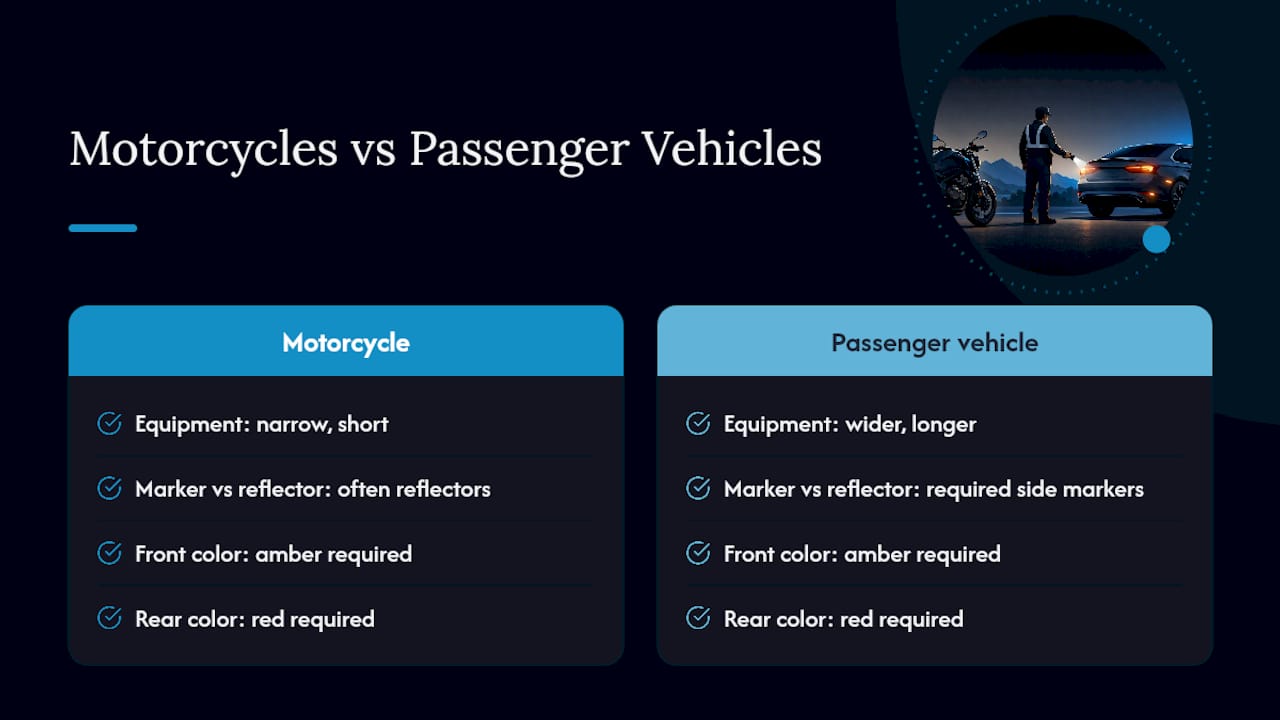
Passenger cars and trucks are required to carry side marker lamps at specific body locations because their length and width create blind zones that need to be visible from the side. Motorcycles, being narrower and shorter, often rely more heavily on reflectors than powered marker lamps, and some states waive certain side marker requirements for motorcycles specifically because of that reduced profile.
Where a motorcycle does carry marker lamps or reflective equipment, the color assignment doesn’t change. Amber still belongs at the front, red still belongs at the rear. What changes is enforcement emphasis: motorcycle inspections tend to focus more on headlight, taillight, and turn signal color than on marker lamps specifically, simply because fewer motorcycles are built with dedicated side marker hardware in the first place.
Riders customizing a motorcycle with auxiliary lighting, including frame or wheel accent lights, should apply the same emitted-color logic used for trucks: check what color the light actually produces, not what the lens looks like when it’s off.
How Side Marker Color Rules Got to Where They Are Today
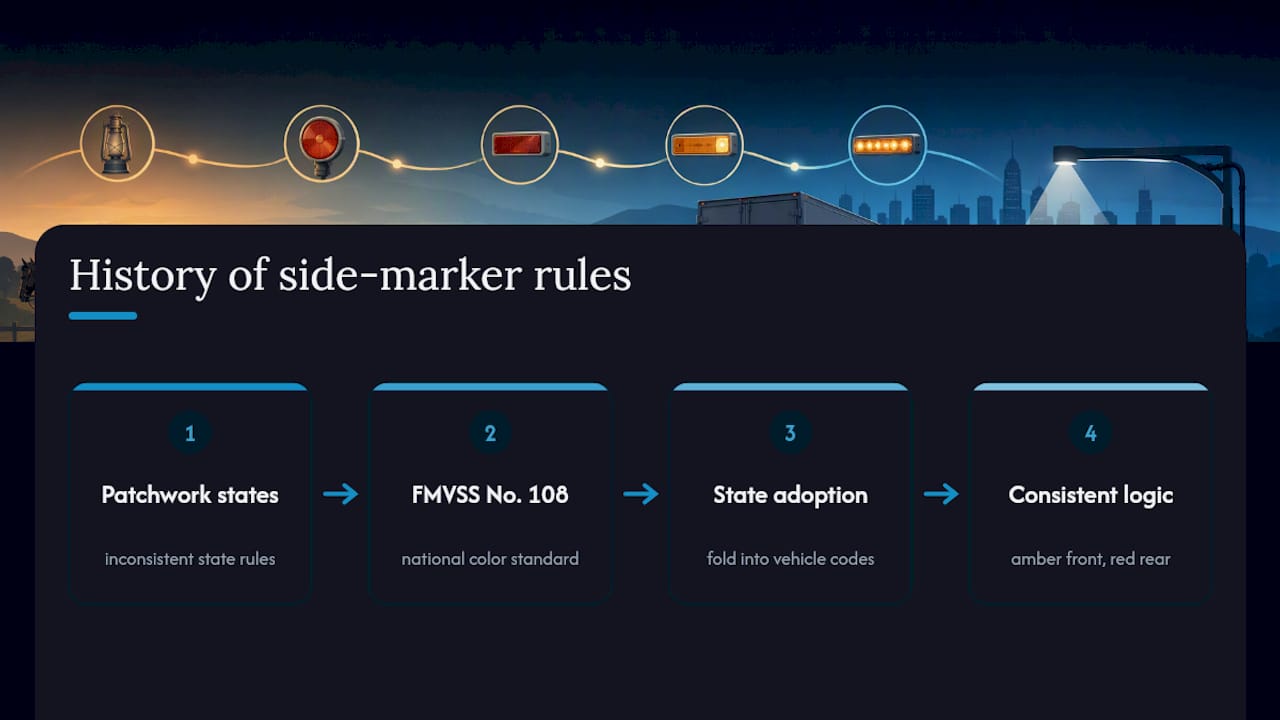
The amber-front, red-rear standard didn’t appear overnight. Federal motor vehicle lighting requirements developed over decades as safety regulators tried to standardize how vehicles communicate their position, direction, and outline to other drivers, particularly at night and from the side, where headlights and taillights don’t help much.
FMVSS No. 108 became the vehicle through which that standardization happened nationally, giving manufacturers one federal color and photometric standard to build to instead of a patchwork of inconsistent state rules. States then largely folded that federal standard into their own vehicle codes rather than maintaining competing definitions, which is why Florida, Ohio, and West Virginia all land on nearly identical language despite being written independently.
The logic behind amber at the front and red at the rear is simple once you think about it from another driver’s point of view: amber reads as “something is approaching from the side or ahead,” while red reads as “something is receding or stopped ahead of you,” matching the same color logic used for headlights and taillights. That consistency is exactly why the rule has held steady through the rise of LED technology, aftermarket customization trends, and the current wave of RGB and switchable lighting products. The color code didn’t need to evolve because the underlying visibility problem it solves never changed.
An Editorial Take on Marker Light Compliance
The conventional advice on this topic treats side marker color as a minor styling question, something you fix if an officer happens to mention it. That framing gets it backward. The color requirement is one of the more rigid parts of vehicle equipment law precisely because it costs regulators nothing to enforce and it’s visible from a patrol car at forty feet. Treating it as low priority is how a five-dollar bulb turns into a fix-it ticket, a missed court date, or in a commercial context, a mark against a carrier’s safety rating.
What actually matters is simpler than most guides make it sound: check the DOT mark, test the emitted color with your own eyes, and skip anything marketed with a “show mode.” The industry hype around switchable RGB marker lights outpaces the legal reality by a wide margin, and NHTSA’s own interpretive letter already closed that loophole. Readers should prioritize buying certified parts the first time, not customizing first and hoping compliance sorts itself out later.
— Christopher
Sources
Keep these on hand if you ever need to double-check a claim or pull exact statutory language for your state: the NHTSA interpretive letter on marker lamp color, 49 CFR 571.108 for the federal standard itself, and the state examples covered here, Florida §316.224, Ohio Rule 4501-15-04, and West Virginia §17c-15-10. If your state isn’t one of these three, check your own DMV or legislative code directly, since minor wording differences do exist even where the color requirement stays the same. Repair costs from ignoring vehicle warning issues can also compound quickly, as FrenzyCars notes regarding flashing check engine lights, which is a good reminder that small equipment problems are cheaper to fix early.
- Interpretation ID: 21872.ztv
- Florida Statutes §316.224 (2025)
- Rule 4501-15-04 - Ohio Administrative Code
- 49 CFR 571.108 - Federal Motor Vehicle Safety Standard No. 108
- West Virginia Code | §17c-15-10