

A light switching system in trucks is an integrated or aftermarket electrical control setup that manages power to auxiliary lighting and accessories safely. It routes current through dedicated switches, relays, and fuse boxes rather than tapping directly into factory circuits. The result: your lights work reliably, your vehicle’s electronics stay protected, and you keep your warranty intact.
Core components you’ll find in any truck light control system:
- Switches: Physical toggles or touchscreen panels that send control signals
- Relays: Electrically operated switches that handle high-current loads the switch itself cannot
- Fuse boxes / power distribution centers (PDCs): Protect circuits from overload
- Upfitter modules: Factory or aftermarket interfaces that connect accessories to the vehicle’s communication network
- Wiring harnesses: The backbone connecting every component cleanly and safely
Table of Contents
- How factory auxiliary switch systems work in your truck
- Modern wireless and automated controls are changing how you run your lights
- Why professional switching systems protect your truck better than DIY shortcuts
- How Wheellightexpress supports your custom truck lighting build
- Common types and configurations of light switching systems
- What to check before installing a light switching system on your truck
- Keeping your light switching system running reliably
- US regulations you need to know for aftermarket lighting
- Key Takeaways
How factory auxiliary switch systems work in your truck
Factory auxiliary switch systems are built directly into the truck’s electrical architecture, typically mounted in the lower instrument panel switch bank. Ram trucks, for example, include six auxiliary switches that communicate over a LIN bus to the vehicle’s Auxiliary Power Distribution Center, with relay outputs routed to dedicated four-way connectors under the hood.
Ford’s approach uses an Upfitter Electronic Module (UEM), also called a VSIM or UIM. This module supports multiple OEM network protocols and allows programmable switch behaviors without any splicing into factory wiring. GM’s Silverado Medium Duty trucks with the RPO 9L7 option place 30-amp-rated auxiliary outputs directly in the instrument panel junction block.
Key safety features built into these systems:
- Circuit ratings of 20A–40A with dedicated fuses that can be relocated to match your accessory load
- Relay isolation keeps high-draw accessories off the switch’s low-current signal circuit
- LIN bus communication preserves the vehicle’s CAN-Bus network integrity
- Programmable modes via the infotainment screen: battery or ignition power, momentary or latching, and last-state memory
Pro Tip: Ram’s first two auxiliary switches are often rated for the highest loads. If you’re running a light bar or winch, start there before reaching for an aftermarket solution.
Modern wireless and automated controls are changing how you run your lights
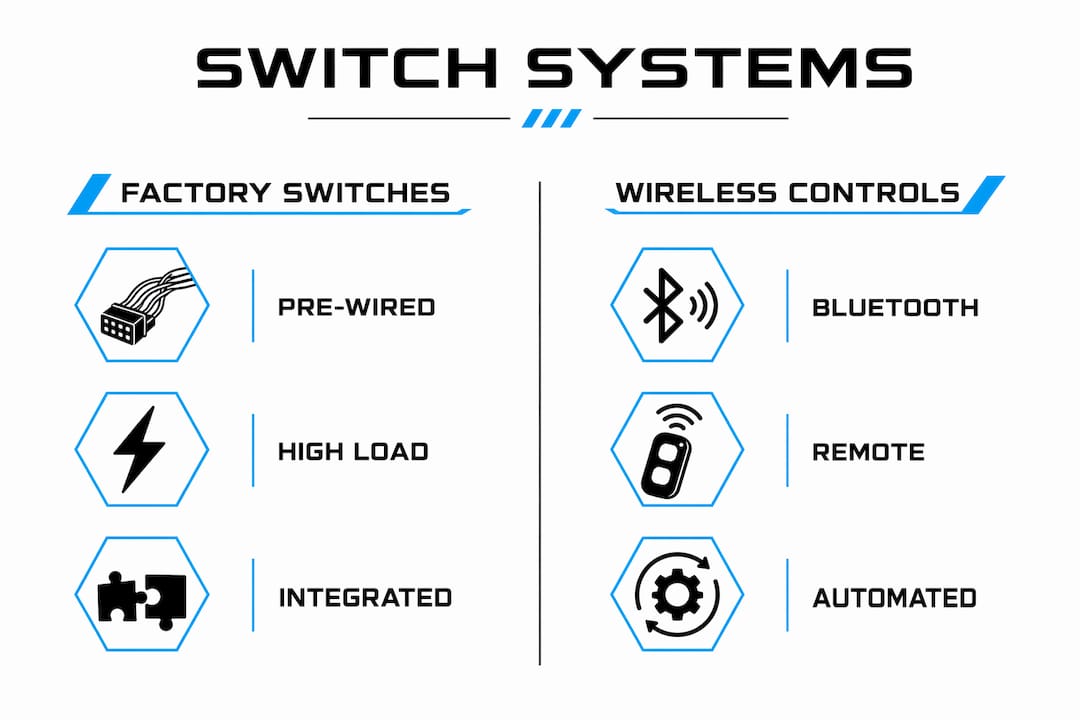
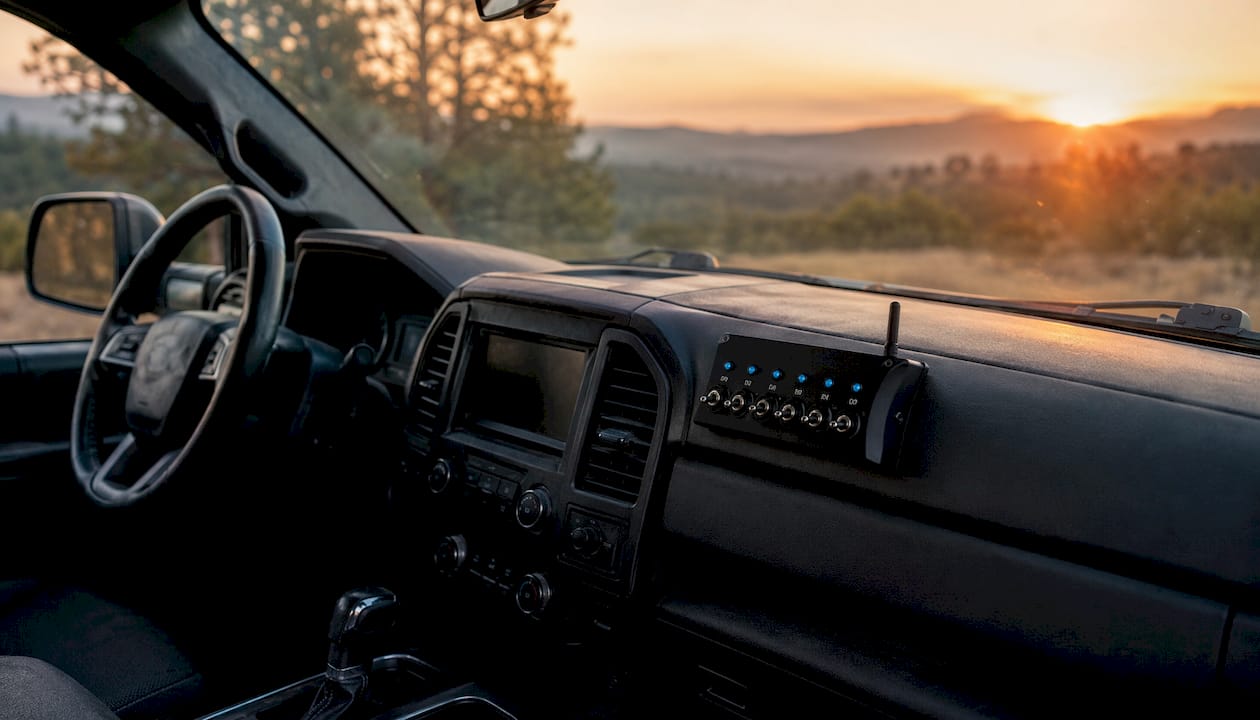
Touchscreen switch panels have replaced the old row of toggle switches for many enthusiasts. The sPOD BantamX, for instance, manages up to eight accessories with Bluetooth connectivity and fully customizable switch behaviors, all from a single panel. You can control everything from inside the cab or from your phone standing outside the truck.
Wireless panels like the Purelux Multi-Switch Dashboard Controller operate on both Bluetooth (up to 10 meters) and RF remote (up to 30 meters), making them practical for job sites and trail use. For app-controlled truck LEDs, the convenience factor alone justifies the upgrade.
Automation goes further with vehicle control modules. Federal Signal’s FSDirect module links lighting outputs to vehicle data bus events like door status, transmission state, or vehicle speed. Your scene lights can activate automatically when you shift into park. Your warning lights can trigger the moment a door opens.
Programmable switch modes to know:
- Latching mode: Light stays on until you press again. Best for light bars and steady-on auxiliary lighting.
- Momentary mode: Light is on only while the button is held. Required for winches and high-draw safety accessories.
- Flashing mode: Timed on/off cycling, useful for warning or accent lighting.
- Last-state memory: The system restores your previous settings after a power cycle.
Why professional switching systems protect your truck better than DIY shortcuts
Splicing into factory wiring or taping into an existing circuit is the fastest way to create problems. It risks voiding your warranty, triggering CAN-Bus network errors, and causing electrical faults that are expensive to diagnose. Factory and professional upfitter systems are specifically designed to prevent this.
Proper auxiliary switch systems isolate accessories from critical vehicle circuits, communicating over dedicated buses to prevent electrical faults and preserve vehicle communication network integrity. Experts consistently caution against hacking factory wiring because the downstream damage often exceeds the cost of doing it right the first time.
Many trucks include factory-designated blunt-cut wires in the footwell or engine bay, pre-fused and connected to the auxiliary PDC. These are your safest power source for aftermarket accessories. When your accessory load exceeds the factory switch’s rating, add a relay rather than bypassing the fuse. Typical auxiliary switch circuits handle 20–40 amps; exceed that without a relay and you’re looking at tripped fuses at best, damaged modules at worst.
Note that upfitter modules like the UEM often require factory installation with a specific upfitter package. Retrofitting them after purchase is not always possible, which makes ordering the right factory option upfront worth the planning.
How Wheellightexpress supports your custom truck lighting build
Wheellightexpress designs every product in Louisiana, which means you’re getting original lighting solutions built for American trucks, not generic imports. Their custom wire harness leads are engineered to connect cleanly with factory switching systems and modern control panels, keeping your build neat and your circuits protected.
Their LED light strips and wheel light rings are designed to complement the switching systems covered in this article, whether you’re running a factory auxiliary bank or a Bluetooth-enabled touchscreen panel. Financing options make it possible to build the setup you want without waiting.
Common types and configurations of light switching systems
- Factory auxiliary switch banks: Integrated, warranty-safe, and rated for moderate loads
- Upfitter electronic modules (UEM/VSIM): Factory-level interfaces for professional upfitting
- Aftermarket toggle/rocker panels: Simple, low-cost, and widely compatible
- Touchscreen and app-based panels: High-feature, wireless-capable, ideal for off-road builds
- Vehicle automation modules: Event-triggered outputs tied to vehicle data bus signals
What to check before installing a light switching system on your truck
Compatibility starts with your truck’s model year and trim. Factory auxiliary switch availability varies: Ram added six switches starting with 2019 models, and GM’s 9L7 option is not retrofittable after the build date. Check your door jamb sticker or window sticker for factory-installed upfitter options before purchasing aftermarket alternatives.
Match your switch system’s amperage rating to your planned accessories. A single LED light bar typically draws 5–15 amps; a set of rock lights and underbody strips combined can push higher. Always verify the dashboard warning lights aren’t masking an existing electrical issue before adding load to the system.
Keeping your light switching system running reliably
Inspect wiring connections twice a year, especially after off-road use. Corrosion at connector pins is the most common cause of intermittent lighting failures. Dielectric grease on every connector prevents moisture intrusion. If a switch stops responding, check the fuse at the PDC first before assuming the switch itself has failed. For touchscreen panels, a firmware update often resolves unresponsive behavior before any hardware swap is needed.
US regulations you need to know for aftermarket lighting
Federal Motor Vehicle Safety Standards (FMVSS) govern lighting on public roads. Auxiliary forward-facing white lights must be wired to turn off when the vehicle is in motion on public roads in most states. Colored lighting (blue, red) is restricted or prohibited on civilian vehicles in nearly every state. Always check your state’s vehicle code before installing accent or off-road lighting, and wire auxiliary lights through a switch that disables them at road speed when required.
Key Takeaways
A truck light switching system is the safest, most reliable way to manage auxiliary lighting without compromising your vehicle’s electrical architecture or factory warranty.
| Point | Details |
|---|---|
| Factory systems offer the safest integration | Ram, Ford, and GM factory auxiliary switches use LIN bus communication and dedicated PDCs to isolate accessories. |
| Circuit ratings matter | Factory auxiliary switch circuits typically handle 20–40 amps; add a relay when your load exceeds that range. |
| Wireless controls add real utility | Bluetooth and RF panels like sPOD BantamX manage up to eight accessories remotely from inside or outside the cab. |
| Avoid splicing into factory wiring | Using factory blunt-cut wires and upfitter modules prevents CAN-Bus damage and warranty voids. |
| US regulations restrict road use | Auxiliary and colored lights must comply with FMVSS and state vehicle codes before use on public roads. |
Recommended
- App-Controlled Truck LEDs: What Every Enthusiast Should Know – Wheel Light Express
- Truck Lighting Kit Components Explained for Enthusiasts – Wheel Light Express
- Remote Control Lighting Trucks: What You Need to Know – Wheel Light Express
- Why Full Truck Light Kits Matter for Safety and Style – Wheel Light Express