

For trail and work rigs, RF remotes win on range and reliability. For show trucks and builds that need color, pattern, and music-sync control, Bluetooth app controllers pull ahead. Range and durability favor RF; features and flexibility favor Bluetooth. The checklist below will help you match either technology to the right kit before you buy.
TL;DR:
- RF remotes offer significantly longer, more reliable range that is less affected by metal shielding and interference, making them ideal for work or trail vehicles.
- Bluetooth controllers provide advanced features such as music sync, customizable patterns, and multi-user control, but have a shorter effective range and depend on a charged phone or app stability.
- Proper receiver placement and high-quality wiring are essential for maintaining range and signal consistency, especially on metal or splash-prone vehicle parts.
- Safety-critical circuits should use RF or physical switches, while Bluetooth is better suited for aesthetic effects like RGB lighting or underglow where brief signal loss is tolerable.
- Cost and complexity increase with feature set, with RF kits typically being simpler and less expensive to install, but Bluetooth offering more control options for show builds.
Table of Contents
- Bluetooth vs RF Comparison for Vehicle LED Control
- How Bluetooth and RF Actually Talk to Your Lights
- How Do You Choose Between Bluetooth and RF for Your Build?
- Installing Wireless Controllers Without Losing Signal
- Why Wheel Light Express Built Its Kits Around These Trade-Offs
- Ready to Match a Kit to Your Controller?
- Sources
- FAQ
Bluetooth vs RF Comparison for Vehicle LED Control
Range is where these two technologies split hardest. RF remotes built for automotive use are typically rated between 100 and 300 feet line-of-sight, while Bluetooth’s effective range inside a vehicle often falls to a shorter distance. Neither number survives contact with a truck cab. Metal bodies, truck beds, and engine blocks eat into both signals, and installers commonly see real-world range drop to a fraction of what’s printed on the box.
Feature depth flips the advantage the other way. Bluetooth app controllers hand you scheduling, multi-user access, and music sync that a basic RF remote simply can’t do. RF remotes are built for one job: turn a circuit on, off, or dim it, from a distance, without needing a phone in your hand.
That last point matters more than it sounds. Bluetooth depends on a paired, charged, updated phone running a working app. RF remotes depend on a battery and a button. If you’ve ever had a lighting app crash mid-drive or lose its pairing after an iOS update, you already know which one fails less gracefully.
- RF advantages: longer range, works through metal, no phone dependency, simple pairing, less vulnerable to crowded frequencies.
- Bluetooth advantages: app-based scheduling, color and pattern libraries, music sync, multi-user control, easier firmware updates.
- RF drawbacks: limited to basic functions, no app ecosystem, fewer zones per remote.
- Bluetooth drawbacks: shorter effective range, phone/app dependency, exposed to 2.4 GHz congestion.
The 2.4 GHz band is one of the most crowded pieces of spectrum in a modern vehicle, shared by Bluetooth, WiFi hotspots, and plenty of consumer electronics. Sub-GHz RF systems run on dedicated frequencies that see far less local interference, which is part of why they hold a connection more consistently in a parking lot full of other vehicles.
Cost and complexity track roughly with feature count. RF remote kits tend to be simpler and less expensive to install since there’s no app setup, account creation, or firmware step. Bluetooth kits generally require more setup but offer greater control options.
Pro Tip: If your build mixes both, use RF for anything safety-related or always-on, like work lights or ditch lights, and reserve Bluetooth for RGB rock lights or underglow where losing sync for a few seconds is a nonissue.
How Bluetooth and RF Actually Talk to Your Lights
Bluetooth Low Energy handles most app-based LED controllers today, connecting your phone directly to a receiver module. Some newer setups use Bluetooth Mesh to let multiple nodes talk to each other, but that adds complexity and isn’t standard in most aftermarket kits yet. RF systems, by contrast, usually run a much simpler signal: a sub-GHz or 2.4 GHz transmitter sends a basic on/off/dim command to a receiver wired into your relay harness, with lower data rate and latency suited for simple commands.
That simplicity has a ceiling. Coordinating a handful of solid-color rock lights is one thing. Driving hundreds of individually addressable pixels for chase patterns or wave effects is another, and that’s where dedicated lighting protocols come in.
Automotive pixel systems require commands that latch and synchronize updates across nodes to prevent visible tearing, which protocols like OSP address.
The OSIRE Open System Protocol supports daisy-chained LED nodes with SYNC commands specifically to prevent that tearing, alongside built-in diagnostics and EMI-conscious signaling. ISELED works on similar principles for high pixel counts with low latency and embedded calibration. Neither is something a basic Bluetooth or RF remote was ever designed to replace; they operate at the device level, between the driver and the LEDs themselves, not between your phone and the vehicle.
- Bluetooth topology: phone or app hub to wireless receiver to relay harness.
- RF topology: handheld remote to wireless receiver to relay harness.
- Pixel-level topology: pixel controller ICs manage per-LED PWM and diagnostics, often mounted on the same board as the LEDs to reduce EMC issues, with a protocol like OSP handling synchronization between nodes.
That third layer explains why a fully addressable, effect-heavy lighting kit needs more than “wireless control.” It needs a controller architecture built for it. Learn more about how lighting controllers for vehicle LED systems handle these layers before you commit to a kit.
How Do You Choose Between Bluetooth and RF for Your Build?
Work through these five checks before you buy anything.
- Match the tech to how you drive. Trail and work rigs that need lights to work every time, in every condition, lean RF. Show trucks and UTVs built around color, patterns, and music sync lean Bluetooth.
- Confirm the electrical specs. Check the current rating per channel against your total LED draw, confirm the harness is fused, and know whether each circuit is switched or constant power.
- Check the physical and environmental rating. Look for an IP rating suited to splash or full submersion depending on placement, connector types that match your existing harness, and a mounting method that keeps the receiver away from major metal shielding.
- Define your control needs upfront. Count how many zones or channels you actually need, how complex your patterns will get, and whether more than one person needs app access.
- Build in a backup. Any circuit tied to safety, like ditch lights or work lights, needs a physical switch or hardwired override that works even if the wireless link fails.
Pro Tip: Write down your zone count and current draw before you shop. A controller rated for four channels at 10 amps each sounds generous until you add up High Density Wheel Lights, rock lights, and portal lights on one harness.
Skipping the electrical check is the most common mistake builders make, and it’s the one most likely to cause a fire, not just a flickering light. A wheel light sizing guide is worth a look before you finalize channel counts, since kit size drives current draw more than most people expect.
Installing Wireless Controllers Without Losing Signal
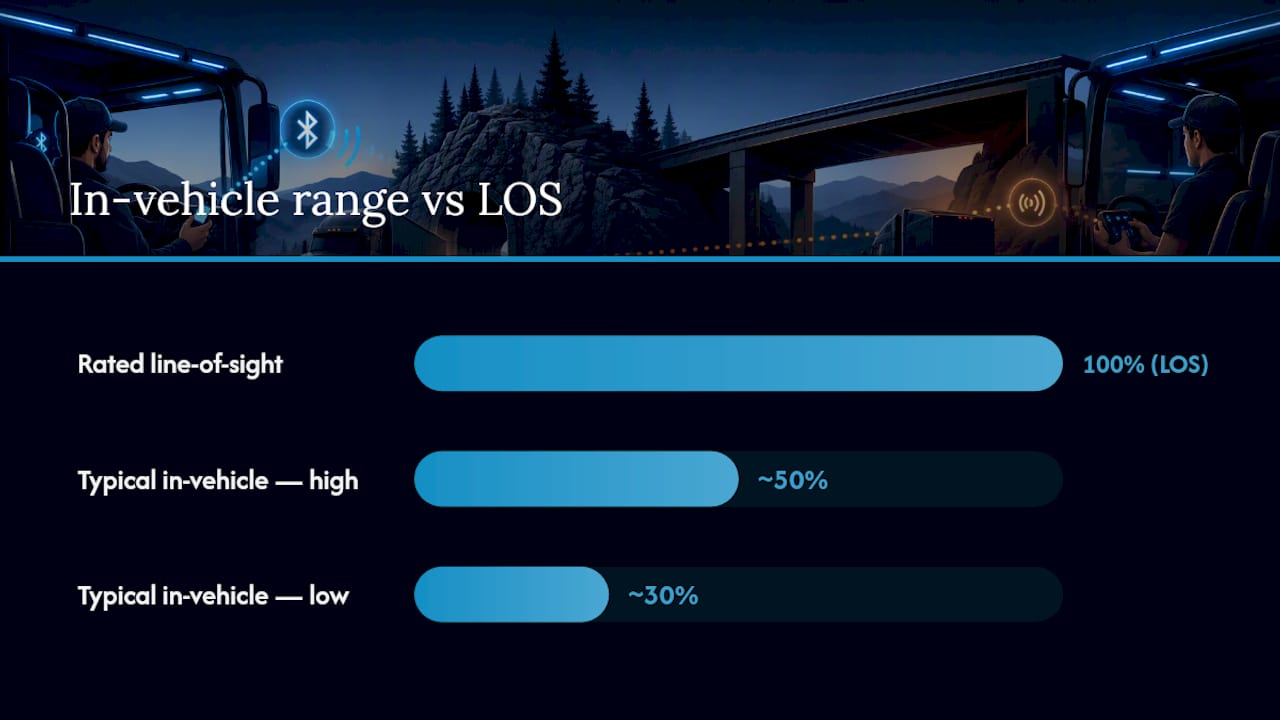
Receiver placement decides most of your range problems before you ever hit the road. Mount receivers as high and forward as your harness allows, away from the truck bed’s metal walls and the engine block, since in-vehicle range typically runs 30 to 50 percent of a controller’s rated line-of-sight distance.
Wiring quality matters just as much as placement. Use a properly fused relay harness rated above your maximum current draw, clean chassis grounds, and weatherproof, sealed connectors anywhere exposed to road spray or mud.
- Mount the receiver away from large metal panels and as close to the front of the vehicle as the harness reaches.
- Use a fused relay harness, not a direct splice into existing wiring.
- Seal every connector rated for outdoor exposure, especially on rock lights and portal lights.
- For multi-pixel setups, follow the synchronization guidance in protocols like OSP to avoid visible lag between nodes.
- If pairing drops intermittently, check for other 2.4 GHz devices nearby before assuming the controller is defective.
- Dead remotes are usually a battery or corroded contact issue, not a receiver failure. Check both before replacing anything.
Why Wheel Light Express Built Its Kits Around These Trade-Offs
Wheel Light Express designs every lighting kit in Louisiana, not overseas, which means the wire harnesses, LED strips, and controller integrations are built to work together instead of bolted on as an afterthought. That matters when the whole point of this comparison is trade-offs between range, features, and durability.
Our product lineup covers both ends of the use case spectrum: wheel lights and portal lights built for show-quality color control, and rock lights engineered for the abuse of trail use. Every kit ships with a satisfaction guarantee, and financing options are available to help manage budget considerations.
— Christopher
Ready to Match a Kit to Your Controller?
This company offers an alternative to piecing together generic parts from overseas suppliers. Their wire harnesses, LED strips, and lighting kits are designed with attention to range, durability, and control trade-offs rather than adaptations from stock product lines.
If you’re building a trail rig, browse the Rock Lights collection for kits built to take a beating with reliable, straightforward control. Show builders chasing color and pattern flexibility should start with Wheel Lights and High Density Wheel Lights, or check Portal Lights for a bolder statement piece. Before you order, confirm your fit and harness needs with the wheel light sizing guide, and reach out to our support team with any wiring or relay questions. Getting the harness rating right the first time saves you a return and a second install.
Sources
For deeper technical detail, the OSP specification covers synchronized pixel control, and this OEM guide to lighting remote protocols breaks down radio selection. For wired versus wireless trade-offs specifically, see this rock light installation comparison.
- Pixel controller and LED driver integration — onsemi application note
- What Is a Wireless Relay Switch and How Does It Work? (Alibaba / CarInterior)
FAQ
Which Has Better Range, Bluetooth or RF?
RF wins on range, typically rated 100 to 300 feet line-of-sight compared to Bluetooth’s 30 to 60 feet inside a vehicle. Metal truck bodies cut both figures down, but RF holds its advantage in nearly every real-world test.
Does Bluetooth Control Require My Phone to Stay Connected?
Yes, most Bluetooth LED controllers need an active, paired connection to your phone’s app to change settings or patterns. If the phone dies, loses the app, or drops the pairing, you lose control until it reconnects.
Can I Retrofit an RF or Bluetooth Controller Onto an Existing LED Kit?
In most cases yes, as long as the receiver’s current rating matches your LED draw and the harness is properly fused. Check compatibility details in a lighting controller guide before wiring anything into an existing kit.
Is RF or Bluetooth Safer for Always-On Lighting Like Work Lights?
RF remotes or a hardwired physical switch are the safer choice for any circuit you need working every time, since they don’t depend on a phone or app staying functional. Reserve Bluetooth control for non-critical effects like RGB rock lights or underglow.
How Much Do Wheel Light Express Controllers and Kits Cost?
Pricing for Wheel Lights, Rock Lights, and Portal Lights is listed directly on each collection page, since kit size and channel count affect the final price. Solar Powered Cab Lights are priced at $399 as a one-time purchase.