

Lighting is now the primary visual shorthand that defines a vehicle’s aesthetic and brand identity — the first cue most observers use to recognize a make or model at night, before the body shape even registers. Ambient interior systems typically incorporate up to 25 LEDs, with current designs often exceeding this count to improve orientation, spaciousness, and brand-aligned atmosphere. Exterior animated LED signatures create instant recognition at a distance. And large-scale studies of roughly 1.2 million vehicle movements confirm that illuminance directly influences driver behavior, making lighting a functional and perceptual force at once.
- Animated exterior signatures (welcome sequences, DRL sweeps) have moved from novelty to mainstream brand tools
- Interior ambient programs with well-placed LEDs increase perceived space, material quality, and driver comfort
- Lighting now replaces mechanical drama — engine sound, grille presence — as the primary emotional signal in EVs
- Safety and glare trade-offs are real: the AAA Foundation links high-intensity animated displays to disability glare for nearby pedestrians
- Wheellightexpress applies these same layering principles to aftermarket LED strips and wire harnesses designed and built in Louisiana
Table of Contents
- How animated LED signatures changed what we expect from exterior lighting
- How designers build a light signature that defines a brand
- How cabin lighting sculpts mood and perceived value at night
- How exterior lighting communicates beyond aesthetics
- How light reshapes surfaces, materials, and perceived scale
- Which technologies enable the next generation of lighting design?
- What are the real constraints designers face with advanced lighting?
- What does the research actually say about lighting and perception?
- Key Takeaways
- The trade-off most designers get wrong
- Wheellightexpress brings these design principles to your build
- Useful sources and further reading
How animated LED signatures changed what we expect from exterior lighting
The shift happened fast. A decade ago, a continuous front light bar was a luxury-segment novelty. Today, animated DRL sweep sequences, illuminated emblems, and goodbye/welcome animations are standard design vocabulary across segments. What made it possible was miniaturization: smaller LED drivers, CAN-bus and serial control protocols, and crystal-clear optical plastics that let designers route light through thin, precise geometries that halogen or xenon sources could never achieve.
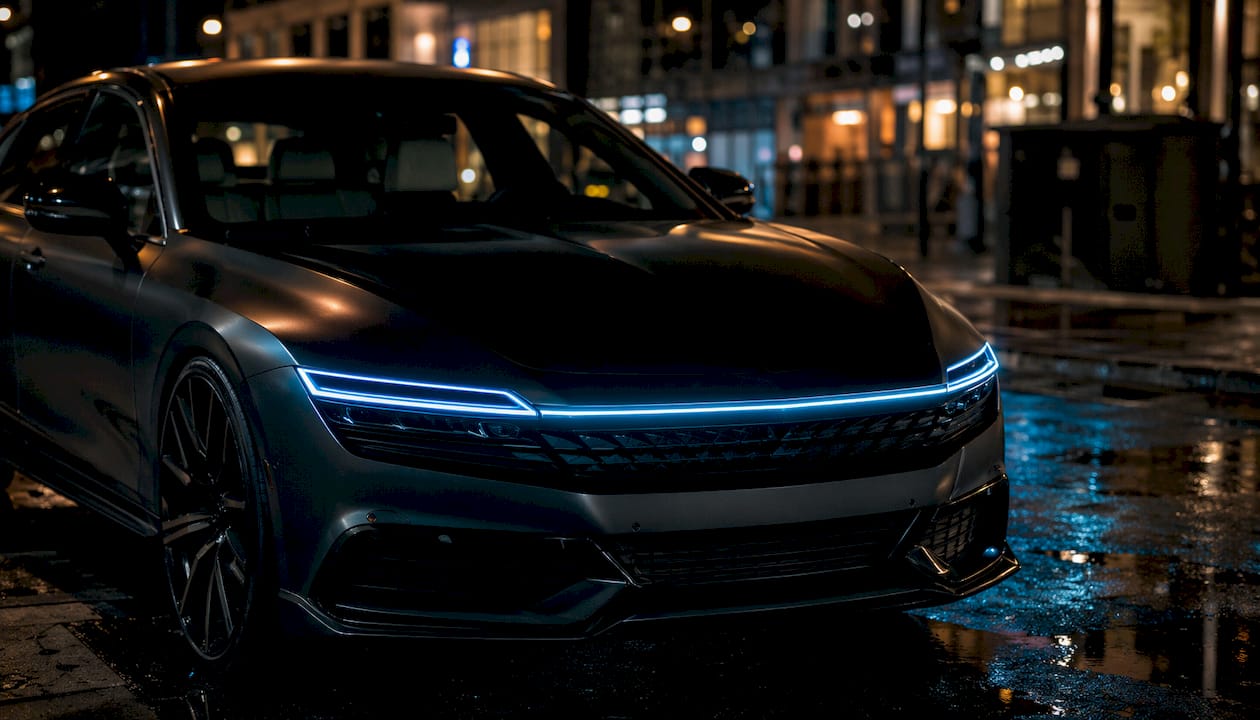
The visual payoff goes beyond aesthetics. Continuous light bars and animated signatures change silhouette recognition — what designers call DRG, or day/night recognition. A distinctive light bar lets a driver identify a brand from 200 feet away in the dark, before any other detail is visible. That recognition shift is intentional. Industry design leaders note that lighting signatures often become the first thing observers see, pushing the body itself into a supporting role.
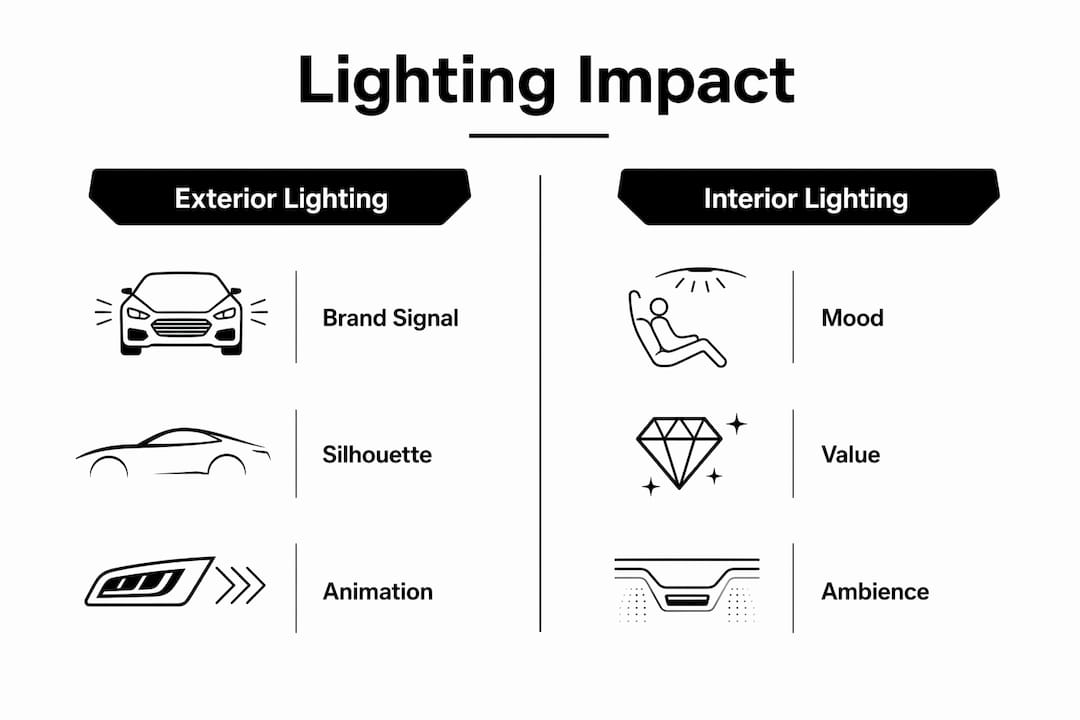
Welcome and goodbye sequences add another layer: they turn a mundane parking moment into an entrance experience. Illuminated emblems pulse on approach. Light sweeps outward from center to edge as the vehicle unlocks. These animations signal intent and personality before the driver says a word.
Pro Tip: Keep animated sequences short, high-contrast, and legible at typical pedestrian viewing distances. A sweep that looks dramatic in a studio render can read as visual noise at 30 feet in real-world ambient light. Prioritize clarity over complexity.
How designers build a light signature that defines a brand
A “light signature” is the combination of geometry, color, motion, and timing that makes a vehicle instantly recognizable at night. Designers now treat it as the primary brand identifier, deliberately shifting visual emphasis from bodywork to the lit aspect of the lamp. The body becomes a canvas; the light is the message.
The visual levers designers tune:
- Form: bar, cluster, pixel array, or point source — each reads differently at distance
- Proportion: bar thickness and spacing determine whether a signature reads as bold or refined
- Dynamic behavior: animated sweep speed, blink rate, and fade timing all carry brand personality
- Color and color temperature: warm whites signal luxury; cool whites and blues signal technology
- Surface integration: how light interacts with surrounding trim, grille elements, and body lines
A bold, thick static bar reads as confident and assertive. A thin, slowly fading dynamic cue reads as precise and restrained. Neither is objectively better — the choice depends on what the brand needs to communicate. Suppliers like Infineon (semiconductor and driver ICs), JW Speaker (adaptive LED optics), and Innotec Group (light-guide and optical components) each enable specific capabilities at the production level, giving designers the hardware to execute these variables with precision.
The original lighting design role in a vehicle program is no longer a styling afterthought. It is a brand decision made early in the design process, with the same strategic weight as color palette or material selection.
How cabin lighting sculpts mood and perceived value at night
Interior ambient lighting works through a principle that most drivers feel but rarely articulate: low-level, indirect light makes a cabin feel larger, more refined, and safer. Research from a controlled interior simulation study with 31 subjects found that ambient lighting increases perceived spaciousness, interior attractiveness, and perceived safety at night. Critically, a small number of well-positioned light sources can match the perceptual effect of many overlapping sources — a finding that has direct cost implications for designers.
Production programs in higher-segment vehicles now commonly incorporate multiple LEDs for ambient interior lighting, with current designs often exceeding that count to improve orientation, spaciousness, and brand atmosphere.
Designers typically layer interior programs in four tiers: functional lighting (map lights, footwells), accent lighting (door panel strips, center console edges), ambient lighting (diffused indirect glow across the headliner and dash), and animation (color-shift sequences on entry or mood changes). Each layer serves a different perceptual purpose. The functional layer is about task visibility; the ambient layer is about emotional tone.
Night design — the discipline of designing how a cabin reads specifically in low light — reframes material selection entirely. Indirect lighting makes leather grain and soft-touch surfaces read as higher quality than they would under flat overhead light. Shadow becomes a design tool, not a deficiency.
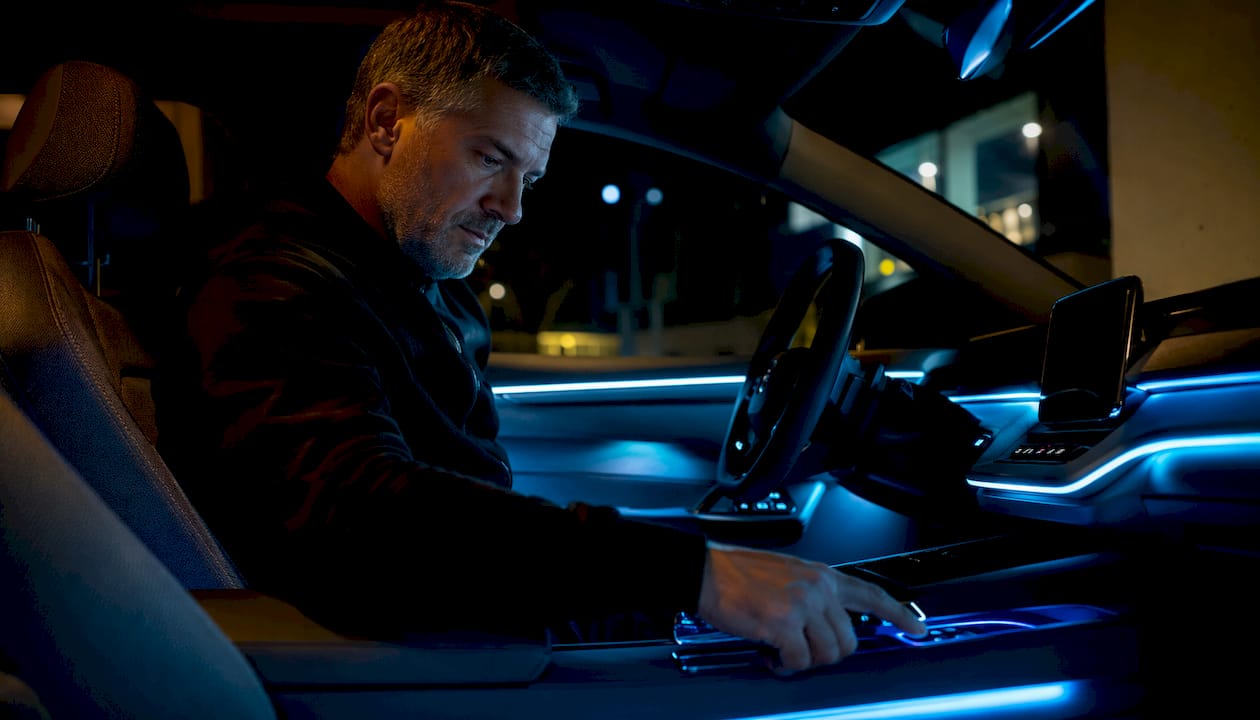
Pro Tip: Use subtle color shifts and low luminance for ambient programs. High-contrast or bright accent lighting creates discomfort glare that fatigues drivers on long trips. The goal is discovery, not spectacle.
For enthusiasts applying these ideas to show builds, interior show lighting follows the same layering logic — the scale is smaller, but the perceptual principles are identical.
How exterior lighting communicates beyond aesthetics
Lighting is increasingly doing work that goes beyond brand recognition. Exterior displays now signal vehicle intent to pedestrians: an autonomous-mode indicator might pulse a specific color to communicate that the vehicle is yielding. V2X-ready visual cues are designed to be read by both humans and infrastructure sensors. These communication functions are moving from concept to production as autonomous and semi-autonomous vehicles enter the U.S. market.
The trade-off is real. AAA Foundation research shows that more lights and higher intensity increase visibility distance but can simultaneously increase disability glare and reduce the visibility of personnel near a vehicle. Flash frequencies around 1–4 Hz and alternating patterns improve detection; complex, high-intensity patterns often reduce distance judgment and make nearby people harder to see.
Legal note: In the U.S., allowable exterior lighting colors and animation behaviors vary by state and vehicle category. Red and blue are generally restricted to emergency vehicles. Animated or non-standard exterior lighting that could be mistaken for emergency signals may violate federal motor vehicle safety standards (FMVSS) or state traffic codes. Designers and enthusiasts should confirm compliance with applicable regulations before finalizing any exterior lighting program. U.S.-designed lighting considerations for the aftermarket context are worth reviewing early.
Pro Tip: Validate any animated exterior cue with low-angle, real-world tests at night — not just studio renders. Consult your state’s vehicle lighting regulations before committing to a design, especially for colors outside white and amber.
How light reshapes surfaces, materials, and perceived scale
Light does not just illuminate a surface — it redefines it. Low-angle ambient strips graze across leather grain and make texture visible in a way that overhead light flattens entirely. Edge-lit panels create a sense of depth and precision that the same panel, unlit, does not suggest. Backlit trim makes a surface read as thinner and more refined. Grille “jewelry” — small, precisely placed light points within a grille structure — changes the perceived scale of the front face, making it read as more intricate and premium.
Lexus design leads describe lighting as an entrance experience and an emotional signature that replaces traditional mechanical drama as electrification removes engine sound and grille presence. The implication for designers is direct: as EVs homogenize exterior silhouettes, lighting becomes the primary differentiator. Designers are already tuning subtle variables — light-bar thickness, fade design, micro-animation timing — rather than altering overall vehicle volume to distinguish one model from another.
Color temperature matching matters here. Warm whites (around 2700K–3000K) make wood and leather read as richer. Cooler whites (4000K–5000K) suit aluminum and carbon fiber. Mismatching temperature to material is one of the most common errors in interior lighting programs, and it shows immediately in a physical prototype.
Pro Tip: Always prototype lighting with actual material samples in a darkened space. Physical mockups reveal how real finishes interact with light in ways that renders consistently misrepresent — especially with matte surfaces and textured leathers.
Which technologies enable the next generation of lighting design?
The enabling technologies each offer distinct design affordances. Choosing the right one depends on the aesthetic goal, production constraints, and budget.
- OLED: Uniform surface glow, thin and flexible form factor, ideal for large-area interior panels and tail-lamp surfaces where even luminance matters
- Micro-LED: High pixel density in small modules, excellent for animated signatures and fine-detail exterior graphics
- Matrix/pixel beam: Adaptive high-beam shaping and real-time animation; primarily exterior, with strong safety and communication applications
- Projection: Localized graphics, ground projections (puddle lamps, welcome graphics), and AR-adjacent displays — low thermal load, high visual impact
Progress from halogen to LED and on to pixel/matrix and OLED has enabled thin modules, high flux, and dynamic behaviors that were simply not achievable with older sources. The shift also moved design focus from lamp shape to lit behavior — what the lamp does when on, not just what it looks like when off.
Advanced adaptive driving beam systems are more prominent in European markets for performance and adaptive use; U.S. adoption has followed a different regulatory path, with NHTSA only recently clearing the way for adaptive driving beams on U.S. roads. Suppliers like Infineon, JW Speaker, and Innotec Group are embedded in production-level solutions for these technologies, providing the semiconductor, optic, and light-guide components that make them manufacturable at scale. For enthusiasts exploring bold automotive lighting styles, LED strip and ring formats offer accessible entry points into the same design vocabulary.
What are the real constraints designers face with advanced lighting?
Every lighting upgrade involves trade-offs. Understanding them early prevents expensive redesigns.
- Component cost: OLED and micro-LED modules carry significantly higher BOM costs than standard LED strips; animated exterior signatures add driver and control hardware on top of the light source itself
- Thermal management: High-flux LEDs generate heat that must be managed to protect lifetime and maintain color consistency; compact modules in tight lamp housings are especially vulnerable
- Electrical load: In EVs, every watt of lighting load competes directly with range; complex ambient programs with dozens of LEDs and animation controllers add up
- Regulatory restrictions: Color and animation rules vary by state and vehicle category in the U.S.; non-compliant exterior lighting can trigger inspection failures or citations
- Serviceability: Complex integrated light bars and sealed LED modules are often non-serviceable; replacement means replacing the entire assembly, which raises long-term ownership costs
On the cost-versus-impact question, refined interior ambient programs typically deliver better perceived-value uplift per dollar than fully animated exterior displays. A well-executed four-zone interior ambient program with quality LED strips and a simple controller reads as premium to every occupant on every drive. A complex animated exterior signature is visible only at night and only to observers outside the vehicle. For enthusiasts working within a budget, custom car lighting benefits are most efficiently captured by starting inside and working outward. Pairing lighting upgrades with exterior body styling can amplify the visual effect of both.
What does the research actually say about lighting and perception?
The evidence base for lighting’s perceptual and behavioral effects is stronger than most designers realize.
Key finding: Studies of roughly 1.2 million vehicle movements show an inverse relationship between illuminance and driving speed, even after controlling for traffic volume and other variables. Higher illuminance is associated with lower speeds — a direct behavioral effect of lighting conditions.
| Study | Method | Key Finding | Design Implication |
|---|---|---|---|
| Illuminance and vehicle speed | ~1.2 million vehicle movements, observational | Lower illuminance linked to higher speeds | Exterior lighting affects road-user behavior, not just aesthetics |
| Ambient interior lighting | Controlled simulation, 31 subjects | Ambient lighting increases perceived space, attractiveness, and safety | Well-placed interior LEDs improve perceived quality without high LED counts |
| Flash rate and glare | Human factors study, closed course | 1–4 Hz flash rates improve detection; high intensity increases glare without proportional visibility gain | Animate at moderate rates; avoid maximum brightness as default |
The interior simulation finding carries a practical cost implication: a small number of well-placed sources can match the perceptual effect of many overlapping ones. Designers do not need to maximize LED count to achieve the desired ambient quality — placement and diffusion matter more than quantity. For exterior programs, the behavioral data argues for treating illuminance as a design variable with real road-safety consequences, not just a styling choice.
Key Takeaways
Lighting transforms vehicle aesthetics because it controls perception, brand recognition, and driver behavior simultaneously — making it the most powerful design variable available to both OEM designers and aftermarket enthusiasts.
| Point | Details |
|---|---|
| Lighting is the primary brand signal | Animated signatures and DRL geometry are now the first identifiers observers use at night, before body shape registers. |
| Interior ambient programs deliver high ROI | Current designs often exceed 25 well-placed LEDs to measurably increase perceived space, material quality, and driver comfort. |
| Safety and glare must be designed in | AAA Foundation research links high-intensity animated displays to disability glare; flash rates of 1–4 Hz balance visibility and safety. |
| Technology choice should match the goal | OLED suits large-area even glow; micro-LED suits fine animated signatures; projection suits ground graphics and welcome sequences. |
| Wheellightexpress applies OEM principles to aftermarket | LED strips, wire harnesses, and remotes designed in Louisiana let enthusiasts build layered ambient and accent programs with the same logic OEM designers use. |
The trade-off most designers get wrong
The conventional wisdom in automotive lighting design is that more complexity equals more impact. More LEDs, faster animations, brighter signatures. The research tells a different story, and studio experience confirms it.
The most effective lighting programs are the ones that know when to stop. A single, well-proportioned light bar with a precise fade design communicates brand identity more clearly than a dozen competing animated elements. Interior programs with three or four well-placed strips at low luminance create a sense of quality that a cabin full of bright, color-cycling LEDs actively undermines. The discipline is in restraint, not in maximizing output.
The studio trade-off that comes up most often is the choice between a subtle signature fade and a bold animated sweep. A bold sweep is attention-grabbing and memorable in a reveal context. A subtle fade is what the owner experiences every single day, twice a day, for years. Brands that optimize for the reveal often create programs that feel exhausting in daily use. The better question is not “what looks impressive?” but “what feels right on the hundredth encounter?”
Wheellightexpress approaches aftermarket lighting with that same logic — original designs built around layered programs that hold up over time, not just at first glance. For enthusiasts who want to apply signature-thinking to their own builds, the principle is the same: start with placement and proportion, then add animation only where it adds genuine character.
Wheellightexpress brings these design principles to your build
If the OEM design principles covered in this article — layered ambient programs, signature geometry, quality wire management — sound like what your vehicle is missing, Wheellightexpress makes them accessible without the production-vehicle budget.
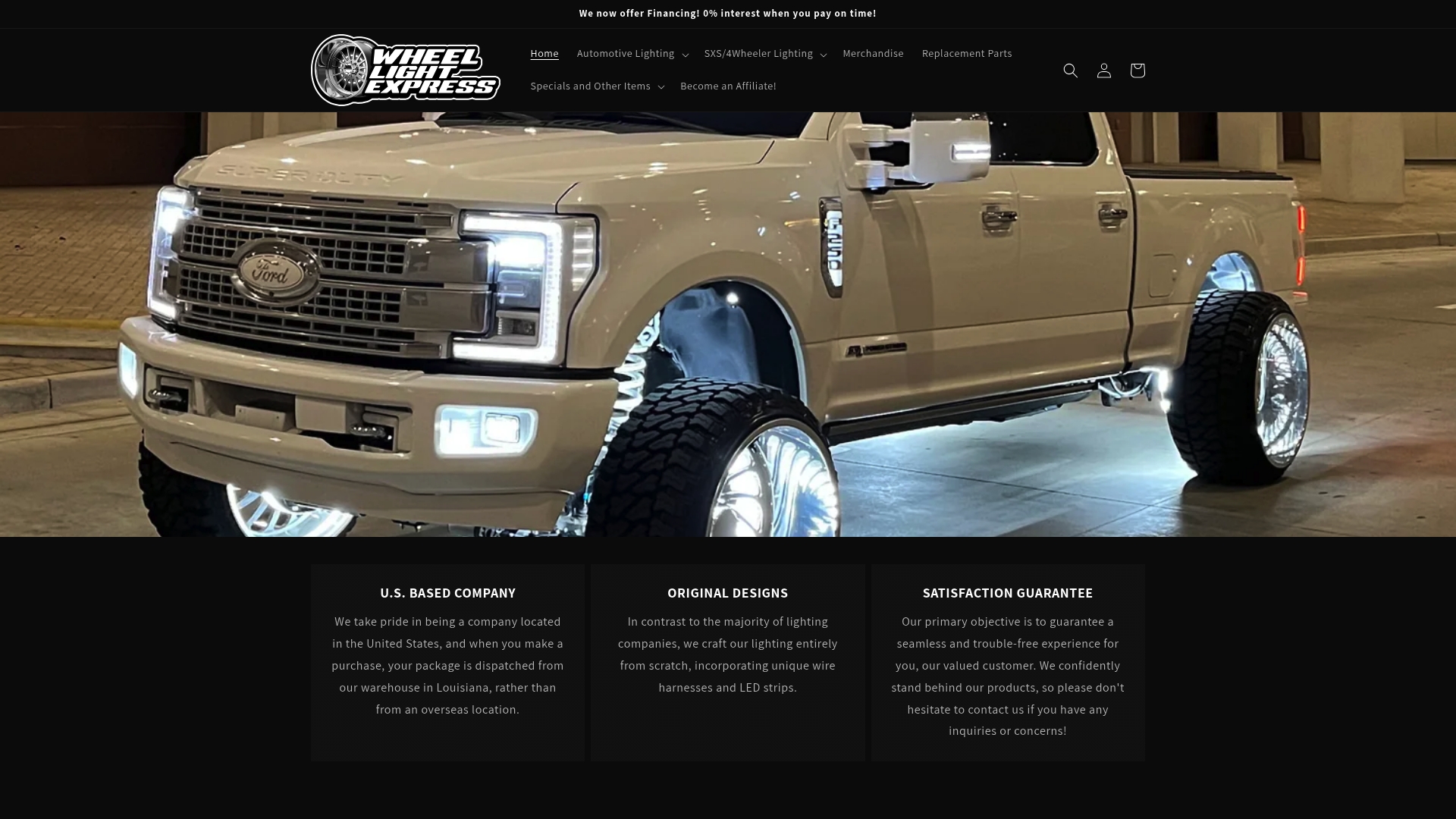
Wheellightexpress designs and builds its LED strips, wheel light rings, and wire harness leads in Louisiana, which means the products are built to U.S. electrical standards and designed with U.S. road and show conditions in mind. Every kit ships with a satisfaction guarantee, and financing options mean you can start your lighting program without waiting to save the full amount upfront. The product line covers the full stack: light sources, wiring, and remote controls for animation and color management. Browse compatible products at wheellightexpress.net and find the right starting point for your build.
Useful sources and further reading
Research and safety evidence
- Illuminance and vehicle speed: 1.2 million movement study
- AAA Foundation: Roadside Assistance Vehicle Lighting — Scientific Research and State Regulations
- NHTSA: Annotated Summary of Literature on Headlamp Performance and Glare
- IIHS: Headlights research and ratings
Design and industry perspective
- Car Design News: Key trends influencing automotive lighting design
- Car Design News: Stellantis — Philipp Röckl on lighting identity
- Car Design News: Lexus — Ian Cartabiano on lighting design and the spindle signature
Interior ambient lighting research
- Influence of ambient lighting in a vehicle interior on driver perceptions — db-thueringen
Wheellightexpress resources