

LED density is defined as the number of individual diodes per meter or foot on an LED strip, and it directly controls whether your vehicle lighting looks smooth and professional or dotted and cheap. This single specification explains why two LED strips can look completely different even when they share the same color and wattage. Understanding why LED density affects appearance gives you the power to choose the right strip for any build, whether you want subtle underbody glow, clean wheel ring illumination, or sharp accent lines. The industry terms you need to know are pixel pitch, irradiance valleys, and diode spacing. Get these right and your lighting will look intentional, not accidental.
Why LED density affects appearance: the spotting problem explained
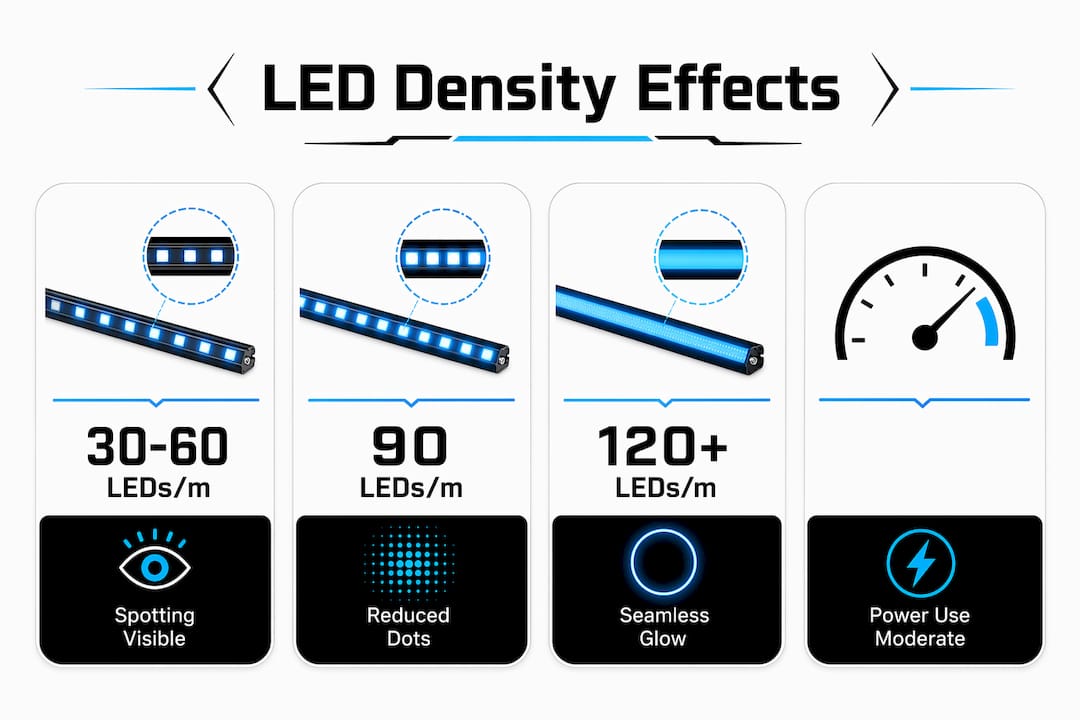
Spotting, also called the picket fence effect, is the visible pattern of individual bright dots separated by dark gaps on an LED strip. It happens because the spacing between diodes is wide enough for your eye to resolve each light source as a separate point. Standard density strips running at 30–60 LEDs per meter produce this effect clearly, especially when viewed from close range or mounted in a visible location on a vehicle.
Higher density eliminates spotting because the beam angles from adjacent diodes overlap before the light reaches your eye. Overlapping beam angles eliminate the dark gaps between diodes, which lighting engineers call irradiance valleys. At 120–144 LEDs per meter, most viewers see a continuous ribbon of light rather than individual dots. At 180 LEDs per meter and above, the light appears as a solid, unbroken glow.
| LED density range | Visual result | Recommended use |
|---|---|---|
| 30–60 LEDs/m | Visible dots, strong spotting | Hidden runs with thick diffusers only |
| 90–120 LEDs/m | Mild dotting, reduced with diffuser | Semi-hidden accent lighting |
| 120–144 LEDs/m | Near-uniform, minimal spotting | Wheel rings, visible trim accents |
| 180–490+ LEDs/m | Seamless solid glow | Architectural, show-quality builds |
The comparison above shows that the visual outcome changes dramatically across density ranges. Choosing the wrong density for a visible location is the most common mistake vehicle modifiers make.
Pro Tip: If your installation hides the LED strip inside an aluminum channel, you still need at least 120 LEDs per meter to avoid visible dots through an opal diffuser. Strips below 90 LEDs per meter will show spotting even with diffusion.
How does LED density impact brightness and power consumption?
Higher density does not automatically mean significantly brighter light. High-density strips run lower current per diode to manage heat, so total lumen output increases only modestly as density climbs. The primary visual benefit of going from 60 to 180 LEDs per meter is uniformity, not raw brightness.
Power consumption, however, scales directly with density. A 60 LEDs per meter strip consumes roughly 4.8–7.2 watts per meter. A 240 LEDs per meter strip consumes 19.2–24 watts per meter. That is a fourfold increase in power draw for a build that may only look marginally brighter to the eye.
The thermal consequences of that power increase are real. High-density LED lighting requires careful thermal management because junction temperature rises cause brightness degradation and color shift over time. Aluminum PCB substrates and aluminum mounting channels pull heat away from the diodes. Skipping these on a high-density strip shortens its lifespan and degrades the appearance it was chosen to create.
- High-density strips need aluminum channels or PCB substrates to dissipate heat properly.
- Avoid low-quality strips with plastic backing on high-density configurations.
- Check the wattage rating of your power supply before upgrading density.
- Color shift from overheating changes your chosen color tone permanently.
- Thermal issues appear gradually, making them easy to miss until the damage is done.
Pro Tip: Touch your LED strip after 30 minutes of operation. It should feel warm, not hot. If it is too hot to hold your finger against, your thermal management is insufficient for that density level.
What is pixel pitch and why does it matter for LED spacing?
Pixel pitch is the center-to-center distance between LED chips, measured in millimeters. It is the more precise engineering term for what density describes in general terms. A smaller pixel pitch means the diodes sit closer together, which produces smoother light output without visible dots.
Residential LED strips typically run 18–30 LEDs per foot, which translates to wide pixel pitch and visible spacing. Commercial and automotive-grade strips run 60–120+ LEDs per foot with tight pixel pitch for seamless illumination. The difference is visible immediately when both strips are mounted side by side.
| Pixel pitch | Approximate density | Typical application |
|---|---|---|
| Wide (10mm+) | 30–60 LEDs/m | Basic accent, hidden only |
| Medium (5–8mm) | 90–120 LEDs/m | Automotive trim, wheel arches |
| Tight (2–4mm) | 144–240 LEDs/m | Show builds, wheel rings |
| Ultra-tight (under 2mm) | 300–490+ LEDs/m | Architectural, display-grade |
Tight pixel pitch also allows slimmer strip profiles. A strip with closely spaced diodes does not need a thick diffuser to hide the dot pattern, which matters when you are fitting lighting into narrow wheel well channels or slim door trim. For a deeper look at high-density strip applications on vehicles, the Wheellightexpress resource library covers the key specs in detail.
How to choose LED density for your vehicle build
The right LED density for your build depends on three factors: how visible the strip will be, how long the run is, and what your power system can support. Getting all three right produces lighting that looks clean from every angle.
-
Identify visibility. Strips mounted inside wheel wells or under body panels where the LED source is hidden can use 90–120 LEDs per meter with an opal diffuser. Strips visible directly, such as wheel rings or door trim, need 144 LEDs per meter minimum for a clean appearance.
-
Choose your voltage system. Voltage drop on 12V systems limits reliable runs to about 16.4 feet before brightness fades at the far end. A 24V system extends that to roughly 80 feet with a single power feed. High-density strips on long runs always perform better on 24V.
-
Match power supply capacity. Calculate total wattage by multiplying watts per meter by total strip length, then add 20 percent headroom. Undersized power supplies cause flickering and uneven brightness that no density upgrade can fix.
-
Use aluminum channels. Aluminum channels with opal diffusers serve two purposes: they dissipate heat from the strip and they scatter light to eliminate any remaining dot pattern. Strips at 180+ LEDs per meter in aluminum channels produce the cleanest possible appearance. For a full breakdown of LED strip applications across vehicle types, Wheellightexpress covers the most common build scenarios.
-
Set a realistic budget. High-density strips cost more per meter and require more capable power supplies and wiring. Density alone does not guarantee quality. Color consistency through binning and high CRI ratings are equally important for premium appearance. A well-specified 120 LEDs per meter strip from a quality manufacturer will outperform a cheap 240 LEDs per meter strip every time.
Pro Tip: For ambient wheel lighting, 144 LEDs per meter is the practical sweet spot. It delivers near-seamless appearance, fits standard 12V vehicle systems on short runs, and does not demand the heavy thermal management that 240+ LEDs per meter requires.
Key Takeaways
LED density is the single most important specification controlling whether vehicle lighting looks polished or amateurish, and choosing the right density requires matching diode count, voltage system, and thermal management together.
| Point | Details |
|---|---|
| Density defines uniformity | Strips below 90 LEDs/m produce visible dots; 144+ LEDs/m delivers near-seamless light. |
| Power scales with density | A 240 LEDs/m strip draws up to four times the wattage of a 60 LEDs/m strip. |
| Pixel pitch is the precise measure | Smaller center-to-center spacing produces smoother light and allows slimmer profiles. |
| Voltage system matters | Use 24V for runs over 16 feet to prevent brightness fade on high-density strips. |
| Density alone is not enough | Color binning, CRI, thermal management, and aluminum channels all determine final appearance. |
What I have learned from watching density upgrades transform builds
The most dramatic lighting improvements I have seen on custom vehicles did not come from switching colors or adding more strips. They came from swapping a 60 LEDs per meter strip for a 144 LEDs per meter strip in the same location. The difference is immediate and obvious. The dotted, bargain-bin look disappears and the lighting reads as intentional design.
What surprises most builders is that the architectural goal of quality LED lighting is to make the source invisible. You should see the glow, not the diodes. That principle applies directly to automotive builds. When you can count the individual LEDs on a wheel ring or door trim strip, the lighting draws attention to itself for the wrong reason.
The mistake I see repeatedly is treating density as the only variable. A builder will install a 240 LEDs per meter strip on a plastic-backed channel with an undersized power supply and wonder why it looks uneven and starts dimming after a few months. Density without proper thermal management and correct voltage is a waste of money. The best custom builds treat lighting as a system, not a single component purchase.
My honest advice: buy the best density you can afford, but spend equal attention on aluminum channels, a properly rated power supply, and quality wire harnesses. Those supporting elements are what separate a build that still looks great two years later from one that fades and flickers by summer.
— Christopher
Wheellightexpress builds LED strips designed for clean automotive appearance
Vehicle modifiers who want smooth, dot-free lighting without guessing at specifications will find what they need at Wheellightexpress. Every product is designed in Louisiana specifically for automotive applications, with density and wiring specs matched to real vehicle power systems.
The aftermarket lighting collection includes wheel light rings and LED strips built for high-density, seamless illumination on custom builds. The Wheel Light Ring and Strip is engineered for visible wheel applications where dot-free appearance is non-negotiable. Pair any strip with the wire harness leads designed for clean, reliable power delivery on vehicle electrical systems. Financing options are available, so you can build the lighting setup your vehicle deserves without waiting.
FAQ
What LED density is best for vehicle wheel lighting?
A minimum of 120–144 LEDs per meter produces near-seamless light for visible wheel applications. Strips below 90 LEDs per meter will show visible dots at close viewing distances.
Does higher LED density always mean brighter light?
Not significantly. High-density strips run lower current per diode to manage heat, so the primary gain is uniformity rather than raw brightness.
Why does my LED strip look uneven at the far end?
Voltage drop on 12V systems causes brightness fade on runs longer than about 16.4 feet. Switching to a 24V system or adding a second power feed at the far end corrects the problem.
What is pixel pitch in LED strips?
Pixel pitch is the center-to-center distance between LED chips in millimeters. Smaller pixel pitch means higher density and smoother light output with fewer visible dots.
Do I need a diffuser with a high-density LED strip?
At 180+ LEDs per meter, an opal diffuser is optional but still improves appearance. At 90–120 LEDs per meter, a diffuser inside an aluminum channel is necessary to eliminate visible dotting.